

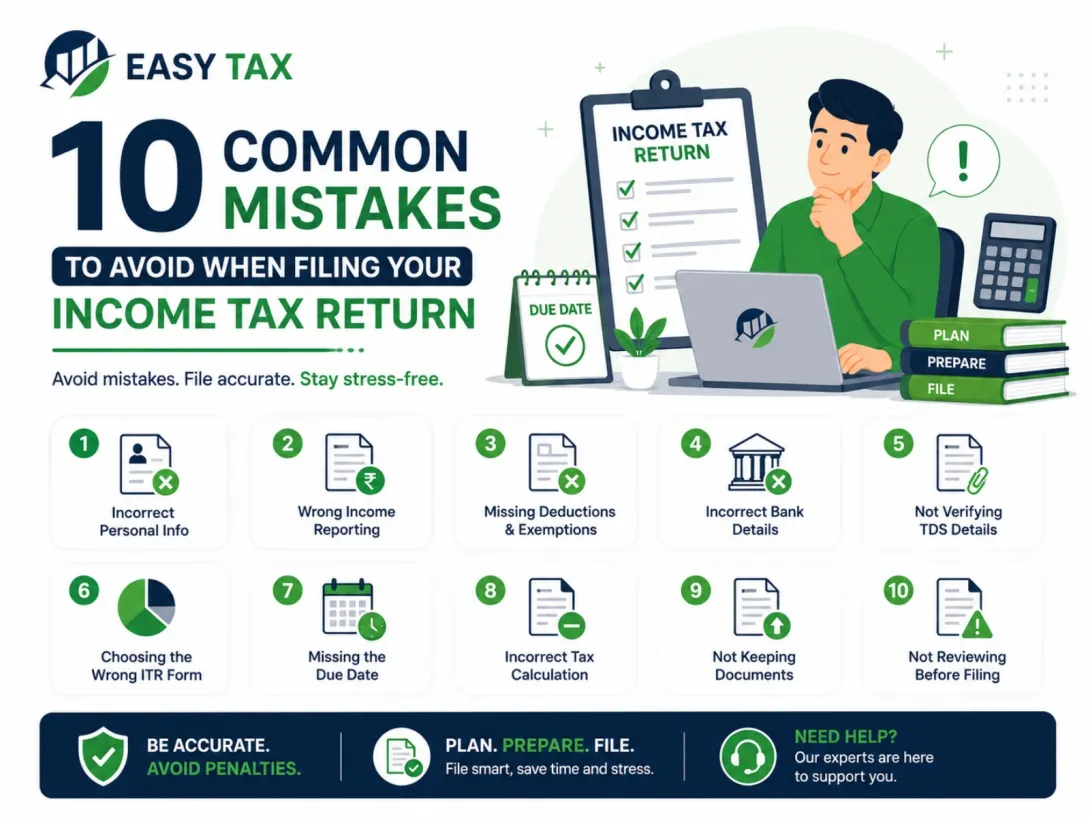
Top 10 Mistakes to Avoid When Filing Your Income Tax Return (2026 Complete Guide)
Filing an income tax return is not just a legal obligation but also an important financial activity that impacts your refunds, compliance status, and long-term financial record. Even a small mistake in your ITR can lead to penalties, delays in refunds, or notices from the Income Tax Department.
In 2026, with increased digital tracking through AIS (Annual Information Statement), Form 26AS, and bank-level reporting, accuracy in tax filing has become more important than ever.
This guide explains the 10 most common income tax filing mistakes and how you can avoid them to ensure smooth, accurate, and stress-free tax filing.
1. Missing the Filing Deadline
One of the most common mistakes taxpayers make is failing to file their income tax return on time. Late filing can lead to penalties under Section 234F and may also delay refunds.
Why it happens:
- Lack of awareness of due dates
- Last-minute document preparation
- Ignoring reminders
How to avoid it:
- Maintain a tax calendar
- Start preparing documents early
- Use professional assistance if needed
Filing early also ensures faster refund processing and fewer errors.
2. Choosing the Wrong ITR Form
Selecting the wrong ITR form can result in your return being marked defective or rejected.
Examples:
- ITR-1: For salaried individuals with simple income
- ITR-2: For capital gains or multiple properties
- ITR-3: For business/professional income
- ITR-4: For presumptive income
How to avoid it:
Always match your income type with the correct form. If unsure, consult a tax professional before filing.
3. Entering Incorrect Personal Information
Even small errors in personal details can cause serious issues in processing your return.
Common mistakes:
- Wrong PAN or Aadhaar number
- Incorrect bank account details
- Typing errors in name or address
Impact:
- Refund failure
- Return rejection
- Verification issues
Always double-check your details before submission.
4. Not Reporting All Sources of Income
Many taxpayers forget to report secondary income sources, which can trigger notices later.
Common missed incomes:
- Savings account interest
- Fixed deposit interest
- Freelance income
- Rental income
- Capital gains from shares or mutual funds
Why it matters:
The Income Tax Department already receives this data through AIS and bank reporting systems.
How to avoid it:
Maintain a complete income record throughout the year.
5. Incorrect Claim of Deductions
Deductions reduce taxable income, but incorrect claims can lead to penalties.
Common mistakes:
- Claiming deductions without proof
- Wrong section selection
- Overclaiming expenses
Important sections:
- Section 80C (LIC, ELSS, PPF)
- Section 80D (Health insurance)
- Home loan interest deduction
Always keep supporting documents ready.
6. Ignoring Income from Previous Employers
If you changed jobs during the financial year, you must include income from all employers.
Mistake:
- Filing based on only one Form 16
Risk:
- Underreporting income
- Tax mismatch with AIS/Form 26AS
Solution:
Collect all Form 16 documents and combine total income correctly.
7. Errors in Tax Calculation
Manual tax calculation is one of the biggest sources of mistakes.
Common issues:
- Incorrect slab application
- Wrong rebate calculation
- Missing surcharge or cess
Impact:
- Underpayment or overpayment of tax
How to avoid it:
Use reliable tax software or consult a professional tax advisor.
8. Not Verifying the ITR After Filing
Filing your return is incomplete without verification.
Important fact:
An unverified return is considered invalid.
Verification methods:
- Aadhaar OTP
- Net banking
- EVC (Electronic Verification Code)
Always verify your return within the allowed time limit.
9. Ignoring Advance Tax or Self-Assessment Tax
Many freelancers, business owners, and investors forget to pay advance tax.
Who needs it:
- Self-employed individuals
- Traders
- Freelancers
- High-income earners
Consequence:
- Interest penalties under Sections 234B and 234C
Solution:
Estimate tax liability quarterly and pay installments on time.
10. DIY Filing Without Proper Knowledge
While online portals have made filing easier, self-filing without understanding tax rules can lead to errors.
Risks:
- Wrong deductions
- Incorrect income classification
- Missed tax-saving opportunities
- Increased chances of notices
When to seek help:
- Multiple income sources
- Business income
- Capital gains
- Foreign income
Professional tax guidance ensures accuracy and compliance.
Why Accuracy in ITR Filing Is More Important in 2026
Tax filing has become more data-driven due to:
- AIS (Annual Information Statement) tracking
- Bank transaction reporting
- Mutual fund and stock data integration
- Digital compliance monitoring
Even small mismatches can trigger automated notices.
Benefits of Filing Correct Income Tax Returns
- Faster refund processing
- Avoidance of penalties
- Better financial record
- Easier loan approvals
- Reduced compliance risk
How to Avoid All ITR Filing Mistakes
To ensure smooth tax filing:
- Keep financial records updated throughout the year
- Match AIS and Form 26AS before filing
- Use the correct ITR form
- Report all income sources
- Consult a tax expert for complex cases
Conclusion
Filing your income tax return accurately is essential for financial stability and compliance. Most errors occur due to lack of awareness, missing documentation, or incorrect assumptions.
By avoiding these 10 common mistakes, taxpayers can ensure faster refunds, reduced risk of notices, and a stress-free filing experience.
In today’s digital tax environment, accuracy is not optional—it is mandatory. Whether you are a salaried individual, freelancer, or business owner, careful planning and professional guidance can help you stay fully compliant and financially secure.
