

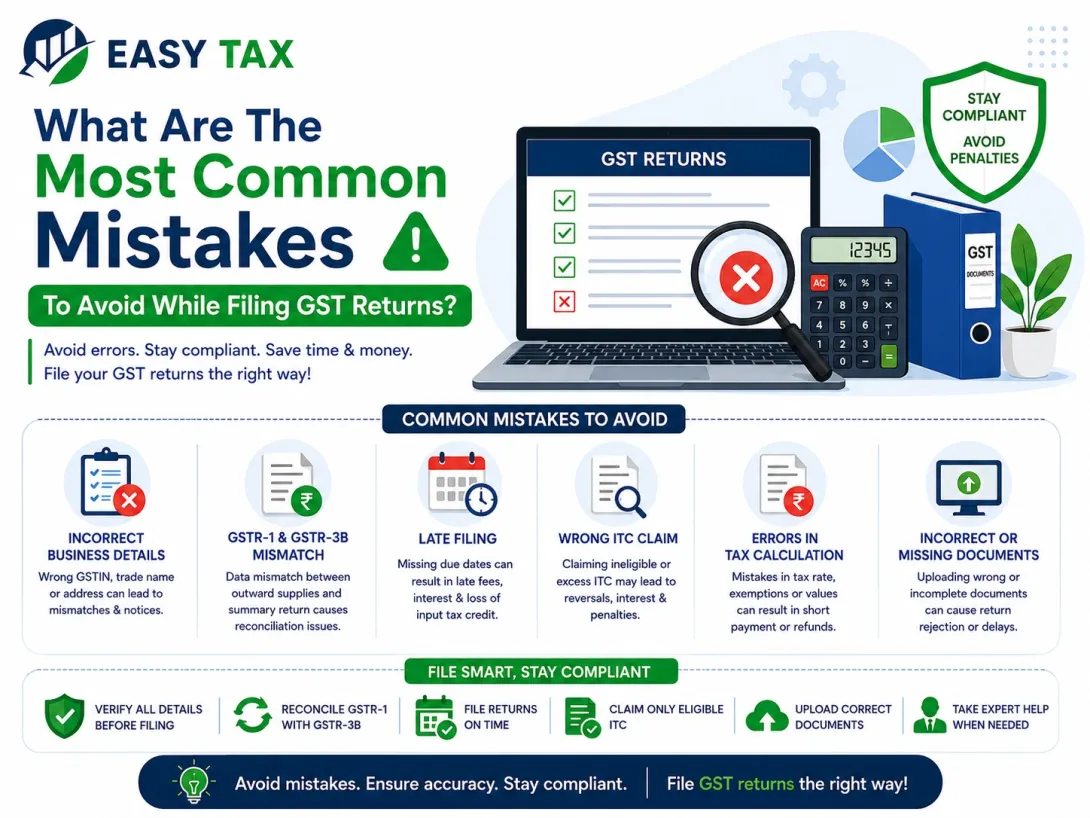
What Are the Most Common Mistakes to Avoid While Filing GST Returns? (2026 Complete Guide)
GST return filing is one of the most important compliance responsibilities for businesses in India. Whether you are a startup, freelancer, ecommerce seller, MSME, or established company, accurate GST filing helps you avoid penalties, maintain compliance, and ensure smooth business operations.
However, many businesses make avoidable mistakes while filing GST returns. These errors can lead to notices, penalties, loss of Input Tax Credit (ITC), and unnecessary compliance complications.
In 2026, GST compliance has become more important than ever due to increased digital monitoring, AI-based scrutiny systems, and automated tax verification processes. This makes it essential for businesses to understand common GST filing mistakes and learn how to avoid them.
In this guide, we will discuss the most common GST return filing mistakes, their consequences, and how businesses can ensure accurate GST compliance.
Understanding GST Return Filing
GST returns are documents that registered taxpayers must submit to report:
- Sales transactions
- Purchase transactions
- GST collected
- GST paid
- Input Tax Credit claimed
- Tax liability
Depending on the nature of the business, different GST returns may be applicable.
Common GST Returns
GSTR-1
Used for reporting outward supplies or sales.
GSTR-3B
A summary return showing tax liability and ITC claims.
GSTR-9
Annual GST return filed by eligible taxpayers.
QRMP Scheme Returns
Quarterly filing option for eligible small taxpayers.
Filing these returns accurately is essential to avoid compliance issues.
Why GST Compliance Matters More in 2026
The GST ecosystem continues to become more technology-driven.
Government departments now use advanced tools for:
- AI-based compliance monitoring
- Invoice matching
- E-invoicing verification
- ITC validation
- Fraud detection
- Automated notices
As a result, even minor filing errors can trigger compliance alerts.
Businesses that maintain accurate GST records and file returns correctly are better positioned to avoid unnecessary scrutiny.
Most Common GST Return Filing Mistakes to Avoid
1. Incorrect GSTIN Details
One of the most frequent mistakes is entering incorrect GST Identification Numbers (GSTINs).
Wrong GSTIN details may result in:
- Rejected invoices
- ITC mismatches
- Return discrepancies
- Compliance notices
How to Avoid It
Always verify GSTIN information before issuing invoices and filing returns.
2. Missing GST Return Filing Deadlines
Late GST filing remains one of the biggest compliance issues for businesses.
Consequences may include:
- Late fees
- Interest charges
- Compliance notices
- Increased scrutiny
How to Avoid It
Maintain a GST compliance calendar and use automated reminders.
3. Incorrect Input Tax Credit (ITC) Claims
Input Tax Credit is one of the biggest benefits under GST.
However, businesses often make mistakes by:
- Claiming ineligible credits
- Claiming duplicate credits
- Claiming ITC without proper invoices
These mistakes can lead to:
- ITC reversals
- Interest liability
- GST notices
How to Avoid It
Regularly reconcile purchase records with GST portal data before claiming ITC.
4. Failure to Reconcile Books with GST Returns
Many businesses file GST returns without reconciling:
- Sales records
- Purchase records
- Accounting software data
- GST return data
This creates mismatches that may attract scrutiny.
How to Avoid It
Perform monthly GST reconciliations to ensure consistency between records and returns.
5. Wrong Tax Rate Selection
Using incorrect GST rates can lead to:
- Underpayment of tax
- Overpayment of tax
- Compliance issues
- Customer disputes
Different products and services may attract different GST rates.
How to Avoid It
Review the latest GST rate notifications and classify products correctly.
6. Errors in Invoice Reporting
Incorrect invoice details can create major compliance problems.
Common mistakes include:
- Wrong invoice number
- Incorrect invoice date
- Missing GST amount
- Customer GSTIN errors
How to Avoid It
Verify all invoice information before uploading return data.
7. Ignoring Vendor Compliance
Many businesses focus only on their own compliance while ignoring vendor compliance.
If suppliers fail to file GST returns properly, buyers may face ITC issues.
How to Avoid It
Work with compliant vendors and periodically verify their GST filing status.
8. Duplicate Invoice Reporting
Businesses sometimes report the same invoice multiple times due to manual data entry errors.
This can result in:
- Tax mismatches
- Reconciliation issues
- GST notices
How to Avoid It
Use accounting software with duplicate detection features.
9. Incomplete Documentation
Proper documentation is critical for GST compliance.
Missing records may create difficulties during:
- Audits
- Assessments
- ITC verification
- Compliance reviews
Important Documents to Maintain
- Tax invoices
- Purchase records
- GST payment challans
- E-way bills
- E-invoices
- Vendor records
10. Ignoring E-Invoicing Requirements
Many businesses now fall under e-invoicing regulations.
Failure to comply may lead to:
- Invalid invoices
- ITC issues
- Penalties
How to Avoid It
Understand whether your business falls under e-invoicing requirements and comply accordingly.
GST Return Filing Checklist
Before filing GST returns, verify the following:
✅ GSTIN details are correct
✅ Sales invoices are updated
✅ Purchase records are reconciled
✅ ITC calculations are accurate
✅ GST rates are correctly applied
✅ Vendor compliance is verified
✅ E-invoice requirements are met
✅ Supporting documents are maintained
✅ Tax liability calculations are accurate
✅ Filing deadlines are monitored
Following this checklist can significantly reduce compliance risks.
Penalties for GST Filing Mistakes
GST filing errors can result in financial consequences.
Possible Penalties Include
Late Fees
Applicable when returns are filed after the due date.
Interest Charges
Interest may apply on delayed tax payments.
ITC Reversal
Incorrect credit claims may require reversal along with interest.
Compliance Notices
Businesses may receive notices for mismatches and discrepancies.
Increased Scrutiny
Repeated errors may trigger additional compliance reviews.
How Professional GST Compliance Services Help
Many businesses choose professional GST consultants to simplify compliance.
Professional GST services help with:
- GST registration
- GST return filing
- ITC reconciliation
- GST audits
- Notice management
- E-invoicing support
- Compliance tracking
This reduces the risk of mistakes while saving time and resources.
Why Businesses Choose Easy Tax Filing
Easy Tax Filing provides complete GST compliance support for businesses across India.
Our GST Services Include
- GST Registration
- GST Return Filing
- GST Reconciliation
- ITC Verification
- GST Notice Handling
- E-Invoicing Assistance
- Compliance Monitoring
Why Clients Trust Us
- Experienced GST professionals
- Accurate filing support
- Affordable service packages
- Timely compliance management
- Personalized business solutions
We help businesses stay compliant while focusing on growth.
Frequently Asked Questions (FAQs)
What happens if GST returns are filed late?
Late filing may result in late fees, interest charges, and compliance notices.
Can GST returns be revised after filing?
GST returns generally cannot be revised directly. Adjustments are usually made in subsequent returns.
Why is GST reconciliation important?
GST reconciliation helps identify mismatches between records and filed returns, reducing compliance risks.
How can businesses avoid ITC mismatches?
Regular reconciliation of purchase invoices and vendor filings helps prevent ITC mismatches.
Is GST filing mandatory even if there is no business activity?
In many cases, nil GST returns must still be filed to maintain compliance.
Do small businesses need professional GST support?
Yes. Professional support helps small businesses avoid costly mistakes and remain compliant.
Final Thoughts
GST return filing is more than just a routine compliance task. In 2026, businesses must navigate a highly digital tax environment where errors can quickly lead to penalties, notices, and ITC losses.
By avoiding common GST filing mistakes such as incorrect GSTIN details, missed deadlines, wrong ITC claims, poor reconciliation, and incomplete documentation, businesses can maintain smooth compliance and avoid unnecessary complications.
Whether you are a startup, freelancer, ecommerce seller, or established company, investing in accurate GST compliance is essential for long-term success.
Easy Tax Filing helps businesses simplify GST compliance through professional support, accurate return filing, reconciliation services, and expert guidance—allowing you to focus on growing your business while staying fully compliant with GST regulations.
