

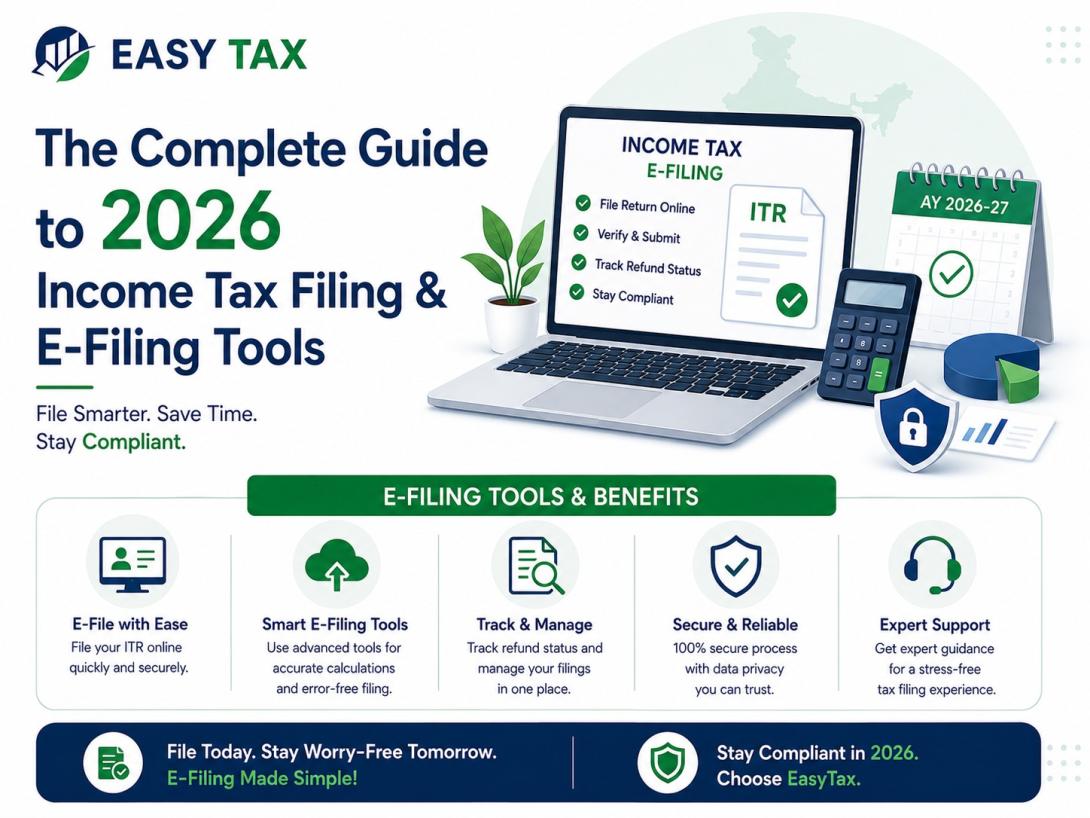
This guide provides you with the right tools and resources to file and e-file all your income tax returns by 2026.
Tax season is always a part of the new fiscal year. Tax time is often a stressful time for many people, with the stress of being swamped with forms and the fear of missing a deadline. But, with the preface of the e-filing portal and a series of digital tools, filing the Income Tax Return (ITR) is much simpler and easier than ever.
Read this guide to learn the essential steps you need to take for tax filing 2026, understand the digital scenery, and learn how to make it more accurate, timely and tax-saving.
Familiarize Yourself With the Tax Filing Landscape in 2026
Tax legislation can never be set in stone. It is crucial that we acknowledge that the government is still focussed more on the New Tax Regime as we continue through 2026. For many taxpayers, the options to move from the Old to New Regimes remain, with the New Regime providing a lower tax rate, and a lesser amount of traditional deductions being available. The e-filing portal defaults increasingly towards the New Regime which provides less tax.
Prior to preparing your taxes, make sure that your financial information is in order. These include paid wage slips, interest certificates from banks and any capital gains or rental income records.
There are many reasons why you should file your taxes online.
The days of paper forms and actual mailing are over. There are several reasons why it is now commonplace to file taxes online:
Faster processing: Refunds often are processed much quicker when the refund is filed electronically.
Accuracy: The e-filing portal has built-in validations to identify some common mathematical mistakes.
Pre-filled Data: Your details like TDS, salary etc. are pre-filled from your Form 26AS and AIS (Annual Information Statement).
Use the Income Tax Calculator to calculate your income taxes.Step 1: Calculating income taxes by using the Income Tax Calculator.
The most important tool that you have at your disposal before you hit the “Submit” button is the income tax calculator. Giving you multiple income sources, or even making a decision between tax regimes, will make tax liability not always easy.
With a reliable calculator, you are able to enter your gross income and view a comparison side by side of your liability. An income tax calculator can help you:
Make a rough calculation of how much tax you spend.
Calculate whether or not there is 'Advance Tax' to pay, to prevent penalties for interest.
Choose between the tax systems that give the greatest after-tax income for the bracket.
Step 2: How to use the E-Filing Portal.
The official e-filing portal is the hub of your Income Tax Return (ITR). The portal has been updated for 2026 with a more user friendly interface and has been created to assist even the most novice.
You can log in by using your PAN or Aadhaar to get started. After logging in, your dashboard will display an overview of your previously filed activities as well as any pending actions. The AIS (Annual Information Statement) is the portal's most valuable feature. This is a detailed listing of all of your financial transactions that you have conducted with third parties like banks and employers. This cannot be neglected, as this will help you match your ITR with the government records before filing it.
Step 3 is Strategic Tax Preparation.Step 3 equals Strategic Tax Preparation
Tax preparation is not just about getting the numbers in, it's about documenting it. A digital filing cabinet for your financial life is a best practice even if you do go with the New Tax Regime.
Key Documents for 2026:
Form 16: It is a summary of your salary by your employer which shows the tax deducted.
Form 26AS – the Statement of all taxes paid against PAN is known as tax credit statement.
Interest Certificates: From savings account, Fixed Deposits.
Investment Proofs: If you are still under the Old Regime, make sure that you have receipts for LIC, PPF and ELSS.
Step 4: Choosing the Right ITR Form
One of the most frequent reasons for receiving a "Defective Return" notice is due to the wrong Income Tax Return (ITR) form being used.
ITR-1 (Sahaj): If the salary income, income from one house property and interest income (if applicable) up to a certain limit.
ITR-2 is to be filed by the taxpayer whose capital gain (stocks/property) or having two or more house properties.
ITR-3 & ITR-4: For professionals, freelancer and small business owners.
The automated wizards offered on the e-filing portal can assist you in picking the right form according to the income sources you disclose.
The final review and E-Verification is step 5.
Once the information is entered into the portal, the portal will determine your final tax liability, or your tax refund. You can pay off the amount if you owe any money using integrated payment gateways.
But it isn't over until you E-Verify your return. Verification is the other half of filing an ITR. The majority of taxpayers will find the OTP authentication via Aadhaar the easiest way to verify. If you don't get your ITR verified, it is considered a fake ITR and will not be processed by the tax department.
No one really wants to fall into these traps in 2026.
Late filing of tax returns 2026 leads to penalties for late filing, such as late filing penalties, and the inability to claim certain losses.
Income Matching: Double check with the perfect match between your income declaration in the ITR and your AIS and Form 26AS. An automated notice can be activated by just a minor difference.
Exempt Income: Some income may be exempt but it will still be required in the “Exempt Income” schedule.
Conclusions: Focus on Financial Health
Submitting the Income Tax Return (ITR) should be considered as an important indicator of the financial health of an individual and not a seasonal responsibility. With the e-filing portal, a running number on the income tax calculator and early tax filing, you have a better picture of your wealth and contribution.
Remember that when filing tax returns online this year, the objective is not simply to get it done, it's to get it right. The best way to guard against future audits and the quickest to get your refund in your bank is to file a well-filed return. Keep up to date, keep your records, and make 2026 the year that you will master your taxes!
