

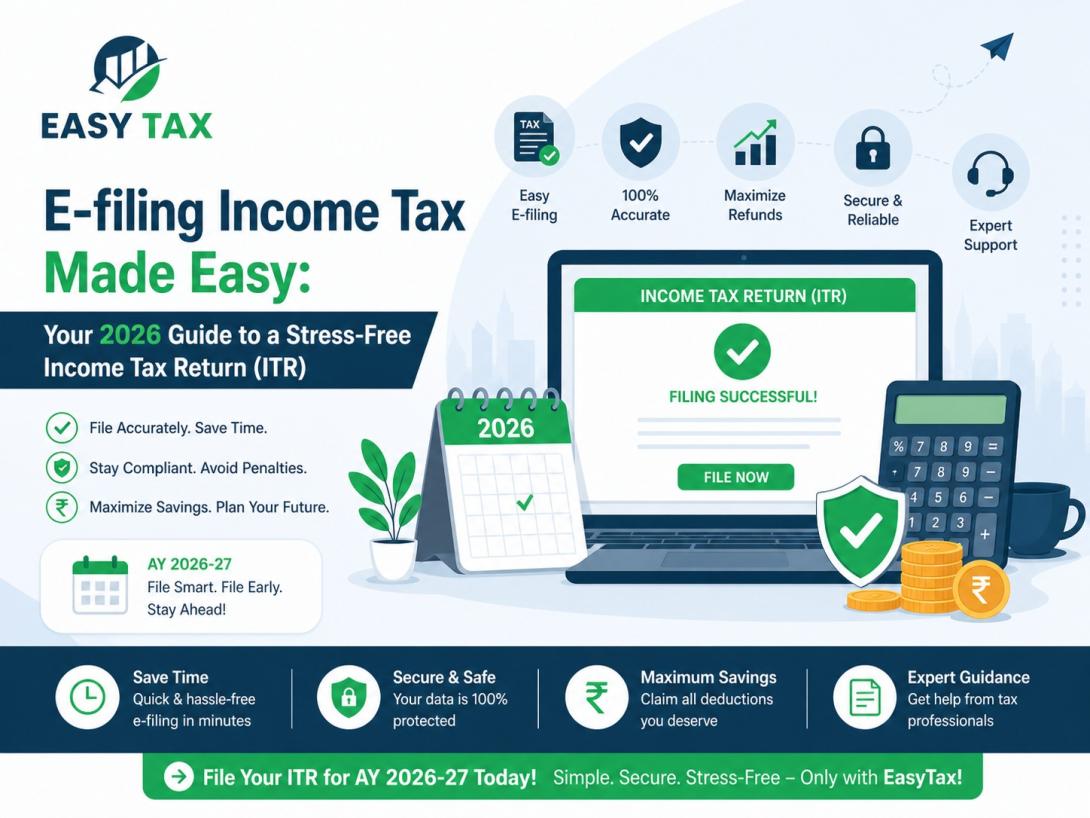
E-filing Income Tax Made Easy: Your 2026 Guide on how to be a stress-free Income Tax Return (ITR).
The year 2026 is a historic milestone to taxpayers in India. As of April 1st, with the new Income Tax Act 2025 officially coming into effect, the situation of fiscal responsibility has changed to be more simplified, fast, and digital. Although a new legal framework may seem daunting, the aim is to make income tax filing in 2026 the easiest experience ever.
The secret of financial peace of mind is to know how to navigate the new income tax portal whether you are a tech-savvy freelancer, a salaried professional, or a small business owner. This guide will take you through on the basics of e-filing income tax and how to ensure that your income tax return (ITR) is correctly and punctually filed.
1. What’s New in 2026?Understanding the Transition
With the onset of the filing season of the Assessment Year (AY) 2026-27 it is worth noting that these two Acts are different. Although the new Income Tax Act 2025 is now operational your ITR filing online of income earned between April 2025 and March 2026 will still be governed by the provisions of the 1961 Act.
However, the "Tax Year" concept has replaced the old Financial Year/Assessment Year terminology for all income earned from this point forward. The income tax portal has been revamped to handle this transition, offering a more intuitive interface that automatically suggests the correct forms based on your financial profile.
2. The Power of the New Tax Regime
One of the most significant highlights for income tax filing 2026 is the further expansion of the New Tax Regime. Designed to be the "default" choice, it now offers:
Zero Tax Liability: Thanks to the enhanced Section 87A rebate, resident individuals with a taxable income up to ₹12 lakh (under the new regime) pay no tax.
Increased Standard Deduction: In the case of salaried workers, the standard deduction has been left at a healthy ₹75,000, effectively making the income earned up to ₹12.75 lakh tax-free.
Simplified Slabs: Tax brackets have been expanded, that is, you have more of your hard-earned money left in your pocket.
3. How to browse through the Income Tax Portal.
The income tax portal is not only a place where one goes to file documents but it has now become a complete digital assistant. One of the biggest upgrades in 2026 is the integration of the Annual Information Statement (AIS).
You can see a pre-filled overview of your financial year, before you start your e-filing income tax journey, including interest on savings accounts, stock market trades and even high value lifestyle expenditures. This Pre-fill technology not only reduces the possibility of human error but, also, ensures that your income tax return (ITR) is correct and matches the data already possessed by the government, which greatly reduces the chance of receiving a tax notice.
4. Step-by-step: Filing ITR Online in 2026.
In order to make this a stress free experience, this is an easier process that is followed:
Gather Your Digital Records: You no longer need a mountain of paper. Log in to the portal and download your Form 16 (now referred to as Form 130 under the new rules) and your AIS.
Choose Your Form: The portal’s "Wizard" tool will ask you a few simple questions about your income sources (Salary, House Property, Capital Gains, etc.) and automatically select the right ITR form for you.
Validate Pre-filled Data: Check the numbers provided by the portal against your bank statements. In 2026, most data is fetched in real-time, making this step faster than ever.
Claim Your Exemptions: If you are opting for the Old Tax Regime, ensure your investments under 80C and 80D are correctly reflected.
E-Verify: This is the most crucial step. Your income tax return (ITR) is not considered "filed" until it is verified. The Aadhaar-based OTP system is now being used by most taxpayers; it takes less than 30 seconds.
5. Deadlines and Cost of Procrastination.
Good performance is rewarded and tardiness is expensive. To use the current cycle, remember the following dates in your calendar:
July 31, 2026: Deadline of non-audit cases and salaried individuals.
August 31, 2026: The new deadline on some categories of business and professional (new in 2026).
December 31, 2026: The last date of Belated Returns.
Late filing will involve a late filing fee of up to 5000 and interest on any outstanding tax. Moreover, filing late prevents you from "carrying forward" capital losses, which could have been used to offset your future tax liabilities.
6. Beyond Filing: The Integrated Tax Ecosystem.
The 2026 ecosystem is not all about income tax. To the business owners, the portal has now made your GST compliance to be linked to your ITR. The integrated tools such as a GST calculator and an income tax calculator over the course of the year can be used to predict outflows and to avoid Tax Season Shock.
In case you discover an error after the filing, the 2026 regulations have simplified the process of making Revised Returns. Until March 31, 2027, you may make corrections to your original filing to ensure that your records are always clean.
Conclusion: Adopting Financial Clarity.
The transition to e-filing income tax is not merely a change in technology, but a change in attitude. Taxation is no longer a maze to be feared but a transparent process that give rewards to those who plan ahead. You are not only remaining compliant but you are in charge of your financial future by leveraging the tools that are available on the income tax portal and keeping up to date with the updates to income tax filing 2026.
Waiting till July rush. Today, you can start your ITR filing online and enjoy the transparency that comes with a well-managed financial life. Make 2026 the year you leave tax-season stress behind and enjoy the sense of achievement that comes with a job well-done.
