

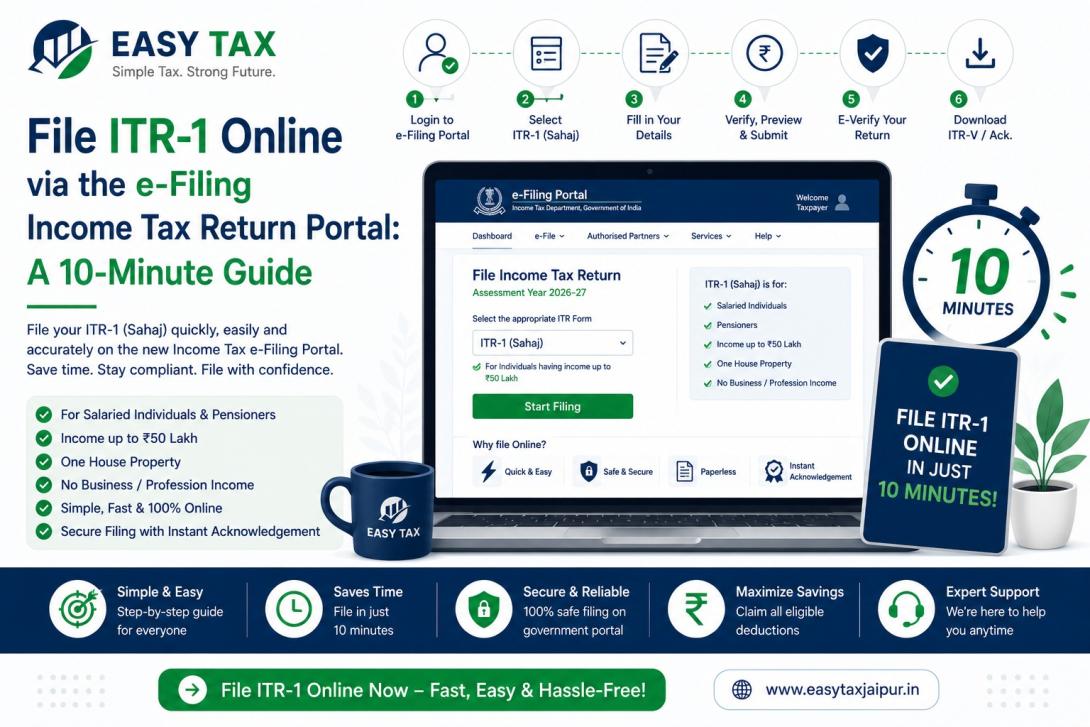
To file ITR-1 Online using e-Filing Income Tax Return Portal, follow these steps:Follow these steps to file ITR-1 Online using e-Filing Income Tax Return Portal:
With the onset of May, it is time for the most important period of the tax season for people in India. With ITR filing online 2026 fast approaching, the sentiment for millions of wage earners is on how to get to the process quickly and correctly. As the deadline for non-audit cases approaches, the Online tax submission portal's complexities become critical to navigate for a smooth experience.
The step-by-step e-filing of ITR-1 online guide is concise and concise, taking no more than 10 minutes to complete so that you stay compliant and benefit from the latest digital improvements.
Understanding the 2026 Landscape
A wide range of changes to the tax landscape have been witnessed in respect of the Assessment Year (AY) 2026-27. Most importantly, the New Tax Regime is now the default option which gives a basic exemption limit of up to ₹12 lakh (which is effectively tax-free after rebates). But, the Old Tax Regime is still available for those who have a big investment in a traditional saving instrument.
The first step in preparing for e-Filing income tax return tasks this year is picking the proper form. ITR-1 (Sahaj) is meant for resident individual who has:
Income from salary or pension.
Income from one house property.
Other income (e.g. bank account interest).
Total income of up to ₹50 lakh.
Step 1 involves getting your Income Tax e-Filing Login ID.Step 1 is to get Income Tax e-Filing Login ID.
The trip starts from the official government website. For the 2026 season, security has been increased, please make sure you are using the right URL.
Go to the Official Online tax submission portal.
On the home page, find the link to Income tax e-filing login.
Please enter your PAN (User ID) and secure password.
The "Forgot Password" utility has been introduced for easy resetting of password with the help of Aadhaar linked mobile OTP in case of loss or forget.
The next step is to understand how to leverage pre-filled data.Step 2 – The Power of Pre-filled Data
Another significant benefit of ITR filing online 2026 is the incorporation of Annual Information Statement (AIS) and Form 26AS (now Form 168).
After logging into the website, click ‘e-File’ > ‘Income Tax Returns’ > ‘File Income Tax Return’. Click on the current Assessment Year (2026-27) and then select 'Online' mode. The portal will pull data directly from employers and banks, automatically.
Pro-Tip: Cross check the salary details filled by the employer with your Form 16 (now 130). Manual correction of discrepancies is crucial at this point because it leads to the automated notices.
In Step 3: Navigating the Filing Process, students will explore the mechanics of filing a claim.
There are five crucial sections in the ITR-1 online filing that need to be validated:
Personal Information: Verifies contact information and bank account information. Make a minimum of one bank account "Validated" for refund credit.
Gross Total Income: Check the salary income, house property income and other sources of income. New for 2026, minor long-term capital gains (up to ₹1.25 lakh) can be reported directly in ITR-1 with certain conditions.
If you're on the Old Tax Regime, make sure to account for the 80C, 80D and 80G deductions. In the New Tax Regime, the Standard Deduction has been hiked to ₹75,000 for salaried individuals.
Tax Paid: This shows the amount of TDS deducted by the employer and advance tax, if any, which you may have paid.
The final tax: This will calculate your total tax liability. If the "Tax Payable" is zero or if you qualify for a refund, you are now prepared to work on your return.
The last hurdle: Verification.
If your e-Filing income tax return is not verified, your return is not complete. The Online tax submission portal provides three main ways to do this:
Aadhaar OTP: The quickest approach. A code is sent to your registered mobile number.
Electronic Verification Code (EVC): This is created on the basis of pre validated bank account or Demat account.
Digital Signature Certificate (DSC): Is applied by higher income bracket professionals and professionals.
If not verified within 30 days of filing, your return is not valid and the penalties are the same as if you had not filed any return.
There are many ways to prevent penalties and late fees.
The best protection against unnecessary costs is to take prompt action. If you miss the July 31, 2026 deadline, you can still file a "Belated Return" until December 31, 2026. This has its costs, however:
Late Fee: Section 234F (upto ₹5,000 - reduced to ₹1,000 if total income is below ₹5 lakhs).
The interest rate on any amount of money left unpaid in tax is 1% per month.
Certain losses are not allowed to be carried over to other years.
Conclusion
You can do your income tax compliance in minutes using the income tax e-filing login and the automated capabilities of the Online tax submission portal. The objective of ITR e-filing 2026 online is to keep ITR filing process ‘Sahaj' (simple) for the honest taxpayer.
Please don't wait for the July rush. Log in today and confirm that you've got all your financial data correct and your finances sorted for the year ahead. May is a good month to be a bit digital otherwise you will be in a last minute scramble in July.
