

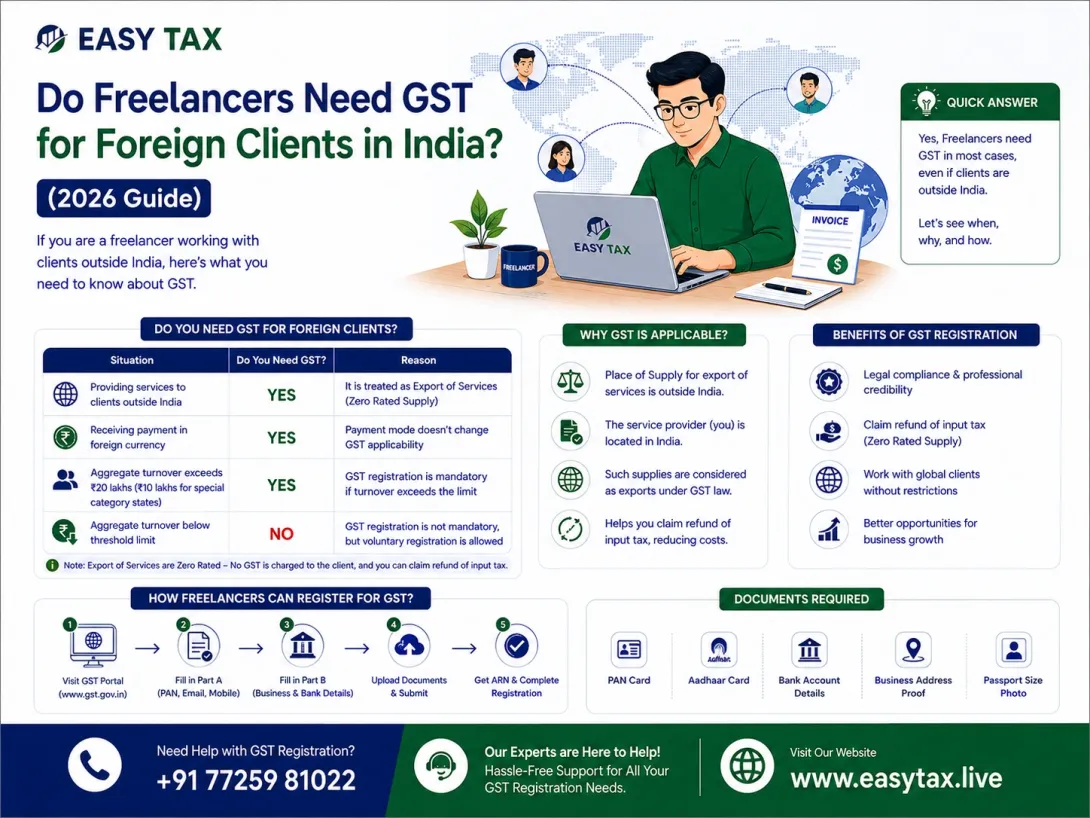
Many Indian freelancers working with international clients wonder whether GST is required on foreign income. In many cases, GST registration may apply, but export of services rules and LUT filing can help freelancers avoid paying GST on international invoices legally.
Many Indian freelancers earn money from clients in the US, UK, UAE, Canada, and Australia. Designers, developers, video editors, marketers, consultants, and AI professionals are working with international clients more than ever before.
But one question keeps confusing freelancers: “Do I need GST if my clients are outside India?”
The short answer is: In many cases, yes — but you may not have to pay GST.
This guide explains everything in simple language.
Is GST Applicable to Freelancers in India?
Yes. Freelancers are treated as service providers under GST law.
If you provide services such as:
- Web development
- SEO services
- Graphic design
- Digital marketing
- Software consulting
- Video editing
- Content writing
then GST rules can apply to you.
However, there is a major benefit available when you work with foreign clients.
Foreign Freelance Income Can Be Treated as “Export of Services”
Under GST law, services provided to clients outside India may qualify as export of services.
This is important because exports are generally considered:
- Zero-rated supplies
- GST exempt from actual payment (with LUT)
To qualify as export of services:
You must meet these conditions:
- Client must be outside India
- Payment must come in foreign currency
- Service should be delivered outside India
- You and the client should not be branches of the same company
If these conditions are satisfied, you may not need to charge GST on invoices.
Do Freelancers Need GST Registration?
This depends on your turnover.
GST registration is usually required if:
- Annual turnover exceeds ₹20 lakh (most states)
- ₹10 lakh in special category states
But there’s a catch.
If you export services internationally, some professionals choose voluntary GST registration to:
- File LUT
- Avoid GST payment legally
- Claim input tax credit
- Work with bigger clients confidently
What Is LUT in GST?
LUT means Letter of Undertaking.
It allows freelancers to export services without charging GST.
Without LUT:
- You may need to charge IGST
- Then claim a refund later
With LUT:
- No GST payment upfront
- Easier compliance
- Better cash flow
Example
Rahul is a freelance web developer in Jaipur.
He earns:
- ₹8 lakh from Indian clients
- ₹12 lakh from US clients
Total turnover = ₹20 lakh
Since export income is included in turnover calculation, GST registration may become applicable.
However, by filing LUT:
Rahul can continue invoicing US clients without charging GST.
Is GST Required on PayPal or Stripe Payments?
No extra GST is charged merely because you receive payment through PayPal or Stripe.
But:
- Platform fees may include GST
- You should maintain proper invoices
- FIRC or foreign inward remittance proof is important
Documents Freelancers Should Maintain
Keep these safely:
- Client contracts
- Invoices
- Foreign remittance certificates
- Bank statements
- LUT copy
- GST returns
These help during notices or compliance checks.
GST Return Filing for Freelancers
If registered under GST:
- File GSTR-1
- File GSTR-3B
- Maintain records properly
Even if no tax is payable, returns may still be required.
Common Mistakes Freelancers Make
1. Ignoring GST completely
Many freelancers assume foreign income is fully tax-free.
It is not.
2. Not filing LUT
Without LUT, GST complications can arise later.
3. Mixing personal and business accounts
Use a dedicated current account if possible.
4. Missing invoices
Every foreign payment should have a proper invoice.
5. Not reporting income in ITR
Foreign freelance income must also be shown in Income Tax Return.
Can Small Freelancers Avoid GST?
If your total turnover stays below threshold and your work structure qualifies, GST registration may not be mandatory.
But every case is different.
Factors include:
- Type of service
- Place of supply
- Client location
- Payment method
- Annual turnover
Benefits of GST Registration for Freelancers
Many freelancers voluntarily register because it:
- Builds trust with clients
- Helps with business expansion
- Makes compliance cleaner
- Avoids future penalties
- Helps during startup funding or visa applications
Final Thoughts
Foreign freelancing is growing rapidly in India. But many freelancers still ignore GST rules until they receive a notice.
Understanding export of services and LUT can save you from:
- Penalties
- Wrong tax payments
- Compliance stress
If you earn from international clients, it’s better to structure your tax setup correctly from the beginning.
GST for Freelancers
EasyTax helps freelancers, consultants, creators, developers, and digital professionals with GST registration, LUT filing, GST returns, export of services compliance, and tax notices across India.
