

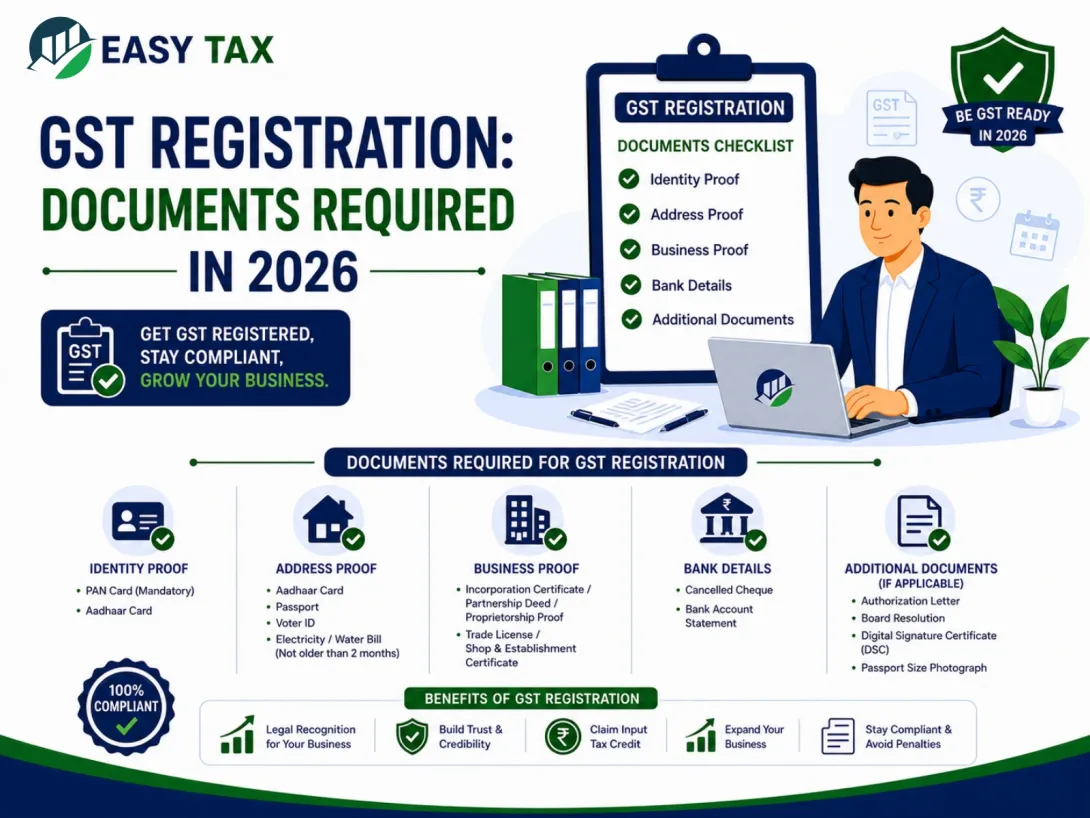
GST Registration Documents Required in India (2026 Guide)
GST registration in India has become more verification-focused in 2026. With Aadhaar authentication, biometric checks, and stricter document validation, keeping the correct GST registration documents ready is essential for faster approval and smoother compliance.
Whether you are a freelancer, small business owner, startup founder, content creator, or company director, understanding the latest GSTIN registration requirements can help avoid delays, notices, and application rejection.
This guide explains the documents required for GST registration in 2026, including address proof, business proof, Aadhaar authentication, bank documents, and frequently asked questions.
What Is the Major Change in GST Registration Process in 2026?
One of the biggest updates in the new GST registration process is:
Aadhaar-Based Authentication & Biometric Verification
The GST portal now relies heavily on:
- Aadhaar e-KYC
- PAN validation
- Mobile OTP verification
- Biometric verification in selected cases
These measures are designed to improve identity verification and reduce fake registrations.
In many cases, successful Aadhaar authentication may help avoid physical verification by GST officers.
Documents Required for GST Registration in 2026
The document requirements depend on the type of business entity.
GST Registration Documents for Sole Proprietors & Freelancers
For individual businesses, freelancers, and sole proprietorships, the document list is relatively simple.
Basic Documents Required
Identity Proof
- PAN Card
- Aadhaar Card linked with mobile number
Photograph
- Passport-size photo of applicant
Address Proof
Accepted documents may include:
- Electricity bill
- Water bill
- Property tax receipt
- Rent agreement
Consent Letter / NOC
If the property belongs to parents, spouse, or another person, a No Objection Certificate (NOC) may be required.
GST Registration Documents for Partnership Firms & LLPs
Partnership firms and LLPs require additional business constitution documents.
Required Documents
Business PAN
PAN Card of the partnership firm or LLP
Partnership Deed / LLP Agreement
Valid signed partnership deed or LLP incorporation agreement
Identity & Address Proof
Documents of:
- Partners
- Authorized signatory
Business Address Proof
- Electricity bill
- Rent agreement
- NOC if applicable
GST Registration Documents for Private Limited Companies
Private Limited Companies generally require more compliance documents.
Common Documents Include
- Certificate of Incorporation (COI)
- Company PAN Card
- Board Resolution / Authorization Letter
- Director PAN & Aadhaar
- Business address proof
- Bank account proof
- DSC (Digital Signature Certificate)
Valid Proof of Business Address for GST Registration
One of the most common reasons for GST application rejection is incorrect address proof.
Accepted Address Proof Documents
For Owned Property
- Electricity bill
- Municipal tax receipt
- Property tax receipt
- Khata copy
For Rented Property
- Rent agreement
- Owner’s electricity bill
- Owner’s property proof
For Shared Property
- Consent Letter / NOC
- Supporting ownership document
Ensure:
- Name and address are clearly visible
- Documents are recent and readable
- Address matches GST application details
Is Bank Account Mandatory for GST Registration?
Bank account details may sometimes be added after GST registration approval, depending on GST portal requirements and registration category.
However, businesses are generally required to update bank account details within the prescribed compliance timeline after GST approval.
Common Bank Proof Documents
- Cancelled cheque
- Bank statement
- Passbook copy
The document should clearly display:
- Business name
- Account number
- IFSC code
What Is DSC in GST Registration?
Digital Signature Certificate (DSC)
DSC is an electronic signature used for GST filings and application verification.
DSC Is Generally Required For:
- Private Limited Companies
- LLPs
Aadhaar OTP / EVC Can Be Used By:
- Sole proprietors
- Individual applicants
- Small businesses
How Long Does GST Registration Approval Take in 2026?
Approval timelines may vary depending on:
- Aadhaar authentication
- Document accuracy
- Risk verification status
- Physical verification requirements
Estimated Timelines
With Aadhaar Authentication
- Approximately 3–7 working days
Without Aadhaar Verification
- Verification may take longer
- Physical inspection may be initiated in certain cases
Can You Use a Virtual Office for GST Registration?
Virtual office addresses may be accepted in certain cases if valid documentation is available.
Documents Usually Required
- Rent agreement
- NOC from provider
- Utility bill
- Valid business address proof
The GST department may conduct additional verification for virtual office registrations.
GST Document Upload Guidelines (2026)
Before applying online, ensure documents are:
- PDF or JPEG format
- Clear and readable
- Properly scanned
- Within GST portal file size limits
Recommended File Size
Photos
- Under 100 KB
Documents
- Usually under 2 MB
Quick GST Registration Checklist 2026
Before applying, keep these ready:
PAN Card
Aadhaar Card
Passport-size Photograph
Address Proof
Rent Agreement / NOC
Business Constitution Proof
Bank Account Proof
Authorized Signatory Proof
Common Reasons for GST Registration Rejection
Avoid these common mistakes:
- Incorrect address proof
- Blurry uploaded documents
- Aadhaar mobile mismatch
- Invalid NOC
- Wrong PAN details
- Incomplete rent agreement
- Name mismatch between documents
Carefully verifying all details before submission can help speed up approval.
Frequently Asked Questions (FAQs)
Is Aadhaar mandatory for GST registration?
Aadhaar authentication is commonly used in the GST registration process and helps simplify verification.
Can I apply for GST without a business bank account?
In some cases, bank details may be updated after GST approval within the prescribed compliance period.
Is DSC mandatory for GST registration?
DSC is generally mandatory for companies and LLPs, while individuals may use Aadhaar OTP-based verification.
Which address proof is accepted for home-based businesses?
Electricity bills, rent agreements, property tax receipts, and NOC documents are commonly accepted.
Can freelancers apply for GST registration?
Yes, freelancers, consultants, creators, and service providers can apply for GST registration subject to applicable rules and turnover limits.
Conclusion
GST registration in 2026 is more digital, verification-focused, and compliance-driven than ever before. Keeping the correct documents ready before applying can significantly improve approval speed and reduce the chances of rejection.
Whether you are a freelancer, startup founder, agency owner, or small business operator, understanding the latest GST registration document requirements helps ensure a smoother and more professional registration process.
Proper documentation is no longer just a formality — it is the foundation of successful GST compliance in India.
