

GST Registration in India 2026: Complete Guide for Businesses and Professionals
Goods and Services Tax (GST) has transformed India's indirect taxation system by replacing multiple taxes with a unified tax structure. Since its implementation, GST has simplified tax compliance, improved transparency, and created a common national market for businesses.
In 2026, GST registration continues to be one of the most important legal requirements for businesses, startups, freelancers, traders, manufacturers, and service providers operating in India. Obtaining a GST Identification Number (GSTIN) not only ensures compliance with tax laws but also enables businesses to claim Input Tax Credit (ITC), expand operations across states, and build credibility in the marketplace.
Whether you are starting a new business or wondering if your existing business needs GST registration, this comprehensive guide explains everything you need to know about GST registration in India in 2026.
What is GST Registration?
GST registration is the process through which a business becomes registered under the Goods and Services Tax regime. Once registered, the business receives a unique 15-digit GST Identification Number (GSTIN) issued by the government.
This GSTIN acts as the official tax identity of the business and must be quoted on invoices, GST returns, and various business transactions.
A GST-registered business can:
- Collect GST from customers
- Claim Input Tax Credit on purchases
- Issue GST-compliant invoices
- File GST returns
- Conduct interstate business activities
- Improve business credibility
GST registration serves as the foundation for lawful and efficient business operations under India's taxation framework.
Why GST Registration is Important in 2026
The business environment in India has become increasingly digital and compliance-focused. GST registration provides several advantages beyond legal compliance.
Legal Recognition
GST registration legally recognizes your business as a taxpayer under GST law. It demonstrates compliance and reduces the risk of penalties and notices.
Input Tax Credit Benefits
Businesses can claim credit for GST paid on purchases and expenses used for business purposes. This reduces the overall tax burden and improves profitability.
Business Expansion Opportunities
GST registration allows businesses to operate more efficiently across state boundaries and serve customers throughout India.
Enhanced Market Reputation
Many clients, vendors, and corporate buyers prefer dealing with GST-registered businesses because it indicates professionalism and compliance.
Access to Government and Corporate Contracts
Many government tenders and large corporate contracts require suppliers to have valid GST registration.
Who Needs GST Registration in India?
GST registration is mandatory for certain businesses and optional for others.
A business may need GST registration depending on factors such as:
- Annual turnover
- Nature of business
- Interstate supply of goods or services
- E-commerce activities
- Specific categories prescribed under GST law
Businesses should regularly review their eligibility because GST regulations may be updated from time to time.
Even when registration is not mandatory, many businesses voluntarily register to enjoy the benefits of Input Tax Credit and improved business credibility.
Types of GST Registration
Different businesses may register under different GST categories depending on their nature and turnover.
Regular Taxpayer Registration
Most businesses choose regular GST registration, which allows them to collect GST and claim Input Tax Credit.
Composition Scheme Registration
Small taxpayers meeting prescribed conditions may opt for the Composition Scheme, which offers simplified compliance and lower tax rates, subject to eligibility criteria.
Casual Taxable Person Registration
Businesses conducting temporary activities such as exhibitions or seasonal sales in another state may require this registration.
Non-Resident Taxable Person Registration
Foreign businesses supplying goods or services in India may require registration under this category.
Selecting the correct category is important because it affects compliance requirements and tax obligations.
Documents Required for GST Registration in 2026
Proper documentation is one of the most important aspects of successful GST registration.
Identity Proof
- PAN Card of the applicant
- Aadhaar Card
- Passport-size photograph
Business Registration Documents
Depending on the business structure:
- Proprietorship details
- Partnership Deed
- LLP Agreement
- Certificate of Incorporation
- Memorandum and Articles of Association
Address Proof
The business address must be supported by valid documents such as:
- Electricity bill
- Property tax receipt
- Rent agreement
- Lease agreement
- No Objection Certificate (NOC)
Bank Account Details
Applicants generally need:
- Bank statement
- Cancelled cheque
- Passbook copy
Authorized Signatory Documents
Where applicable:
- Authorization letter
- Board resolution
Ensuring consistency across all documents significantly improves the chances of quick approval.
Step-by-Step GST Registration Process in India
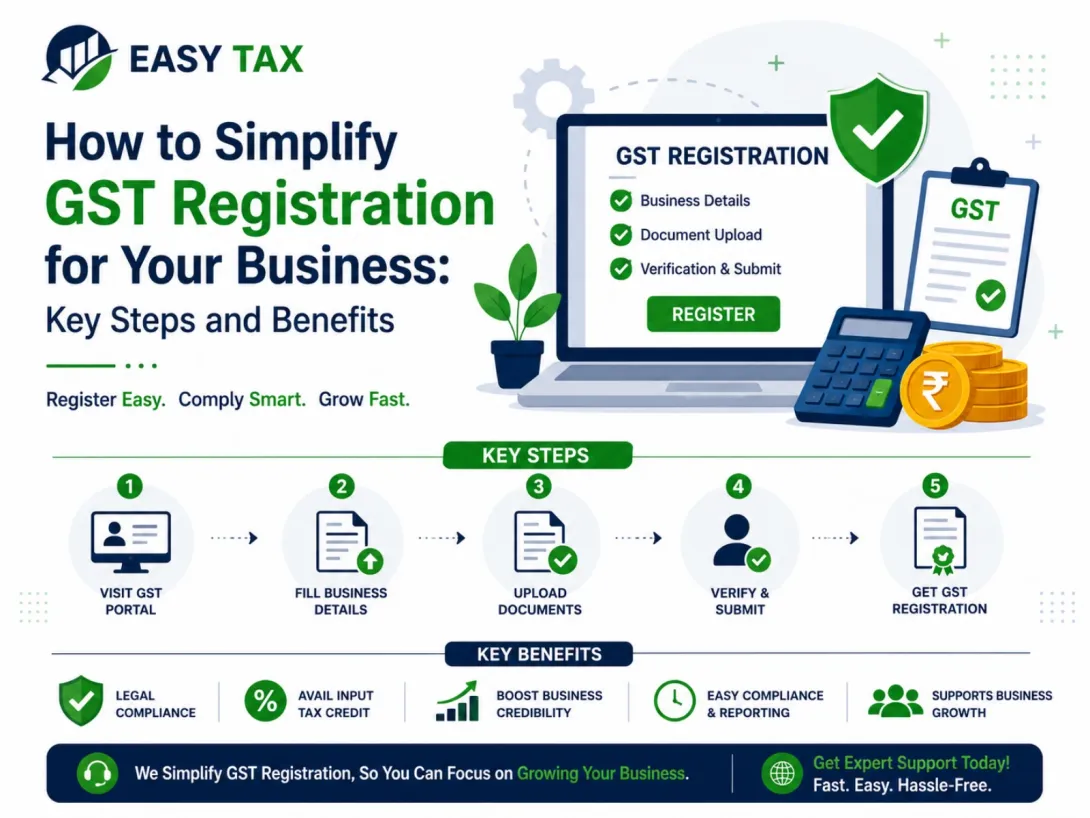
The GST registration process is fully online and can be completed through the GST portal.
Step 1: Access the GST Portal
Visit the GST registration portal and select the option for new registration.
Step 2: Fill Preliminary Information
Provide:
- Legal name of business
- PAN number
- Mobile number
- Email address
- State and district
OTP verification is completed through the registered email and mobile number.
Step 3: Receive Temporary Reference Number
After successful verification, a Temporary Reference Number (TRN) is generated.
The TRN enables applicants to continue and complete the registration application.
Step 4: Complete the Application Form
Applicants must provide:
- Business details
- Promoter information
- Authorized signatory details
- Principal place of business
- Additional business locations
- Goods and services information
- Bank account details
Step 5: Upload Supporting Documents
Upload all required documents in the prescribed format.
Documents should be clear, accurate, and up to date.
Step 6: Aadhaar Authentication
Aadhaar authentication has become an important component of the registration process.
Successful Aadhaar verification often speeds up registration approval and reduces the need for additional verification procedures.
Step 7: Submit the Application
The application may be verified using:
- Digital Signature Certificate (DSC)
- Electronic Verification Code (EVC)
- E-sign facility
Step 8: Receive Application Reference Number
An Application Reference Number (ARN) is generated for tracking purposes.
Step 9: Verification by Authorities
Tax authorities review the application and supporting documents.
If additional information is required, a notice may be issued seeking clarification.
Step 10: GSTIN Issuance
Upon approval, the applicant receives:
- GST Registration Certificate
- GST Identification Number (GSTIN)
The business can then begin operating as a registered taxpayer.
Benefits of GST Registration
1. Input Tax Credit (ITC)
One of the biggest advantages of GST registration is the ability to claim Input Tax Credit on eligible purchases.
This helps reduce tax costs and improves cash flow.
2. Nationwide Business Operations
GST registration simplifies interstate transactions and enables businesses to expand into new markets.
3. Better Business Opportunities
Registered businesses often gain access to larger clients and business opportunities.
4. Increased Trust and Credibility
Customers and suppliers generally view registered businesses as more reliable and professional.
5. Compliance with Tax Laws
GST registration helps businesses avoid legal issues and maintain compliance with tax regulations.
6. Participation in E-Commerce
Many online marketplaces require sellers to have GST registration before listing products.
Common Mistakes to Avoid During GST Registration
Incorrect PAN Information
The PAN details provided must exactly match official records.
Wrong Business Constitution
Selecting the wrong business type can lead to future compliance issues.
Incomplete Documentation
Missing documents are among the most common causes of delays and rejection.
Address Mismatch
The business address should be consistent across all supporting documents.
Poor Quality Uploads
Blurred or unreadable documents often result in additional queries from authorities.
Ignoring Notices
Applicants should regularly monitor the application status and respond promptly to any notices.
Compliance After GST Registration
Obtaining GST registration is only the beginning.
Registered taxpayers must continue complying with GST requirements.
GST Return Filing
Businesses must file applicable GST returns within prescribed timelines.
Tax Payment
Any GST liability must be paid on time.
Record Maintenance
Businesses should maintain proper books of accounts and supporting records.
Invoice Compliance
Invoices must contain mandatory GST details including GSTIN and tax breakdown.
Updating Registration Details
Changes in address, business structure, or authorized signatories should be updated promptly.
Maintaining compliance helps avoid penalties and supports smooth business operations.
Why Professional Assistance Can Help
While GST registration is designed to be user-friendly, businesses often face challenges related to:
- Documentation
- Eligibility assessment
- Aadhaar authentication
- Application errors
- Clarification notices
Professional assistance can simplify the process and reduce the risk of delays or rejection.
Tax professionals can help businesses understand their obligations, prepare documentation correctly, and ensure accurate filing.
Frequently Asked Questions (FAQs)
Is GST registration mandatory for every business?
No. GST registration requirements depend on turnover, business activities, and applicable GST provisions.
Can I apply for GST registration online?
Yes. GST registration is completely online through the GST portal.
What is GSTIN?
GSTIN stands for Goods and Services Tax Identification Number. It is a unique 15-digit number assigned to registered taxpayers.
How long does GST registration take?
Processing time varies depending on verification requirements and document accuracy.
Can I claim Input Tax Credit after registration?
Yes. Registered businesses can claim eligible Input Tax Credit subject to GST regulations.
Is Aadhaar authentication required?
Aadhaar authentication plays an important role in the registration process and can help facilitate faster approvals.
What happens if I fail to register when required?
Failure to obtain GST registration when legally required may result in penalties, interest, and compliance issues.
Conclusion
GST registration remains a crucial step for businesses operating in India in 2026. It not only ensures compliance with tax laws but also provides numerous business advantages, including Input Tax Credit benefits, improved credibility, interstate expansion opportunities, and access to larger markets.
By understanding eligibility requirements, preparing accurate documents, completing Aadhaar authentication, and following the correct registration process, businesses can obtain their GSTIN smoothly and efficiently. Whether you are a startup, freelancer, trader, manufacturer, or service provider, GST registration can play a significant role in supporting long-term business growth and financial success.
A well-managed GST registration process lays the foundation for a compliant, trustworthy, and scalable business in today's competitive marketplace.
