

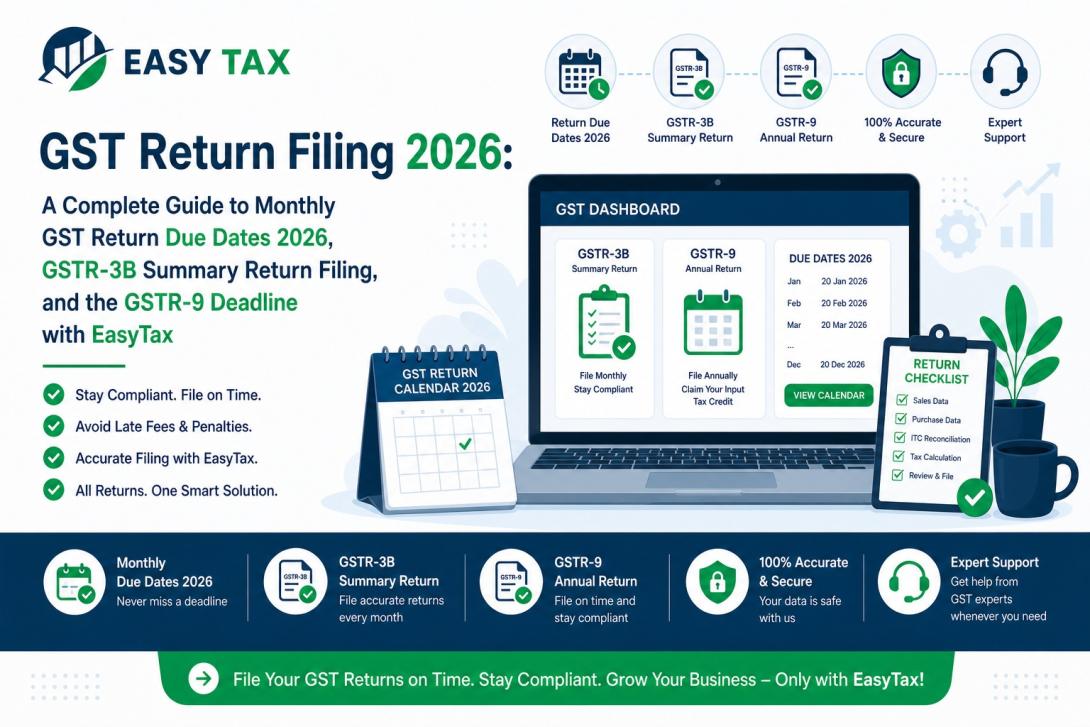
GST Return Filing 2026: A Complete Guide to the Monthly Due Dates of GST Return Filing 2026, GSTR-3B Summary Return Filing, and the GST-9 Deadlines with Easy Tax.
The year 2026 has ushered in a new era for the Indian tax landscape. The manner in which businesses are tackling compliance has radically altered with the full integration of the New Income Tax Act 2025 and a more robust and AI-driven GST e-filing portal 2026. Our days are no longer the days of manual reconciliation; now it is the days of real-time data reconciliation.
We have realized that the fast digital changes can be quite daunting to business owners, freelancers, and accounting professionals. This handy guide is aimed at getting you through the mazes of GST return filing 2026, without having to break the law, and still make the most of your cash flow.
1. 2026 Compliance Landscape: What has Changed?
By May 2026, the Goods and Services Tax Network (GSTN) has implemented a number of so-called smart features. The largest is the compulsory Invoice Management System (IMS). This system functions as a digital gatekeeper where taxpayers are required to accept, reject or keep pending all invoices that are uploaded by their suppliers before the Input Tax Credit (ITC) can be claimed.
This implies that GSTR-3B summary return filing is no longer a separate task that you do on the 20th of the month. It is the climax of a month-long program of active invoice management. In Easy Tax, our automated tools can help you close this gap by identifying mismatches in real-time, long before the deadline arrives.
2. Monthly GST Return Due Dates 2026: Your Compliance Calendar.
Timing is the key in the world of GST. In 2026, the interest calculator on the portal will automatically activate once a deadline has been missed. To escape the "Late Fee Trap" you will need to enter these monthly GST returns due dates 2026 in your calendar:
In the case of Monthly Filers (Turnover > ₹5 Crore):
GSTR-1 (Outward Supplies): The 11 th of each month.
GSTR-3B (Summary & Payment): The 20th of every month.
GSTR-6 (ISD): Each 13th of the month.
In the case of Quarterly Filers (QRMP Scheme).
IFF (Invoice Furnishing Facility): The 13 th of the first two months of the quarter.
GSTR-1:13 th of the month after the quarter.
GSTR-3B:22 nd or 24 nd of the month after the quarter (depending on your state).
3. How to File GSTR-1 Online AY 2026-27
Reporting your sales to the government so that your customers can claim their credit is in essence, a reporting of your sales to the government when you prepare to file GSTR-1 online AY 2026-27. The portal in the present Assessment Year has shifted to the "System-Driven" accuracy.
Easy Tax Step-by-Step Process:
Data Extraction: Have your sales data exported to your accounting software.
E-Invoicing Sync: In companies that have a turnover of over 5 crores make sure that your E-invoices are automatically pushed to the GSTR-1 tables.
HNS Summary Validation: The portal of 2026 is very strict in terms of HSN codes. A misfit in this may result in an automated show-cause notice.
Verification: OTP (EVC) is based on Aadhaar to verify instantly after uploading data to the GST e-filing portal 2026.
With Easy Tax, you can automatically push your data out of your billing software directly to the portal, eliminating up to 99 percent of errors in manually entering the data in your billing software.
4. Learn to fill GSTR-3B Summary Return Filing.
The real payment of the tax occurs in GSTR-3B summary return filing. Table 4 (Input Tax Credit) in 2026 will be fully auto-populated based on your GSTR-2B. But with the new IMS rules, the accuracy of your GSTR-2B is no better than the steps you took on the portal earlier in the month.
The Easy Tax Triple Check:
Check 1: Make sure that Table 3.1 (Tax Liability) corresponds to your GSTR-1 that you have filed.
Check 2: Check that the ITC in Table 4 only represents accepted invoices in your IMS dashboard.
Check 3: Be sure to accurately account and pay in cash all liabilities on a "Reverse Charge" (RCM) basis.
Remember, the GST department’s AI now compares your GSTR-3B data with your E-way bills and ITR filings. Any deviation above 5 percentage evokes a "Risk Flag" on your GSTIN profile.
5. Final Audit: Annual GST Return GSTR-9 Deadlines.
Whereas monthly returns deal with the present, annual return deals with the past. The deadline of the Tax Year 2025-26 GST return GSTR-9 is December 31, 2026.
This return is a summary of all your monthly returns. This will be the last chance to rectify any omissions or errors that were made in the year.
GSTR-9: It is required when the taxpayer has turned over of more than 2 crores.
GSTR-9C: A self-certified reconciliation statement required of any person over ₹5 crore.
We at Easy Tax would suggest that you begin your annual reconciliation in October. The last month of the year results in last minute entries and more likely to be scrutinized in the audit.
6. Penalties and the "Hard Stop" Rule of 2026
A Hard Stop policy has been introduced by the government in the GST e-filing portal 2026. In case you do not submit your returns two periods in a row:
GSTR-1 Blocking: This will mean you will not be able to submit your sales information and as such, your customers will not be able to receive ITC.
E-Way Bill Blocking: You will not be allowed to transport goods that are worth more than ₹50,000.
GSTIN Suspension: When non-compliance is continued then your registration is automatically suspended.
In conclusion: Your Partner in Compliance.
In 2026, taxation will no longer be about simply filling out forms. It concerns data management, reacting to nudges introduced by AI, and having an untainted digital footprint. With your monthly GST return due dates 2026 and through the professional assistance of Easy Tax, compliance is no longer a burden but a competitive advantage.
Clean GST record enhances your credit rating with banks and develops trust with your B2B suppliers. Allow Easy Tax to take care of the intricacies of the GST e-filing portal 2026 as you concentrate on what is really important which is the growth of business to new heights.
Are you willing to make your tax process easier? Get in touch with Easy Tax today and see the future of hassle-free compliance!
Q1. What is GST Return Filing?
A: GST return filing is the process of submitting details of sales, purchases, tax collected, and tax paid to the GST portal for compliance with GST law.
Q2. Which are the main GST returns required in 2026?
A: The main GST returns are:
- GSTR-1: Details of outward supplies (sales)
- GSTR-3B: Monthly summary return for tax payment
- GSTR-9: Annual return summarizing the entire financial year
Q3. What are the monthly GST return due dates in 2026?
A:
- GSTR-1: 11th of every month
- GSTR-3B: 20th of every month
- IFF (QRMP taxpayers): 13th of the first two months of the quarter
Q4. What is GSTR-1 used for?
A: GSTR-1 is used to report outward supplies (sales) so that buyers can claim Input Tax Credit (ITC).
Q5. What is GSTR-3B?
A: GSTR-3B is a monthly summary return where taxpayers declare total sales, input tax credit, and pay GST liability.
Q6. What is the due date for GSTR-9 (Annual Return)?
A: The due date for GSTR-9 for FY 2025–26 is 31st December 2026.
Q7. Who must file GSTR-9C?
A: Taxpayers with turnover above ₹5 crore are generally required to file GSTR-9C as a reconciliation statement (as per applicable rules).
Q8. What happens if GST return is not filed on time?
A: Late filing can lead to:
- Late fees and interest
- Blocking of return filing (GSTR-1 restriction)
- E-way bill restrictions
- Possible GST registration suspension in severe cases
Q9. What is the Invoice Management System (IMS)?
A: IMS is a system where taxpayers must accept, reject, or hold invoices uploaded by suppliers before claiming Input Tax Credit (ITC).
Q10. What is the benefit of filing GST returns on time?
A: Timely filing ensures:
- Smooth ITC claims
- Avoidance of penalties
- Better compliance rating
- Uninterrupted business operations
Q11. Can GSTR-3B be filed without GSTR-1?
A: GSTR-3B can be filed, but mismatch between GSTR-1 and GSTR-3B may trigger notices and ITC issues.
Q12. What is the QRMP scheme?
A: QRMP (Quarterly Return Monthly Payment) allows eligible taxpayers to file GSTR-1 and GSTR-3B quarterly while paying taxes monthly.
