

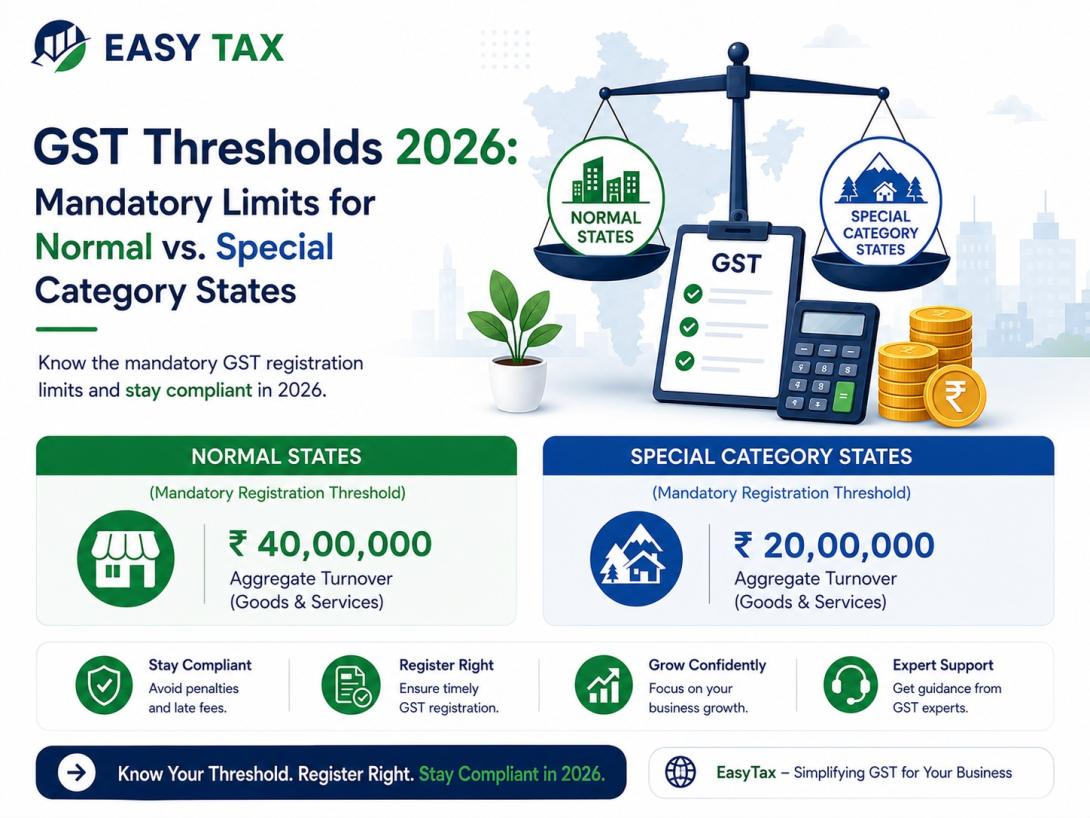
Normal vs Special Category States: Mandatory Thresholds for GST (2026)
There was always a need to be meticulous when dealing with the Indian tax regime, but now, with the complete implementation of the GST Rules 2026, the challenges were further exacerbated in ensuring the compliance of businesses. The "Threshold Limit" is the turnover limit of a small business, entrepreneur or digital freelancer that triggers the requirement to register for Goods and Services Tax (GST).In the world of small business, entrepreneurship and the digital freelance, grasping the concept of the "Threshold Limit"—the turnover threshold at which businesses are required to register for Goods and Services Tax (GST)—is a crucial step toward growth.
The government has simplified the registration process to promote formalisation while retaining stringent ‘Compulsory Registration' parameters which do not give any exception to turnover. The current threshold for goods, services and special states are explained in this guide so that your business stays compliant with the law.
The General Thresholds: Normal Category States
In most parts of India (Normal Category States), the requirement to register will depend on the type of your supply.
Adding a GST limit on goods (₹40 Lakh).Introduction of Goods GST limit (₹40 Lakh).
In case of a business trading only in goods, the GST limit for goods (₹40 Lakh) continues to be the benchmark. The annual turnover (on PAN-India basis) is the limit beyond which you have to compulsorily obtain a GSTIN within 30 days.
Note: This higher limit of ₹40 Lakh does not apply to some restricted categories such as manufacturers of ice cream, pan masala or tobacco products, who still need to adhere to the lower limit of ₹20 Lakh.
2. GST Limit for Services (₹20 Lakh)
The service sector, which includes software consultancy to salon services, is governed by a narrower margin. Any person/entity that renders taxable service must charge the GST limit for services (₹20 Lakh). Where both service and goods are supplied together (a "mixed supply"), the lower of the two service thresholds dictates registration requirements.
Students will acquire an understanding of Special Category States.
Geographically challenged areas or economically backward areas have been given special status in the Indian Constitution. These thresholds are significantly lower in these areas, to achieve wider tax compliance.
Special Category States GST limit (₹10 Lakhs/₹20 Lakhs)
There are two tiers for classification for 2026:
In certain states like Manipur, Mizoram, Nagaland and Tripura, the goods and services threshold limit is only ₹10 Lakh for Tier A.
In states like Arunachal Pradesh, Meghalaya, Sikkim, Uttarakhand, the threshold for goods has been kept on par with the services limit of ₹20 Lakh, which is Tier B.
Even if your business has a single branch in a state that is in the "Tier A" category, you can see that your PAN-based registration threshold is reduced to ₹10 Lakh. If you run a business in multiple states, always get the advice of a tax professional.
When Turnover is not a Factor, it is Compulsory Registration.
Turnover thresholds offer a "safe harbour" for small businesses, but the GST Act makes clear that there are certain situations where businesses must be registered from the first rupee in.Turnover thresholds offer a "safe harbour" for small businesses, but the GST Act makes clear that there are certain situations where businesses must be registered from the first rupee in.
Mandatory GST for E-commerce Sellers
There are rules to the digital economy. One of the most stringent sections of the 2026 framework will be the mandatory GST for e-commerce sellers. No matter if you are a seller of handmade crafts on Etsy, electronics on Amazon, or food through delivery apps, you will need to be a GST registered seller. The exemption of ₹40 Lakh/₹20 Lakh is not available to the sellers who sell through ecommerce operator (ECO).
Inter-State Taxable Supply Registration
You must register for GST if you are making inter-state taxable supplies (selling goods from one state to another state). For the inter-state supply of goods there is no threshold for turnover. But a small comfort for Service Providers, the total turnover of those offering Inter State service doesn't require their registration if it is below ₹20 Lakh/₹10 Lakh.
Casual Taxable Person (CTP) Registration
A Casual Taxable Person (CTP) registration is provided if someone makes occasional supplies of goods or services in a state where they do not have a fixed place of business. It is a usual occurrence in businesses that are involved in temporary exhibitions, trade shows or seasonal pop-up stores.
The Advance Deposit: A CTP cannot get a license until they have predicated their tax liability and paid out the amount in advance.
Validity: The registration is valid until the 90 days specified with an option to extend upon request.
Why Compliance is fixed in 2026
In 2026, the GST portal will be enhanced with cutting-edge AI technology and seamless data integration with the Income Tax Department.In 2026, the GST portal will feature cutting-edge AI technology and a seamless integration with the Income Tax Department. There is no longer any difficulty in detecting the operation without GSTIN above the threshold.
The following are the costs of non-compliance:
Financial Penalties: If registered when liable, a penalty of 10% on the tax amount (with a minimum of ₹10,000) will be imposed. When it comes to intentional evasion, the fines can reach up to 100% of the tax amount.
Loss of Input Tax Credit (ITC): If you haven't registered for a GSTIN, you can't claim credit for taxes paid on your inputs such as rent, raw materials, software etc, and this will cost you 18% or more in your business.
Business Barriers: If you want to list most of the big B2B vendors or you are looking to sell via e-commerce, then you need a valid GSTIN.
Conclusion
The GST Thresholds 2026 are a compromise between supporting small local businesses, and ensuring that the growing digital, and inter-state trade, sectors pay into the national exchequer. Having your focus on “Aggregate Turnover” (taxable, exempt, and export supplies) keeps you in the perfect situation to register at the ideal time.
If you are covered by the goods bracket till ₹40 Lakh or the necessary compliance with the rules of e-commerce, registering early is a sign of professional business. Avoid any delays and make the most of the Indian market today by availing the tools on the e-filing portal to register for GSTIN.
