

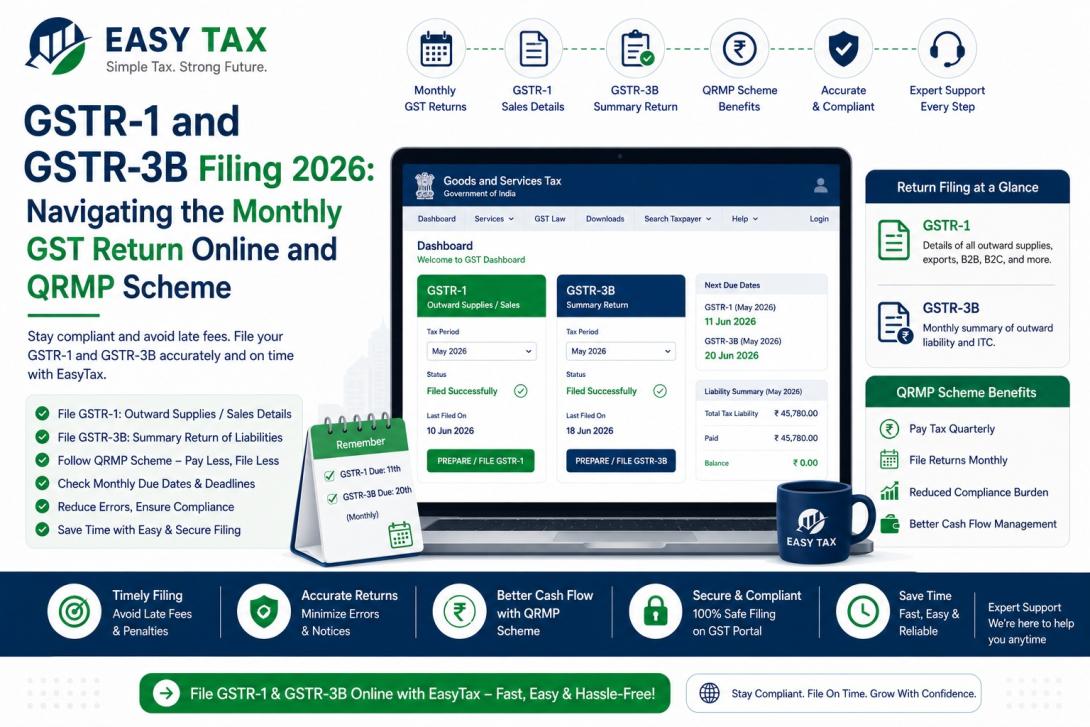
How to do Monthly GST Return Online and QRMP Scheme GSTR-1 and GSTR-3B Filing 2026?
In the 2026-27 Budget year, the GST regime in India has started from a flexible reporting system and now it has become a strict enforcement-driven regime with the support of technology. Filing of GST Return Online monthly is not just a routine process for a business; it is a process that is a part of their business. The consequences of having a single mistake in GSTR-1 and GSTR-3B Filing 2026 are more expensive than ever before, thanks to the new feature ‘Sequential Filing Locks' and the AI-powered validations.
This guide provides a step-by-step guide to ITC reconciliation, Quarterly Return Monthly Payment (QRMP) Scheme and other compliance issues.
When it comes to filing your returns, you have to decide between Monthly and QRMP.There are two filing tracks available, monthly versus QRMP.
The frequency of filing is according to the Aggregate Annual Turnover (AATO) of the previous financial year (2025-26).
Monthly Filing: If amount of AATO is more than ₹5 Crore, Monthly Filing is Mandatory. All these business entities will have to submit GSTR-1 and GSTR-3B on monthly basis.
Optional track for small taxpayers (for AATO ₹5 Crore). It enables the returns to be submitted quarterly and the tax payments are made online in Monthly GST Return Online by the 25th of the month via PMT-06 challan.
##The Core Duo:GSTR-1 and GSTR-3B Filing 2026
Due to enhancements made to the portal for the 2026 return it is now not possible to differentiate between the two returns.Now after the completion of the outward supplies (GSTR-1) process, a person has to file the summary return (3B) return.
GSTR-1 (Statement of Outward Supplies): Filed monthly along with the 11th of each month. The businesses with a turnover of more than ₹5 Crore will be able to auto-populate this form using e-Invoicing in 2026.
Everyone to file GSTR-3B on 20th of every month. You will be able to find your taxable income with your ITC in this section.
To know about the "No Match, No Credit" concept with respect to GSTR-2B and GSTR-3B Matching.
The most important changes in 2026 is that the portal has moved to zero tolerance policy for GSTR-2B vs GSTR-3B Matching. The best way to obtain credit is no longer "provisional".
This will be prepared monthly, on the 14th, and is called GSTR-2B (The Static Truth), which will be based on information provided by your suppliers.
Matching requirement: The requirement is that ITC claim reflected in GSTR-3B should match to that in GSTR-2B. If the ITC is self-declared more than the value of ITC, generated by the portal, an Automated Scrutiny Notice will be generated and in some cases, the person might not be able to generate E-Way bills.
## The Importance of ITC Reconciliation
Safeguard your Cash flow in 2026 with Effective Input Tax Credit (ITC) Reconciliation. There are a number of things that have to be remembered about it. For one thing, discrepancies cannot be avoided since “old” returns (those older than 3 years) are no longer accepted.
Maintain Vendor Management: Check vendors' filing status regularly. Removal of the credit will not be reflected in your GSTR-2B, if you do not timely file GSTR-1, and you will have to pay the tax out of your pocket.
On the portal: Accept, reject or leave an invoice "pending" in real time: Invoice Management System (IMS). This might help you ensure that only proper credits are credited to your GSTR 3B.
The GST Annual Return GSTR-9/9C is due for filing on a yearly basis.GST Annual Return GSTR-9/9C is an annual return to be filed annually.
Similar to the final exam at the end of the year, the GST Annual Return GSTR-9/9C is one that is completed periodically on a monthly / quarterly basis, but at the end of the day is one that determines the fate of the year.
GSTR-9: It is a consolidated return for all the monthly/quarterly returns for a whole Financial Year.For FY 2025-26, the deadline is December 31,2026.
GSTR-9C will be a self-certified recon statement for taxpayers with AATO of more than ₹5 Crore.It guarantees that there is consistency between your turnover and tax declared in your GST returns and your audited financial statements.
2026 Compliance Checklist - May 2026.The May 2026 Compliance Checklist provides a list of current compliance issues that are relevant to 2026 compliance.
Since there's already been a year and a half since you launched, just be sure your team has been working on the following first steps:
New Invoice Series: Make sure that you have started a new special invoice numbering for the new financial year 2026-27.
Exporters: Ensure that you submit your Letter of Undertaking (LUT) for FY 2026-27 to ensure that you continue to export without any tax implication.
Bank Verification: Make sure that your bank account is fully verified on the site, otherwise your accounting statements for June won't be filed.
## Conclusion
In 2026, the Monthly GST Return Online system will work on the principle of rewarding transparency and punishment delay. Disciplining GSTR-1 & GSTR-3B Filing 2026 and conducting a thorough GSTR-2B vs GSTR-3B Matching process help keep your business "audit-ready" all the time.
With automated late fees and permanent return blocking in this world, Input Tax Credit (ITC) Reconciliation isn't just an accounting exercise; it's the heart of your business's financial vitality. Make a habit of reconciling your GST Annual Return GSTR-9/9C now, don't wait till the December due date
