

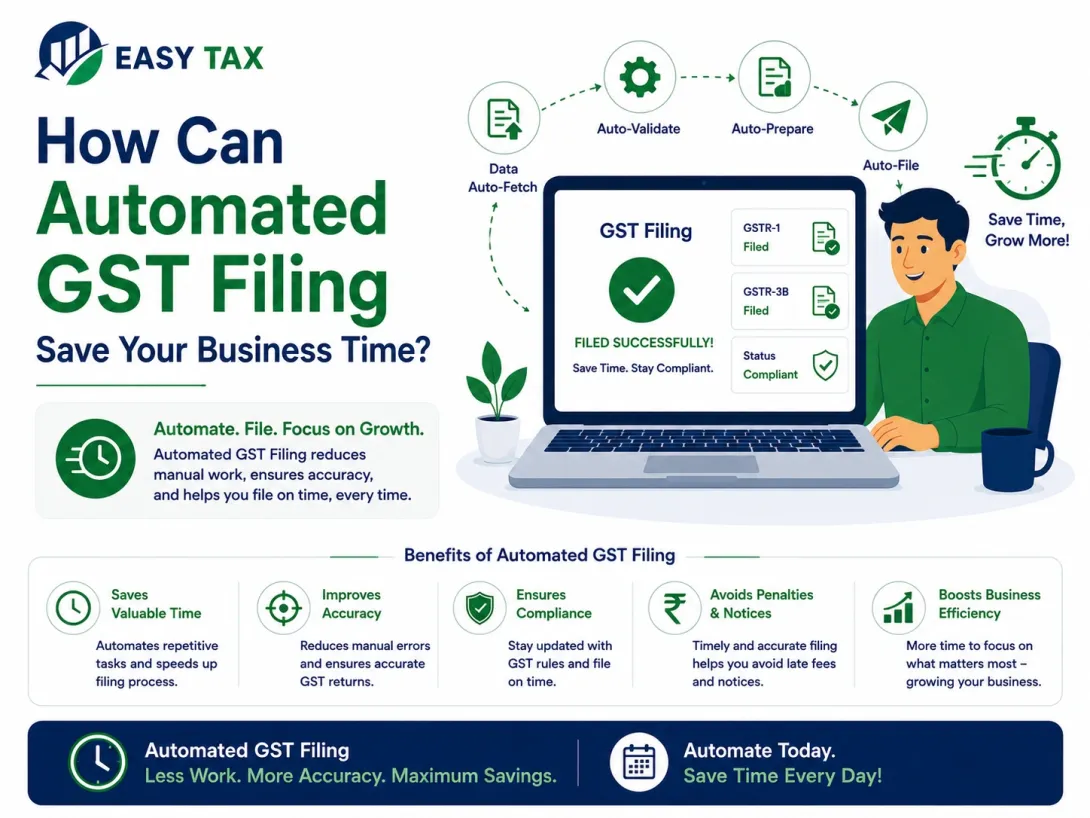
Yes, automated GST filing can significantly save your business time by reducing repetitive manual work involved in GST compliance. Instead of spending hours preparing returns, reconciling invoices, and checking tax calculations, automation tools handle most of these tasks automatically.
GST compliance has become an essential part of running a business in India. Whether you are a retailer, manufacturer, service provider, startup, freelancer, or e-commerce seller, timely and accurate GST return filing is critical for avoiding penalties and maintaining compliance.
This guide explains how GST filing automation works, its benefits, common challenges it solves, and how you can choose the right GST compliance software for your business.
What Is Automated GST Filing?
Automated GST filing is the use of software to simplify and automate GST return preparation and submission.
Automated GST filing eliminates many manual processes involved in GST compliance. It connects accounting data, invoices, purchase records, and GST returns into a single workflow.
GST (Goods and Services Tax) is an indirect tax applicable on the supply of goods and services in India. Businesses registered under GST must file periodic returns through the GST portal. Automation tools help generate return data automatically, reducing manual effort and improving accuracy.
How Does GST Filing Automation Work?
GST filing automation works by integrating your accounting data with GST compliance software.
Most GST automation tools connect directly with accounting systems, ERP software, billing applications, and spreadsheets. The software collects transaction data and prepares GST returns automatically.
A typical automation workflow includes:
- Import invoice data.
- Classify GST transactions.
- Reconcile purchase and sales records.
- Generate GST returns.
- Validate return data.
- File returns electronically.
This process significantly reduces the workload for business owners and accountants.
How Can Automated GST Filing Save Your Business Time?
Automated GST filing saves time by reducing repetitive compliance tasks.
Many businesses spend several hours every month preparing GST returns manually. Automation dramatically reduces this effort.
Ways Automation Saves Time:
- Automatic invoice imports
- Faster GST calculations
- Automated data validation
- Bulk transaction processing
- Real-time reconciliation
- Instant report generation
Example: A retail business processing 2,000 invoices monthly may spend several days preparing GST returns manually. By leveraging GST filing solutions in Jaipur or robust automation software, return preparation can be completed in a few hours.
What Are the Biggest Benefits of GST Filing Automation?
GST filing automation improves efficiency, accuracy, and compliance. Businesses benefit from automation in multiple ways.
Key Benefits:
- Reduced compliance workload
- Faster return filing
- Lower risk of penalties
- Improved data accuracy
- Better record management
- Easier audit preparation
- Reduced operational costs
Automation also allows business owners to focus on growth rather than paperwork.
How Does Automation Reduce GST Filing Errors?
Automation reduces errors by minimizing manual data entry and calculations.
Manual GST filing often leads to mistakes such as incorrect GST rates, duplicate entries, missing invoices, and reconciliation mismatches.
Automation software helps by:
- Validating GSTIN numbers
- Detecting duplicate invoices
- Matching purchase and sales records
- Identifying missing transactions
- Calculating taxes automatically
Reducing filing errors helps prevent notices and compliance issues.
Can Small Businesses Benefit from Automated GST Filing?
Yes, small businesses can benefit significantly from GST filing automation.
Many small businesses assume automation is only for large companies. In reality, modern GST compliance software is designed for businesses of all sizes.
Small Business Benefits:
- Saves administrative time
- Reduces dependency on manual spreadsheets
- Improves compliance management
- Simplifies return filing
- Supports business growth
A small service provider with limited accounting staff can automate compliance and focus on customer service.
Which GST Returns Can Be Automated?
Most commonly filed GST returns can be automated using GST software. GST return filing software can support multiple return types.
Common GST Returns:
- GSTR-1 (Outward Supply Return)
- GSTR-3B (Monthly Summary Return)
- GSTR-9 (Annual Return)
- GSTR-9C (Reconciliation Statement)
- E-Way Bill generation
- E-Invoicing compliance
The availability of specific features depends on the software provider.
What Features Should You Look for in GST Filing Software?
The right GST software should simplify compliance and improve accuracy. Before selecting software, evaluate its features carefully.
Essential Features Checklist:
- ✔️ GST return automation
- ✔️ Invoice reconciliation
- ✔️ GSTIN validation
- ✔️ E-invoicing support
- ✔️ E-way bill integration
- ✔️ Multi-user access
- ✔️ Data security controls
- ✔️ GSTN integration
- ✔️ Audit reports
- ✔️ Dashboard and analytics
How Does Automated GST Filing Improve Compliance?
Automation helps businesses comply with GST regulations consistently.
GST compliance requires timely filing, accurate reporting, and proper record keeping.
Automation supports compliance by:
- Sending filing reminders
- Monitoring due dates
- Maintaining audit trails
- Generating compliance reports
- Reducing missed filings
This helps businesses stay aligned with GST Act requirements and GSTN processes.
What Are Common GST Filing Challenges That Automation Solves?
Automation addresses many common GST compliance challenges. Businesses frequently encounter compliance issues due to manual processes.
Challenges Solved:
- Data entry errors
- Invoice mismatches
- Filing delays
- Missing records
- Complex reconciliations
- High compliance workload
Automation simplifies these tasks and improves overall efficiency.
Comparison: Manual vs Automated GST Filing
| Manual GST Filing | Automated GST Filing | Time Saved | Accuracy |
|---|---|---|---|
| Manual entry required | Automated data import | High | Higher |
| Time-consuming reconciliation | Automated reconciliation | Significant | Higher |
| Greater error risk | Automated validation | High | Better |
| Manual reminders | Automated alerts | Moderate | Better |
| Slow reporting | Real-time reporting | High | Higher |
How to Choose the Right GST Automation Tool?
The best GST automation tool depends on your business size and compliance needs. Before selecting software, assess your business requirements.
Selection Criteria:
- Business volume
- GST return requirements
- ERP compatibility
- Automation capabilities
- Customer support quality
- Security standards
- Pricing structure
Choose a solution that can scale as your business grows.
How to Implement GST Filing Automation for Your Business
Implementing GST automation requires proper planning and system integration.
Step-by-Step Process:
- Assess your GST filing workload.
- Select suitable GST software.
- Import historical data.
- Connect accounting systems.
- Configure GST settings.
- Train relevant staff.
- Test return generation.
- Monitor filing performance.
- Review compliance reports regularly.
Following these steps helps ensure a smooth transition.
Common Mistakes to Avoid
Avoiding implementation mistakes helps maximize automation benefits.
Common Mistakes:
- Choosing software without GSTN integration
- Ignoring staff training
- Failing to verify data imports
- Not reviewing generated returns
- Selecting tools based only on price
- Neglecting security requirements
Regular monitoring remains important even when automation is used.
Is Automated GST Filing Worth It in 2026?
Yes, automated GST filing is increasingly valuable for businesses in 2026.
As GST compliance requirements continue evolving—and keeping up with the latest GST news updates becomes crucial—automation helps businesses maintain accuracy and efficiency.
Businesses using automation typically experience:
- Faster return preparation
- Better compliance management
- Reduced filing errors
- Improved productivity
- Lower administrative burden
For growing businesses, GST filing automation can become an important operational advantage.
Frequently Asked Questions (FAQs)
Is automated GST filing legal in India?
Yes. Automated GST filing software is legal and widely used in India. Businesses remain responsible for ensuring the accuracy of submitted returns. The software simply assists with preparation and filing.
Can automation file GSTR-1 and GSTR-3B?
Yes. Most GST automation tools support GSTR-1 and GSTR-3B filing. For more detailed instructions on monthly summaries, you can refer to our GSTR-3B return filing guide. Many platforms also support annual returns and reconciliation processes.
Does GST software reduce filing mistakes?
Yes. Automation reduces manual data entry, validates information, and identifies inconsistencies before filing. This helps reduce common compliance errors.
What is the best GST filing software for small businesses?
The best software depends on business size, transaction volume, budget, and integration requirements. Features and support should be evaluated carefully before selection.
Can startups automate GST compliance?
Yes. Startups can benefit from automation from the beginning. It helps maintain compliance while allowing founders to focus on business growth.
How much time can GST automation save?
The amount varies by business size and transaction volume. Many businesses save several hours each month by automating reconciliation and return preparation tasks.
Is automated GST filing secure?
Most reputable GST compliance software providers use security measures such as encryption, user authentication, and secure data storage. Businesses should review security features before implementation.
Do I still need an accountant after GST automation?
Yes. Automation reduces routine work, but accountants still provide valuable expertise for tax planning, compliance reviews, audits, and complex GST matters.
Conclusion
Automated GST filing helps businesses save time, improve accuracy, reduce compliance workload, and strengthen GST compliance. By automating invoice management, reconciliation, tax calculations, and return filing, you can focus more on growing your business and less on administrative tasks.
Whether you run a startup, retail store, manufacturing unit, service business, or e-commerce operation, GST compliance automation can simplify your filing process and reduce the risk of costly mistakes.
If you're looking for expert guidance on GST compliance and automation, EasyTax can help you understand the right approach for your business while ensuring smooth and accurate GST return filing.
