How to Fill Form 121 Online for Bank FD
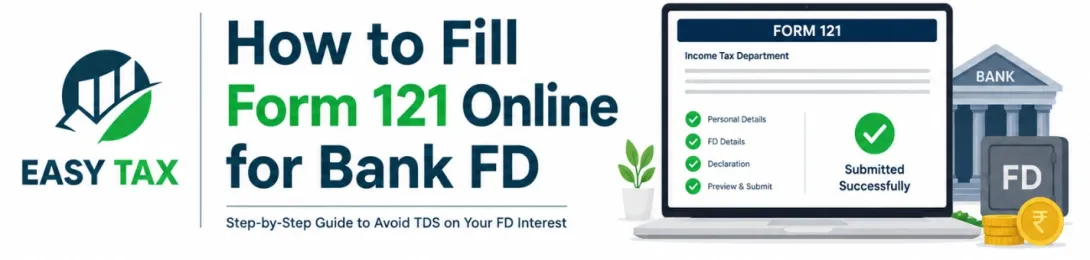
How to Submit Form 121 for Bank FD Interest
If you earn interest from a fixed deposit (FD), your bank may be required to deduct tax at source (TDS) when the applicable conditions are met. Eligible taxpayers may submit Form 121 to request non-deduction of TDS on specified income, including qualifying bank deposit interest.
Form 121 is the declaration prescribed unde For related tax guidance, visit EasyTax income-tax services and our expert-assisted ITR filing service.r section 393(6) of the Income-tax Act, 2025, read with Rule 211 of the Income-tax Rules, 2026. It replaces the earlier Forms 15G and 15H for declarations relating to a Tax Year beginning on or after 1 April 2026.
01 What is Form 121?
Form 121 is a self-declaration used by an eligible recipient of specified income to tell the payer that the tax on their estimated total income for the relevant Tax Year will be nil. Where the statutory conditions are satisfied, the payer may rely on the declaration and not deduct TDS on the specified payment.
For a bank FD holder, this declaration may be relevant to interest payable by a bank or co-operative bank. It is not a general application for a tax refund, a certificate of lower deduction, or a declaration that FD interest is always tax-free.
Form 121 and the earlier Forms 15G and 15H
| Earlier form | Broad earlier use | New form for Tax Year 2026–27 onward |
|---|---|---|
| Form 15G | Eligible declarants, including resident individuals below 60, subject to the prescribed conditions. | Form 121 |
| Form 15H | Eligible resident individuals aged 60 or above, subject to the prescribed conditions. |
The Department's FAQs explain that the earlier forms have been combined into Form 121 for the new framework. The eligibility conditions must still be checked; using one combined form does not mean that every taxpayer can submit it.
02 Who can submit Form 121?
The main test is not simply whether your FD interest is small. The declaration is based on your estimated total income for the Tax Year and the conditions applicable to your category of declarant.
For a person below 60 years of age and other eligible persons
The Form 121 guidance note states that:
- The tax on the declarant's estimated total income for the relevant Tax Year must be nil.
- The aggregate of the specified income or sums covered by the declaration must not exceed the maximum amount not chargeable to tax, as applicable to this category.
- The person and income must fall within the categories permitted under the relevant provision and form.
For a resident individual aged 60 years or more
- The tax on the person's estimated total income for the relevant Tax Year must be nil.
- The age-related eligibility treatment differs from the category applicable to persons below 60. Check the current Form 121 guidance and the full statutory conditions before submitting.
Who should not assume they are eligible?
- A person whose estimated tax liability for the Tax Year is not nil.
- A person whose income or status is outside the categories permitted by section 393(6) and the prescribed Form 121 conditions.
- A person who is unsure whether their total income or specified income meets the statutory tests.
Companies and firms should not assume that they can use Form 121. The Income Tax Department's FAQs describe the earlier eligible categories and say the eligibility criteria continue under section 393(6). Check the official guidance for the exact category before filing.
03 Does Form 121 apply to bank FD interest?
Yes. The official Form 121 guidance includes interest other than interest on securities paid by a banking company, co-operative bank or post office among the specified income categories.
This can include qualifying interest on a fixed deposit. The declaration is furnished to the payer responsible for paying the interest, such as the relevant bank.
What if you have FDs in more than one bank?
Treat each payer relationship separately when contacting the banks. Ask each bank how it accepts Form 121, how it records the declaration and how it handles the current UIN process. Do not assume that submitting a declaration to one bank automatically updates every other bank.
Keep a record of the declarations you submit and the acknowledgements provided by each bank. Also check the Department's latest UIN guidance, because its published FAQ and the March 2026 CBDT notification describe different aspects of the allocation process.
04 Details to keep ready before submitting Form 121
Review the current form and your bank's instructions before starting. The following details are useful to prepare:
- PAN: Your valid PAN, which must be quoted in Part A.
- Personal details: Name, address and contact details requested in the form.
- Residential status: Confirm the status relevant to the declaration.
- Age details: Information needed to establish whether the age-related eligibility condition applies.
- Tax Year: The Tax Year for which you are making the declaration.
- Income estimate: Details needed to estimate your total income for that Tax Year.
- FD interest information: Relevant deposit and interest details requested by the bank or form.
- Earlier declarations: Details of other relevant Form 121 declarations and specified income, where the form asks for them.
- Previous return information: Keep the prior Tax Year return details requested in the official form available.
A bank may request supporting information to verify the declaration. Follow that bank's current instructions. Do not upload identity or financial documents to an unofficial website.
05 How to submit Form 121 to your bank
Rule 211 permits Form 121 to be furnished electronically after due verification through an electronic process or in paper form. The actual customer-facing process can vary by bank.
01 Check your eligibility first
Estimate your total income for the Tax Year, including FD interest and other relevant income. Check the nil-tax condition and the applicable specified-income limit before making the declaration.
02 Identify the bank or payer
Identify the bank responsible for paying the FD interest. If you hold deposits with multiple banks, contact each bank about its submission process.
03 Open the bank's official channel
Use the bank's official internet banking portal, mobile application, branch or other channel specified by that bank. Look for its Form 121 or tax-declaration facility, if available.
If you cannot find the option, contact the bank through the phone number or support channel published on its official website. Do not assume every bank uses the same menu names or online screens.
04 Complete Part A of Form 121
Enter the requested personal, PAN, Tax Year, income and declaration details. Check the form carefully before submission. Your declaration must reflect your actual estimated total income and the applicable eligibility conditions.
05 Verify and submit the declaration
Complete the electronic verification required by the bank, or submit the paper declaration if the bank accepts that method. Follow the bank's instructions for identity or supporting-document verification.
06 Save the acknowledgement
Save the submission confirmation, acknowledgement or receipt provided by the bank. Note the date, Tax Year, bank and any reference number shown. Keep a copy of the submitted declaration for your records.
07 Check the bank's processing status
Confirm with the bank that it has received and processed the declaration. Ask whether it needs any further information and when the declaration will be considered for relevant interest payments.
06 Understanding Part A and Part B of Form 121
Form 121 involves both the person making the declaration and the payer receiving it. Understanding the difference helps avoid confusion about who must complete which part.
| Part | Who is responsible? | What it covers |
|---|---|---|
| Part A | Declarant / recipient of income | Personal details, PAN, relevant Tax Year, specified income and the declaration that the statutory nil-tax condition is satisfied. |
| Part B | Payer / deductor, such as the bank | Payer verification and reporting details relating to declarations received in Part A. |
The Income Tax Department's online User Manual explains the payer's e-filing workflow. It includes payer login using TAN, selecting Form 121, choosing the Tax Year and quarter, entering payer and declarant details, uploading the prescribed data file, reviewing the form and completing verification.
These are the payer's reporting steps. They should not be confused with the steps an individual FD holder follows on a bank's customer portal.
07 What is the UIN in Form 121?
UIN means Unique Identification Number. It is used to identify and track a Form 121 declaration in the reporting process.
Under Rule 211 and CBDT Notification No. 01/CPC(TDS)/2026, the payer allots a UIN to each declaration received and reports the relevant details under the prescribed process. The notification dated 28 March 2026 describes a 26-character format for the UIN.
If you submit declarations to more than one bank, ask each bank how it identifies your declaration and whether it retrieves or assigns the UIN under the currently implemented process. Keep the bank's confirmation with your acknowledgement.
08 Common mistakes to avoid when submitting Form 121
- Submitting without checking total income: Consider all relevant income, not just the interest from one FD.
- Assuming low FD interest automatically means eligibility: The nil-tax condition and other statutory conditions must be met.
- Entering an incorrect PAN: Check that your PAN is accurate and quoted as required.
- Selecting the wrong Tax Year: Confirm the Tax Year for which you are making the declaration.
- Waiting until after interest is credited: Submit in time and preferably before the relevant income is credited or paid.
- Assuming one bank submission covers all banks: Confirm the process separately with every relevant payer.
- Not saving proof of submission: Retain the acknowledgement and any bank reference number.
- Guessing the UIN: Let the payer or the applicable Department process handle UIN allocation or retrieval.
- Assuming Form 121 makes the interest tax-free: The declaration concerns TDS deduction. The underlying interest remains subject to the applicable income-tax rules.
09 Frequently asked questions about Form 121 for bank FD
01 Is Form 121 applicable to fixed deposit interest?
Yes. The official guidance includes specified interest paid by banking companies, co-operative banks and post offices. You must still satisfy the eligibility conditions under section 393(6).
02 Has Form 121 replaced Forms 15G and 15H?
For a Tax Year beginning on or after 1 April 2026, Form 121 is the prescribed declaration under the new Income-tax Rules, 2026. The Department describes it as the combined successor to the earlier Forms 15G and 15H.
03 Can I submit Form 121 online?
Rule 211 permits electronic submission after due verification through an electronic process. It also permits paper submission. The channel available to you depends on the bank or payer's current process.
04 Can a senior citizen submit Form 121?
A resident individual aged 60 years or more may be eligible if the nil-tax condition and the other applicable requirements are satisfied. Check the current Form 121 guidance before submitting.
05 Does Form 121 mean that FD interest is tax-free?
No. Form 121 is a declaration for non-deduction of TDS where statutory conditions are met. It does not, by itself, exempt the interest from being included in taxable income.
06 Should I submit Form 121 to every bank?
Contact each bank that pays you relevant interest and follow its submission process. Do not assume that a declaration submitted to one bank is automatically available to every other bank.
07 When should I submit Form 121?
The Department recommends submitting it before the income is credited or paid, preferably at the start of the Tax Year. Check the bank's processing time and do not wait until after the relevant payment.
08 Who assigns the UIN?
Rule 211 and CBDT Notification No. 01/CPC(TDS)/2026 describe payer allocation for each declaration. The Department FAQ also describes a consolidated UIN approach. Because the published descriptions differ, do not generate one yourself; confirm the current process with your bank.
09 What if the bank has already deducted TDS?
Submitting Form 121 after deduction does not automatically reverse the TDS. Check your tax records and claim eligible TDS credit or refund through the applicable income-tax return process, where permitted.
10 Where can I find the official Form 121 instructions?
Refer to the Income Tax Department's Form 121 User Manual, Income Tax Forms FAQs, the notified Income-tax Rules, 2026 and CBDT Notification No. 01/CPC(TDS)/2026. Official links are listed below.
10 Form 121 submission checklist
Before sending your declaration to the bank, check the following:
- ☐ I have checked the eligibility conditions for Form 121.
- ☐ I have estimated my total income for the correct Tax Year.
- ☐ I have included relevant income, not only one FD's interest.
- ☐ My PAN and personal details are correct.
- ☐ I have selected the correct Tax Year.
- ☐ I have followed the bank's official electronic or paper process.
- ☐ I have completed the required verification.
- ☐ I have saved the submission acknowledgement.
- ☐ I have checked whether the bank needs any further information.
Official sources and further reading
The following primary sources should be used to verify the current rules and filing process:
- Income Tax Department — Form 121 User Manual — payer portal workflow and submission guidance.
- Income Tax Department — Income Tax Forms FAQs — transition from Forms 15G/15H and the Department's UIN explanation.
- CBDT Notification No. 01/CPC(TDS)/2026 — UIN procedure and payer reporting, dated 28 March 2026.
- Income Tax Department — Form 121 Guidance Note — purpose, eligibility, income categories and form details.
- Income-tax Rules, 2026 — notified rules — Rule 211 and prescribed Form 121.
Always check the latest Department instructions and any subsequent amendments before relying on a tax procedure.
Need help understanding your tax declaration?
If you are unsure whether your estimated total income meets the Form 121 conditions, review your income details before submitting a declaration. EasyTax can help you understand your tax-related requirements and identify the appropriate next step.
Disclaimer: This article is for general educational information and is not individual tax advice. Form 121 eligibility depends on the applicable law, the declarant's status, estimated total income and the nature of the specified income. The official Department FAQ and the published UIN notification/manual contain differing descriptions of the UIN process. Confirm the current procedure with the payer or the Income Tax Department before filing. This article should be reviewed by a qualified tax professional before publication and whenever the law or official instructions change.
Was this guide helpful?
Related reading
Form 121 New TDS Declaration Form: 2026 Filing Guide
.et-form121 { --et-ink: #202b3c; --et-muted: #586579; --et-line: #dce3ec; --et-blue: #174ea6; --et-soft: #f3f7fc; max…
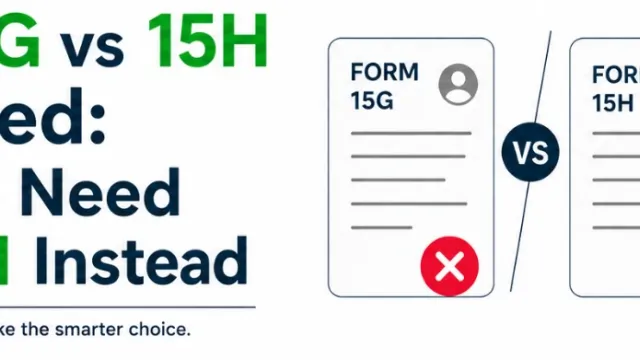
Form 15G vs 15H Explained: Why You Need Form 121 Instead
.et-form121-article { --et-ink: #172033; --et-muted: #5b6475; --et-border: #dce2ea; --et-soft: #f5f8fc; --et-link: …
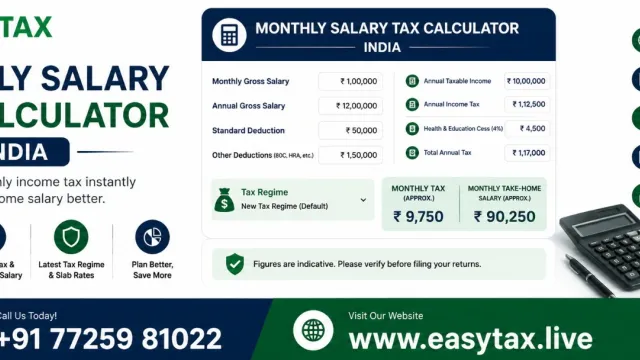
Monthly Salary Tax Calculator India
.et-salary-guide { --et-text: #172033; --et-muted: #5b6475; --et-border: #dce2ea; --et-soft: #f5f8fc; --et-link: …
Latest from the blog
SEO Agent connection test (temporary)
This is a temporary test post. It checks the connection between the EasyTax website and the SEO Agent publishing tool,…
Tax-Smart Tips for Salaried Employees: New Tax Regime
Tax-smart tips for salaried employees under the new tax regime: understand deductions, employer NPS, tax rebates,…
Tax-Smart Tips for Salaried Employees | EasyTax
Tax-smart tips for salaried employees under India’s new tax regime: compare deductions, employer NPS, rebates and…
EasyTax • Trusted by 10,000+ Clients
TDS Return Filing & Advisory
Quarterly TDS return preparation, 26AS reconciliation & error-free FVU generation with dedicated CA assistance.