

Quick Answer
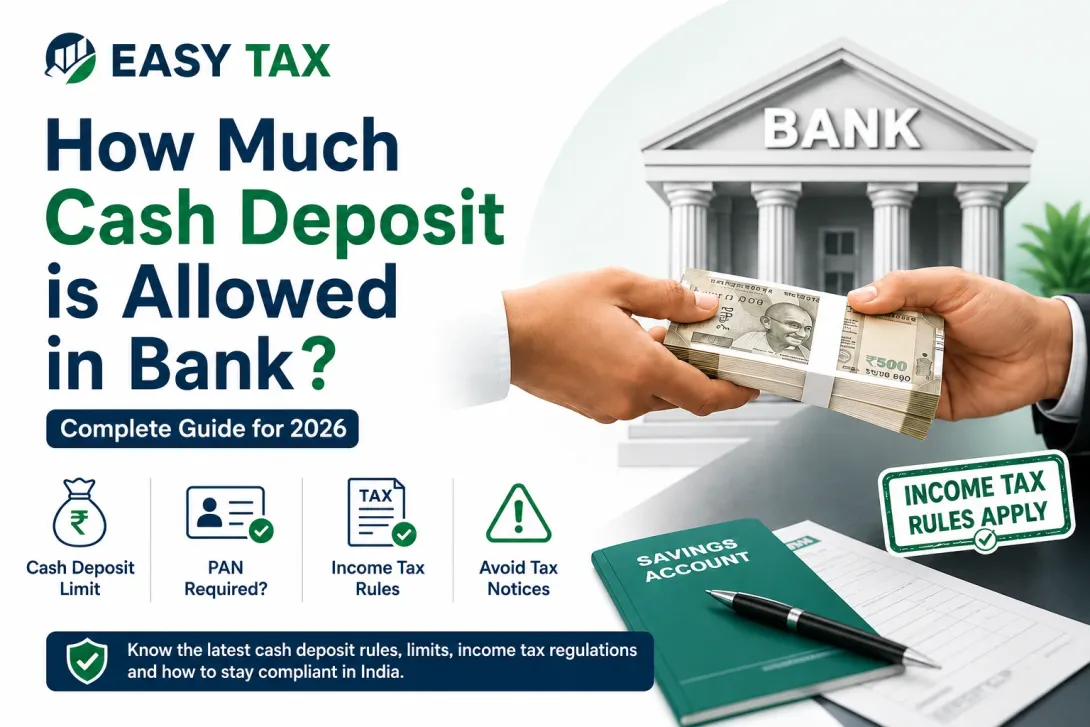
There is no fixed maximum limit on how much cash you can deposit in a bank account in India. However, banks may report large cash deposits to the Income Tax Department under reporting rules. Deposits above prescribed limits may require PAN verification and source proof.
Introduction
Cash deposits in Indian banks are allowed, but large or unusual deposits may attract attention from the Income Tax Department. Banks monitor high-value transactions and report certain deposits under income tax and RBI compliance rules.
Many taxpayers believe there is a strict cash deposit limit in India. In reality, the important factor is whether you can explain the source of the deposited money if questioned later.
Understanding the latest 2026 bank cash deposit rules can help you avoid notices, penalties, and unnecessary scrutiny from tax authorities.
How much cash deposit is allowed in bank in India?
The Income Tax Department tracks large financial transactions through SFT (Statement of Financial Transactions) reporting.
Transactions commonly monitored:
- Large savings account deposits
- Frequent business cash deposits
- Multiple branch deposits
- Deposits not matching filed ITRs
For example, if a salaried employee earning ₹6 lakh annually deposits ₹18 lakh cash into a savings account, the department may ask for source clarification.
What is the cash deposit limit in a savings account?
| Account Type | Reporting Threshold | Authority | Common Risk |
|---|---|---|---|
| Savings Account | ₹10 lakh yearly | Income Tax Department | Unexplained cash notice |
| Current Account | ₹50 lakh yearly | Income Tax Department | Business scrutiny |
| Fixed Deposit | Pattern based | Bank & Tax Department | Source verification |
Banks calculate deposits collectively across branches linked to the same PAN.
What is the cash deposit limit in a current account?
Current accounts are commonly used by:
- Retail shops
- Restaurants
- Traders
- Wholesalers
- Service providers
A grocery store owner in Delhi depositing ₹4 lakh monthly into a current account may not face issues if business turnover supports the deposits.
Common problems:
- GST turnover mismatch
- Underreported income
- Unusual cash deposits
- Low ITR income
Is PAN required for large cash deposits?
PAN (Permanent Account Number) is a unique 10-character tax identification number issued by the Income Tax Department.
Transactions where PAN may be required:
- Large cash deposits
- Fixed deposits
- Property purchases
- High-value banking transactions
Splitting deposits into smaller amounts usually does not avoid reporting because banks track linked transactions.
What are Section 269ST cash transaction rules?
Section 269ST applies when:
- Cash received from one person exceeds ₹2 lakh in a day
- A single transaction exceeds ₹2 lakh
- Related transactions together exceed ₹2 lakh
Example: A car dealer in Mumbai cannot accept ₹3 lakh cash for a vehicle sale.
Violations may attract penalties under Section 271DA.
Can large cash deposits trigger income tax notices?
Common notice triggers:
- Deposits much higher than annual income
- Frequent unexplained cash deposits
- Mismatch between GST and bank records
- Sudden large deposits
A freelancer in Bengaluru showing ₹4 lakh annual income but depositing ₹15 lakh cash regularly may receive clarification notices.
How can you safely deposit large cash amounts?
Best practices:
- Keep invoices and receipts safely
- Match deposits with ITR income
- Maintain GST records
- Avoid unnecessary cash transactions
- Deposit business cash regularly
- Respond quickly to notices
Proper bookkeeping is extremely important for cash-heavy businesses in India.
Which taxpayers face the highest scrutiny risk?
| Taxpayer Type | Main Risk | Common Issue | Key Solution |
|---|---|---|---|
| Salaried Employee | Income mismatch | Unexplained deposits | Maintain proof |
| Freelancer | Irregular cash flow | Unreported income | Bookkeeping |
| Shop Owner | GST mismatch | Underreported sales | Correct invoicing |
| Investor | Large sudden deposits | Source verification | Transaction records |
Frequently Asked Questions
How much cash can be deposited without PAN?
Banks may allow smaller deposits without PAN, but large deposits usually require PAN or Form 60. Repeated high-value deposits may still attract scrutiny.
Can I deposit ₹20 lakh cash in my savings account?
Yes, you can deposit ₹20 lakh cash if the source is genuine and documented. However, such deposits may be reported under SFT rules.
Is depositing cash taxable?
Cash deposits are not automatically taxable. Tax applies only if the deposited money represents unexplained or undeclared income.
What happens if deposits exceed ₹10 lakh?
Deposits above ₹10 lakh in savings accounts may be reported to the Income Tax Department. Legitimate deposits with proper proof usually do not create issues.
Can the Income Tax Department check my bank account?
Yes, the department can access reported financial transaction data linked to your PAN. High-value transactions may receive additional scrutiny.
Is there a daily cash deposit limit?
There is no universal legal daily deposit limit, but banks may set branch-level operational restrictions.
Can business owners deposit unlimited cash?
Business owners can deposit large cash amounts if transactions are genuine and supported by invoices, GST returns, and business records.
What documents help explain large cash deposits?
Invoices, property sale deeds, loan documents, agricultural income proof, gift deeds, and GST records help explain large cash deposits.
Conclusion
Large cash deposits are allowed in India, but the source of funds is more important than the amount itself.
Maintaining proper records, filing accurate ITRs, and matching deposits with declared income helps avoid notices and compliance issues.
If you need help understanding cash deposit rules or responding to income tax notices, EasyTax can help you with practical tax guidance and compliance support.
