

As the 2026 filing season approaches its peak, the Income Tax Act 2025's full-scale implementation is causing a stir in the Indian tax system. Individual taxpayers now approach their annual compliance in a completely different way thanks to this historic legislation that superseded the outdated 1961 Act.
With new rebates a restructured bracket system and a move toward a more streamlined digital economy the need for an accurate Income Tax Calculator FY 2025-2026 has never been greater.
Whether you are a freelancer in Mumbai, a tech entrepreneur in Bengaluru or a salaried professional in Jaipur the "standard" method of dealing with taxes has changed. A high-fidelity Tax Liability Calculator India is necessary to account for the details of the current assessment year and ensure you are not overpaying.
The Great Shift: Understanding the New Default
In 2026, the New Tax Regime is no longer just an alternative; it is the firmly established default. For the Assessment Year (AY) 2026-27, the government has aggressive incentives for those who choose simplicity over traditional deductions. However, the complexity lies in the "break-even point."
Every taxpayer today must run an Old vs New Tax Regime Calculator 2026 simulation before making a final commitment. Under the new law, the Section 87A rebate has been significantly enhanced. If your taxable income is up to ₹12 Lakh, your tax liability under the new regime is essentially nil. When you factor in the updated Standard Deduction of ₹75,000, individuals earning up to ₹12.75 Lakh can effectively walk away with zero tax liability.
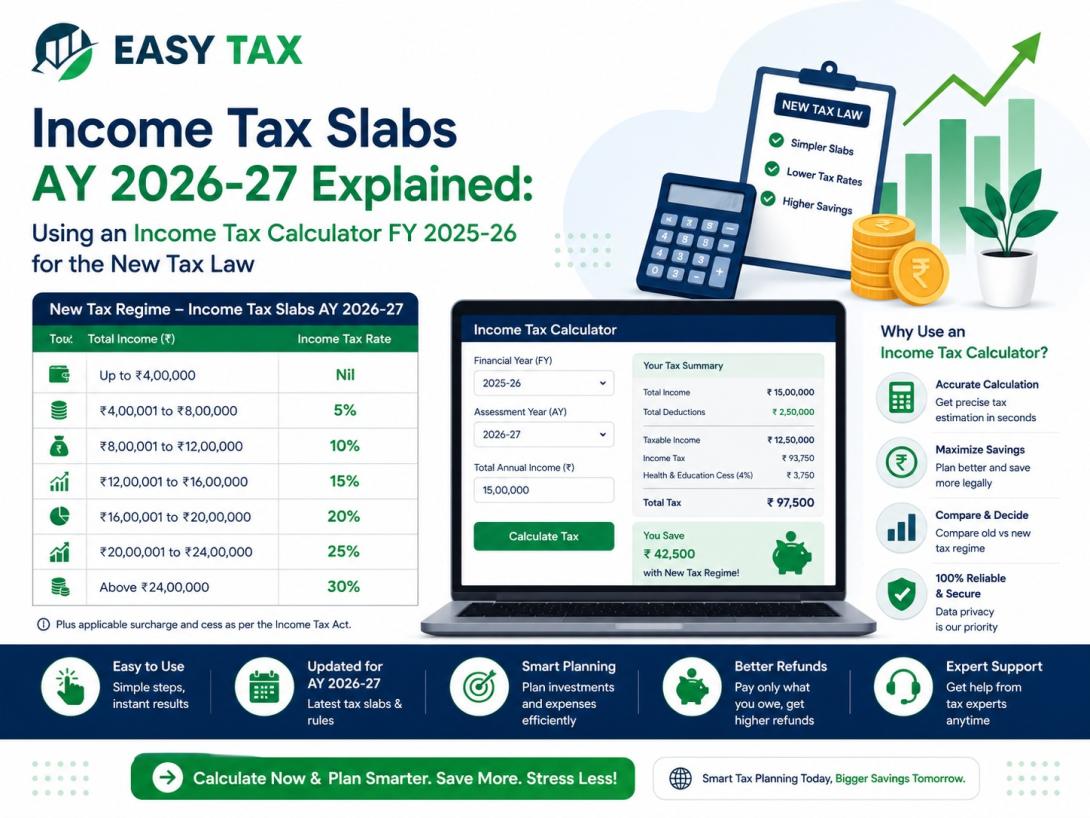
Breaking Down the Income Tax Slabs AY 2026-27
Before you can efficiently take advantage of any e-Filing Tax Calculator 2026, you will first need to determine where your income falls in the new progressive brackets! For the financial year 2023, slabs have been extended to provide inflation relief and keep a salary hike from immediately pushing you into higher tax category.
New Tax Regime Slabs (AY 2026-27):
| Income Range | Tax Rate |
|---|---|
| ₹0 – ₹4,00,000 | 0% (Nil) |
| ₹4,00,001 – ₹8,00,000 | 5% |
| ₹8,00,001 – ₹12,00,000 | 10% |
| ₹12,00,001 – ₹16,00,000 | 15% |
| ₹16,00,001 – ₹20,00,000 | 20% |
| ₹20,00,001 – ₹24,00,000 | 25% |
| Above ₹24,00,000 | 30% |
The majority of India urban middle class resides in the 10% and 15% slabs. When you enter your data in an Income Tax Calculator FY 2025-26, you can know exactly how much money is "leaking" away at every level of tax, and if you are just over the rebate limit then see just what marginal relief comes into play.
Old vs. New: The Battle of Deductions
Despite the simplicity of the new regime the old regime remains a fortress for those with significant financial commitments. If you are servicing a home loan, paying high premiums for life and health insurance,or contributing to a diverse range of 80C instruments, you must perform a side-by-side comparison.
A comprehensive Tax Liability Calculator India will ask you for:
- Section 80C: (PPF, ELSS, LIC, Home Loan Principal) – capped at ₹1.5 Lakh.
- Section 24(b): Home loan interest up to ₹2 Lakh.
- Section 80D: Health insurance premiums.
- HRA (House Rent Allowance): Vital for people residing in cosmopolitan cities with exorbitant rents.
Most of high-earners also say, that they deduct ₹4.25 Lakh annually & this is the tipping point for them.
The new regime is almost always better if your deductions are below this. The old regime may still be your best friend, if they are above.
Leveraging the e-Filing Tax Calculator 2026
The official e-Filing Tax Calculator 2026 on the Income Tax Department's portal has been upgraded with AI-driven pre-filling capabilities. It now pulls data directly from your Annual Information Statement (AIS) and Form 26AS. However, the portal's calculator is often a "final step" tool.
When planning proactively, follow up with a stand-alone Income Tax Calculator FY 2025-26 to:
- Variable Pay- Model the impact of a year-end bonus on your surcharge, and whether you qualify for marginal relief.
- Use the Capital Gains Planning: If you sold property or stocks last year, be sure to dive with the calculator into account capital gains calculation new unified rates under the 2025 Act.
- Review Surcharge Caps: The surcharge on high-income earners is more simplified; ensure that your calculator matches the current 25% cap.
Why May is the Critical Month for Planning
While the deadline is July 31st, waiting until the last minute is a recipe for error. By using an Old vs New Tax Regime Calculator 2026 today, you can:
- Re-declare to Payroll: If you realize you’ve chosen the wrong regime at the start of the fiscal year, some employers allow a mid-year correction, or you can at least plan your liquid cash for the eventual tax payout.
- Verify Bank Validation: The 2026 portal requires pre-validation of bank accounts for refunds. Checking this now ensures you aren't stuck when you finally file.
- Address Discrepancies: Running your numbers against the e-Filing Tax Calculator 2026 early helps you spot mismatches between your records and the AIS before they become legal notices.
Conclusion
The introduction of the Income Tax Act 2025 has successfully reduced the tax burden for millions, but it has increased the importance of making an informed choice. You are no longer just a "taxpayer";you are a financial manager.
Keeping up with the Income Tax Slabs AY 2026-27 along with constantly using a precision Income Tax Calculator FY 2025-26 ensures that your money remains yours and not with the Government. Be it the old regime that favours deductions, or the new one which is leaner and offers rebates, decide based on data. Take your time spend 10 mins with Tax Liability Calculator India today; it could be best earned 10 mins of your life.
