

Income Tax Around the World: Who Pays Income Tax and Why It Varies (2026 Guide)
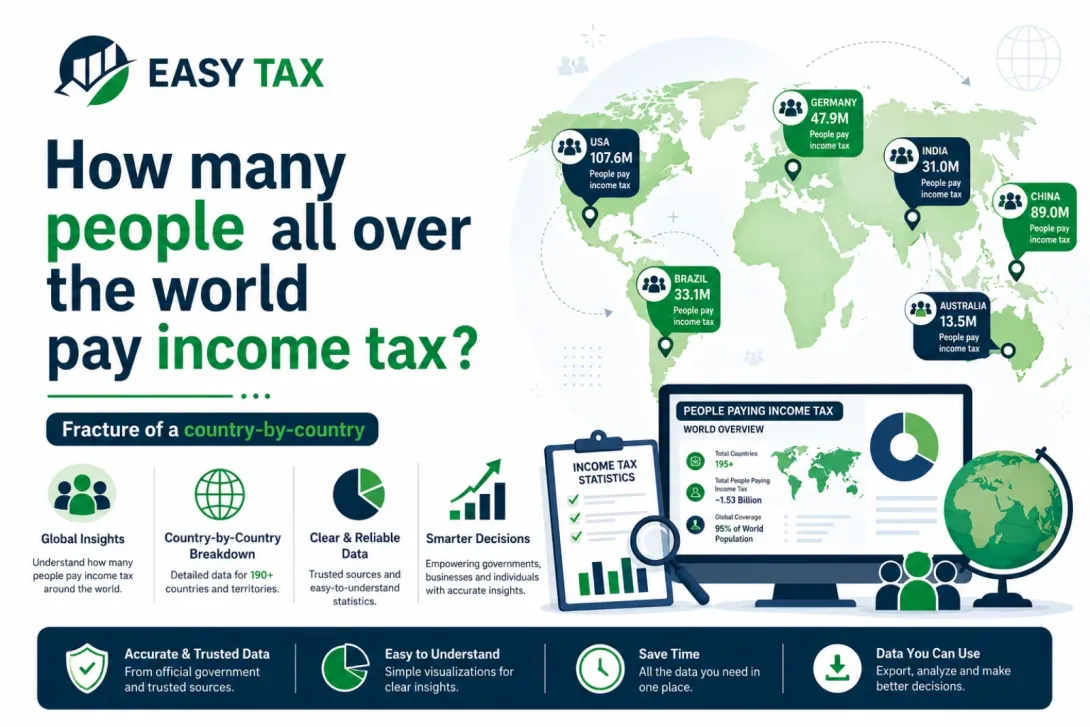
Income tax systems differ significantly across countries based on economic structure, government policies, employment patterns, and income levels. While developed countries generally have a higher percentage of taxpayers, developing economies like India have a relatively smaller taxpayer base due to structural and demographic factors. In some countries such as the UAE, there is no personal income tax at all.
This article explains how many people pay income tax in major countries and the key reasons behind these differences.
Global Overview of Income Tax Participation
- India: ~6–7% of population files income tax returns
- Germany: ~50% of population pays income tax
- France: ~43% pays income tax
- United Kingdom: ~60% pays income tax
- United States: ~56% pays federal income tax
- United Arab Emirates (UAE): 0% personal income tax
India has a population of over 1.4 billion, but only a small portion contributes to income tax.
Key reasons for low taxpayer base:
- Large informal economy
- Agricultural income exemption
- High exemption threshold for individuals
- Lower average taxable income levels
Most tax collection in India also comes from indirect taxes like GST, corporate tax, and TDS deductions.
Key insight: Only around 6–7% of Indians file income tax returns, but this number is gradually increasing due to digital tracking systems (AIS, PAN linking), GST-based financial monitoring, and expansion of formal employment.
Income Tax in Germany
Germany has a highly structured and compliance-driven tax system.
Key highlights:
- Around 50% of the population pays income tax
- Progressive tax system (higher income = higher tax rate)
- Strong social security funding through taxes
Most salaried individuals pay taxes automatically through payroll systems.
France follows a progressive taxation system combined with social contributions.
Key highlights:
- Around 43% of the population pays income tax
- High social security contributions included
- Middle-income tax relief reforms in recent years
Tax burden is shared between income tax and social charges.
Income Tax in United Kingdom
The UK has a structured tax system with strong compliance mechanisms.
Key highlights:
- Around 60% of the population pays income tax
- Tax-free allowance for low-income earners
- National Insurance contributions fund public services
A large portion of tax is automatically deducted from salaries.
The United States has a complex federal and state tax structure.
Key highlights:
- Around 56% of the population pays federal income tax
- Some states do not impose income tax
- Multiple deductions, credits, and exemptions affect liability
Taxation varies significantly depending on income, state laws, and filing status.
Income Tax in United Arab Emirates
The UAE does not impose personal income tax on individuals.
Revenue sources include:
- Value Added Tax (VAT)
- Corporate tax (on selected sectors)
- Government fees and oil revenue
This tax-free structure attracts global professionals and investors.
Why Income Tax Participation Differs Across Countries
Income tax rates vary globally due to several factors:
- Economic structure
Countries with large formal employment sectors have higher tax compliance. - Government revenue models
Some countries rely heavily on income tax (USA, UK, Germany), while others depend on indirect taxes (India, UAE). - Income levels and thresholds
Higher exemption limits reduce the number of taxpayers. - Size of informal economy
Larger informal sectors result in fewer registered taxpayers. - Tax collection systems
Automatic payroll systems increase compliance in developed countries.
Key Takeaways
- Developed countries generally have higher income tax participation
- India has a low taxpayer base but is steadily increasing compliance
- UAE has no personal income tax system
- Digital tracking is increasing global tax compliance
- Tax structures depend heavily on each country’s economic model
Frequently Asked Questions
Why do so few people pay income tax in India?
Because of the large informal economy, agricultural exemptions, and relatively high income thresholds.
Which country has the highest income tax participation?
Countries like the United Kingdom and Germany have high participation due to structured payroll systems.
Why does UAE not have income tax?
UAE generates revenue through VAT, corporate tax, oil income, and government fees instead of personal income tax.
Is global tax compliance increasing?
Yes, digital monitoring systems are improving tax compliance worldwide.
Conclusion
Income tax participation varies widely across countries based on economic structure, government policies, and income distribution. While developed nations like Germany, the United Kingdom, and the United States have higher taxpayer participation, countries like India are still expanding their tax base. Meanwhile, the UAE remains unique with a zero personal income tax system.
Understanding these differences helps in analyzing global economic systems and taxation policies more effectively.
