
New Income Tax Slab in India for 2025–26: Complete Guide to Tax Rates, Benefits & Smart Tax Planning
Income tax rules in India are updated periodically to improve compliance and provide relief to taxpayers. For the financial year 2025–26, understanding the new income tax slab structure is extremely important for proper financial planning.
Whether you are a salaried employee, senior citizen, or self-employed professional, choosing the right tax regime and understanding slab rates can help you save significant tax legally.
In this detailed guide, we will explain:
- New income tax slabs for 2025–26
- Old vs new tax regime differences
- Key changes introduced
- Tax-saving strategies
- How professional services like Easy Tax help you optimize tax liability
What is Income Tax Slab System?
Income tax in India is calculated based on income slabs, meaning different portions of income are taxed at different rates.
Higher income = higher tax rate
Lower income = lower or zero tax
The government provides different slab structures for:
- Individuals below 60 years
- Senior citizens (60–80 years)
- Super senior citizens (80+ years)
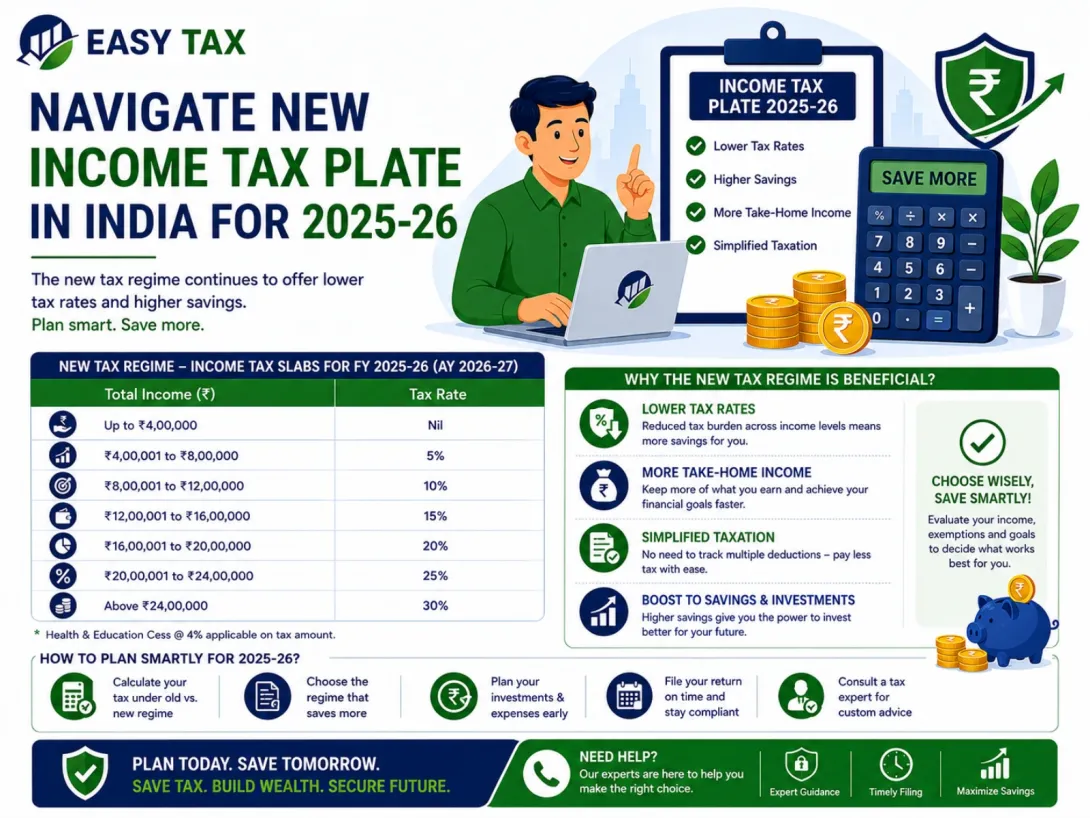
New Income Tax Slabs for 2025–26 (New Tax Regime)
The new tax regime is designed with lower rates but fewer exemptions.
🔹 For Individuals Below 60 Years
- Up to ₹3,00,000 → No Tax
- ₹3,00,001 to ₹6,00,000 → 5%
- ₹6,00,001 to ₹9,00,000 → 10%
- ₹9,00,001 to ₹12,00,000 → 15%
- ₹12,00,001 to ₹15,00,000 → 20%
- Above ₹15,00,000 → 30%
🔹 For Senior Citizens (60 to 80 Years)
- Up to ₹3,00,000 → No Tax
- ₹3,00,001 to ₹6,00,000 → 5%
- ₹6,00,001 to ₹9,00,000 → 10%
- ₹9,00,001 to ₹12,00,000 → 15%
- ₹12,00,001 to ₹15,00,000 → 20%
- Above ₹15,00,000 → 30%
🔹 For Super Senior Citizens (Above 80 Years)
- Up to ₹5,00,000 → No Tax
- ₹5,00,001 to ₹10,00,000 → 20%
- Above ₹10,00,000 → 30%
Key Features of New Tax Regime 2025–26
1. Higher Basic Exemption Limit
The government has increased relief for lower-income groups:
- Up to ₹3,00,000 income is tax-free (general category)
This helps reduce tax burden for middle-class taxpayers.
2. Simplified Tax Structure
The new regime removes multiple deductions and simplifies taxation.
✔ No complicated exemptions
✔ Easy calculation
✔ Transparent system
3. Standard Deduction Benefit
Salary earners get:
- ₹50,000 standard deduction (as applicable)
This reduces taxable salary automatically.
4. Lower Tax Rates
Compared to the old regime:
- Lower slab rates
- Reduced compliance burden
- Simplified tax planning
Old Tax Regime vs New Tax Regime
Feature
Old Regime
New Regime
Tax Rates
Higher
Lower
Deductions
Available
Limited
Complexity
High
Simple
Best For
Investors
Salaried with low deductions
Which Tax Regime Should You Choose?
Choosing the right regime depends on your financial situation.
✔ Choose Old Regime if:
- You invest in 80C (PPF, ELSS, LIC)
- You claim HRA
- You have home loan interest
- You want maximum deductions
✔ Choose New Regime if:
- You have fewer investments
- You want simple tax filing
- You do not claim many exemptions
Major Tax Changes for 2025–26
1. Increased Exemption Limit
Income up to ₹3,00,000 is now tax-free for most taxpayers.
2. Standard Deduction Continuation
Salaried individuals continue to benefit from ₹50,000 deduction.
3. Reduced Dependence on Deductions
The new regime reduces dependency on:
- 80C
- 80D
- HRA claims
4. Simplified Filing Process
Tax filing becomes faster and more transparent under the new system.
How to Reduce Tax Liability in 2025–26
Even in the new regime, smart planning helps reduce taxes legally.
✔ 1. Plan Your Salary Structure
Optimize components like allowances and bonuses.
✔ 2. Use Eligible Deductions
If using old regime:
- 80C investments
- Health insurance (80D)
- Home loan benefits
✔ 3. Invest in Tax-Saving Instruments
- ELSS mutual funds
- PPF
- NPS (National Pension System)
✔ 4. Compare Both Regimes Every Year
Tax planning is not one-time—it should be reviewed annually.
✔ 5. Take Expert Guidance
Professional consultation helps maximize savings.
Role of Easy Tax in Tax Planning
Easy Tax provides expert tax consultancy services to help individuals and businesses:
✔ Choose the best tax regime
✔ File accurate income tax returns
✔ Maximize deductions legally
✔ Avoid penalties and errors
✔ Plan long-term tax savings
With expert support, taxpayers can make smarter financial decisions and reduce tax burden effectively.
Common Mistakes Taxpayers Should Avoid
- Ignoring regime comparison
- Choosing wrong slab interpretation
- Not updating salary structure
- Missing tax-saving investments
- Filing returns late
Benefits of Understanding Tax Slabs
Knowing income tax slabs helps you:
- Plan investments better
- Reduce unnecessary tax payments
- Improve financial discipline
- Increase long-term savings
Frequently Asked Questions (FAQs)
1. What is the income tax slab for 2025–26?
It depends on your age and regime, starting from 0% to 30%.
2. Which is better: old or new tax regime?
It depends on your deductions and investments.
3. Is income up to ₹3 lakh tax-free?
Yes, under the new regime for most individuals.
4. Is standard deduction available?
Yes, ₹50,000 for salaried individuals.
5. Can I switch regimes every year?
Yes, salaried individuals can choose each financial year.
Conclusion
The Income Tax Slab for 2025–26 brings simplicity, flexibility, and reduced tax burden for many taxpayers. While the new tax regime offers lower rates, the old regime still benefits those with multiple deductions.
Smart tax planning is the key to maximizing savings and reducing financial stress.
By understanding slab rates and choosing the right regime, you can significantly improve your financial efficiency.
For expert tax planning and filing assistance, Easy Tax helps you make the right decisions and stay fully compliant with confidence.
