

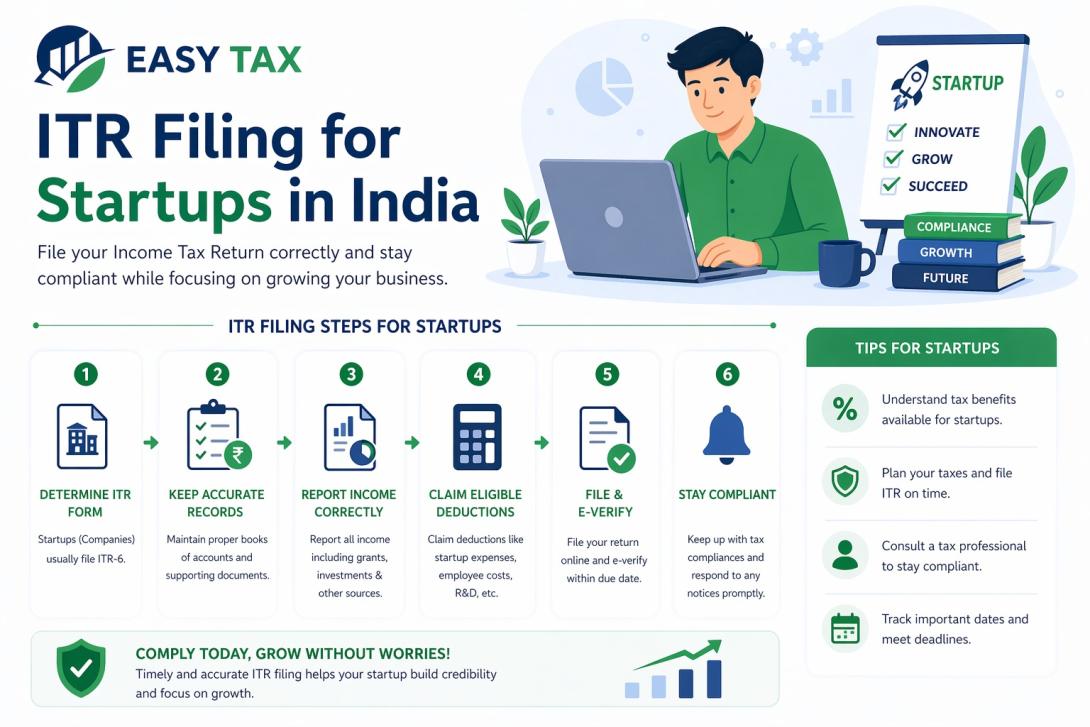
Starting up a business in India is a task full of responsibilities and ITR filing is one of the most critical. Regardless of the stage of your startup or the amount of revenue it makes, it is imperative to submit your Income Tax Return on time, otherwise you risk falling out of compliance with the law, and be penalized.
This guide will discuss the process of filling the ITR, the correct ITR form and some of the most important aspects a startup should consider when filling the ITR 2025.
ITR filing of startups implies filing incomes, expenses, and taxes of your business with Income Tax Department. Although your startup is not profitable, you should still file your return in most instances.
The varieties of startups in India might include:
Sole proprietorship
Partnership firm
LLP (Limited Liability Partnership)
Private Limited Company
There are various rules and ITR forms in each structure.
Reasons why ITR Filing matters to Startups.
Compliance is not the only purpose of filling your ITR, it also contributes to the smooth growth of your business.
Key benefits:
Escape punishment and lawsuits.
Take losses and carry forward.
Build financial credibility
Loans and funding required.
Periodical ITR filing of startups demonstrates that your company is transparent and reliable.
It is crucial to select the right ITR form. Entrepreneurs must be careful about using the incorrect form as it may be rejected or put on hold.
Common ITR Forms:
ITR-3 → In case of proprietors and freelancers whose business incomes are available.
ITR-5 → To LLPs and partnership firms.
ITR-6 → To limited companies that are in the private sector.
There is always a form that you have to choose depending on your business structure.
ITR Filing Process of Startups.
It can be a lot easier when one knows the ITR filing process. Do the following steps:
1. Collect Financial Documents
Profit & Loss statement
Balance sheet
Bank statements
GST returns (where applicable
2. Calculate Total Income
Include:
Business income
Other revenue (interest, investments)
3. Select the proper ITR Form.
Pick the appropriate ITR form depending on your type of startup.
4. File Return Online
Visit the income tax site and complete all the information.
5. Verify Your ITR
Check your return with:
Aadhaar OTP
Net banking
Digital signature (to companies)
Mistakes in ITR Filing of Startups.
Numerous startups commit preventable mistakes when submitting ITR.
Avoid these mistakes:
Wrongly selected ITR form.
Failing to report all income.
Mistakes in costs or allowances.
Failure to check the return.
Missing the deadline
Such errors may result in warnings or fines.
ITR Fill 2025: 5th things to keep in mind.
The startups should remember the following when filing ITR 2025:
Keep good accounting books.
Reconcile GST and income information.
Check Form AIS and 26AS.
Submit within time.
Seek advice of a tax expert where necessary.
Premeditated planning makes it an easy process.
Your startup may or may not need an audit, and this determines your due date.
Without audit → Typically 31 st July.
With audit → Typically 31st October.
Late submission will result in penalties and interest charges.
Startups in India do not have a complex ITR filing when done properly. The trick is to remain systematic, select appropriate ITR form and adhere to the correct process of filling the ITR.
To file ITR 2025, ensure you do it in time, prevent the most frequent errors and maintain the accuracy of your financial records. This will both keep you accountable and help give your startup the confidence it needs to succeed.
If you have any question regarding each step, attend help to a professional rather than afraid it fallacious.
