

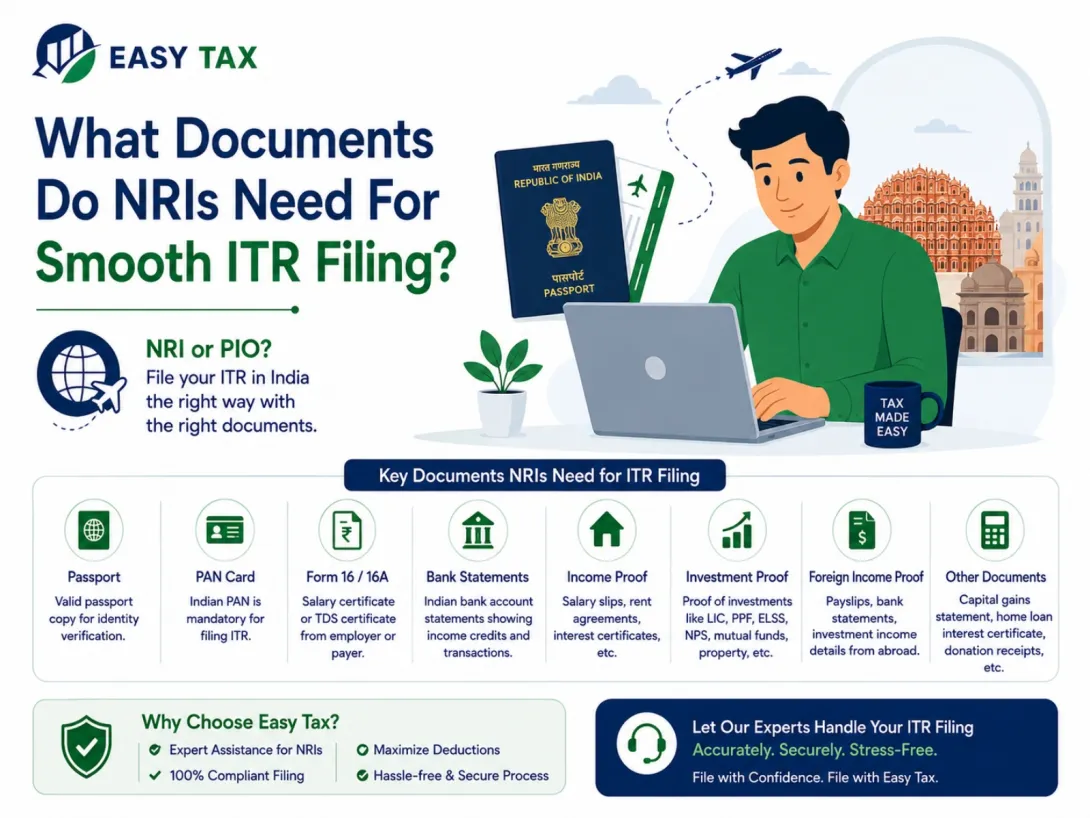
What Documents Do NRIs Need for Smooth ITR Filing in India? Complete NRI Tax Guide
Non-Resident Indians (NRIs) often face unique tax filing requirements when they earn income in India. Whether you receive rental income, interest from bank accounts, capital gains from investments, or income from other Indian sources, filing your Income Tax Return (ITR) correctly is essential for maintaining compliance and avoiding future tax issues.
Many NRIs are unsure about which documents are required, what income is taxable in India, and how to claim available tax benefits. Preparing the right documents before filing can make the process much smoother and help ensure accurate reporting.
This guide explains the key documents NRIs need for ITR filing, common tax rules, available deductions, and practical tips for hassle-free compliance.
Who Is Considered an NRI for Tax Purposes?
Your residential status determines how your income is taxed in India.
Generally, an individual is treated as an NRI if they do not satisfy the prescribed residency conditions under the Income Tax Act. Since taxability depends on residential status, determining whether you qualify as an NRI is one of the first steps before filing your return.
Is ITR Filing Mandatory for NRIs?
An NRI may need to file an Income Tax Return in India if:
- Taxable income exceeds the applicable threshold.
- They wish to claim a tax refund.
- TDS has been deducted and a refund is due.
- They have earned rental income from property in India.
- They have capital gains from shares, mutual funds, or property.
- They need income proof for loans, visas, or financial transactions.
Even when filing is not mandatory, many NRIs choose to file returns to maintain financial records and claim refunds.
Essential Documents Required for NRI ITR Filing
Preparing your documents in advance helps avoid delays and errors during filing.
Passport
A passport serves as important proof of overseas residence and helps establish NRI status.
Tax professionals often review passport details to verify travel history and determine residential status correctly.
PAN Card
A Permanent Account Number (PAN) is mandatory for filing an Income Tax Return in India.
Without a valid PAN, tax compliance and refund processing can become difficult.
Aadhaar (If Applicable)
Depending on eligibility and regulatory requirements, some taxpayers may also need Aadhaar-related information for compliance purposes.
Bank Statements
Bank statements provide a complete record of financial transactions and help verify income received during the financial year.
These may include:
- NRE account transactions
- NRO account transactions
- Savings account interest
- Fixed deposit interest
Income Proof
Income documents vary depending on the source of earnings.
Examples include:
- Salary slips
- Employment contracts
- Foreign income statements
- Consultancy income records
- Professional receipts
Accurate reporting of income is essential for proper tax calculation.
Rental Income Documents
If you own property in India and earn rental income, keep records such as:
- Rent agreements
- Rental receipts
- Property tax payment receipts
- Home loan interest certificates
These documents help calculate taxable rental income and eligible deductions.
Investment Proofs
NRIs who invest in India should maintain records of:
- Mutual funds
- Shares and securities
- Fixed deposits
- Government bonds
- Tax-saving investments
These documents are useful for reporting capital gains and claiming deductions.
Form 26AS
Form 26AS provides details of taxes deducted and deposited against your PAN.
It helps verify:
- TDS deductions
- Advance tax payments
- Tax credits
Reviewing Form 26AS before filing is highly recommended.
Annual Information Statement (AIS)
AIS provides a broader summary of financial transactions reported to the Income Tax Department.
This includes:
- Interest income
- Dividend income
- Securities transactions
- Property transactions
Matching your return with AIS data can reduce the likelihood of notices.
Income Taxable for NRIs in India
Not all income earned by NRIs is taxable in India.
Generally, income earned or accrued in India may be taxable.
Common examples include:
Rental Income
Income earned from property located in India is generally taxable.
Capital Gains
Profits from the sale of:
- Real estate
- Shares
- Mutual funds
may attract capital gains tax.
Interest Income
Interest earned on certain bank accounts and deposits may be taxable depending on the account type and applicable provisions.
Business or Professional Income
Income earned through business operations or professional activities carried out in India may also be taxable.
NRI Income Tax Exemptions and Deductions
NRIs can often claim various deductions under the Income Tax Act.
Common deductions may include:
Section 80C Benefits
Eligible investments may qualify for deductions under Section 80C.
Examples include:
- Life insurance premiums
- ELSS investments
- Principal repayment of home loans
Home Loan Benefits
NRIs may claim eligible deductions on home loan interest and principal repayments, subject to applicable conditions.
Other Eligible Deductions
Additional deductions may be available for:
- Health insurance premiums
- Education loan interest
- Certain donations
Professional guidance can help identify all available benefits.
Understanding NRI Rental Income Tax Rules
Rental income is one of the most common sources of income for NRIs in India.
Key points include:
- Rental income must generally be reported in the ITR.
- Certain deductions may be available.
- TDS provisions may apply.
- Proper documentation should be maintained.
Accurate reporting helps avoid future disputes and compliance issues.
Double Taxation Avoidance Agreement (DTAA)
Many NRIs worry about paying tax twice on the same income.
India has Double Taxation Avoidance Agreements (DTAAs) with several countries.
These agreements help taxpayers:
- Avoid double taxation
- Claim foreign tax credits
- Determine taxing rights between countries
Understanding DTAA provisions can significantly reduce tax burdens.
Common Mistakes NRIs Make During ITR Filing
Many tax notices arise due to avoidable mistakes.
Common errors include:
- Incorrect residential status declaration
- Failure to report rental income
- Ignoring capital gains transactions
- Not reviewing Form 26AS
- Missing TDS credits
- Incorrect bank account details
- Failing to claim eligible deductions
Professional review can help prevent these issues.
Why Professional Assistance Matters
NRI taxation involves multiple compliance requirements that differ from those applicable to resident taxpayers.
Professional assistance can help with:
- Residential status determination
- Income classification
- Tax calculations
- Deduction claims
- DTAA benefits
- Refund claims
- Notice handling
This reduces the risk of errors and helps ensure accurate filing.
Why Choose EasyTax for NRI ITR Filing?
EasyTax provides specialized support for NRIs looking to file their Income Tax Returns in India.
Our services include:
- NRI tax consultation
- Income tax return filing
- Rental income taxation assistance
- Capital gains reporting
- DTAA guidance
- Refund assistance
- Tax notice support
Our experienced professionals help NRIs navigate tax regulations while ensuring compliance and maximizing eligible benefits.
Conclusion
Proper documentation is the foundation of smooth NRI ITR filing. By keeping records such as your passport, PAN card, bank statements, income proofs, investment documents, Form 26AS, and AIS, you can simplify the filing process and reduce the chances of errors.
Since NRI taxation often involves rental income, capital gains, foreign income considerations, and DTAA provisions, professional guidance can be valuable. With the right preparation and expert support from EasyTax, NRIs can file their returns confidently, remain compliant with Indian tax laws, and make the most of available tax benefits.
