

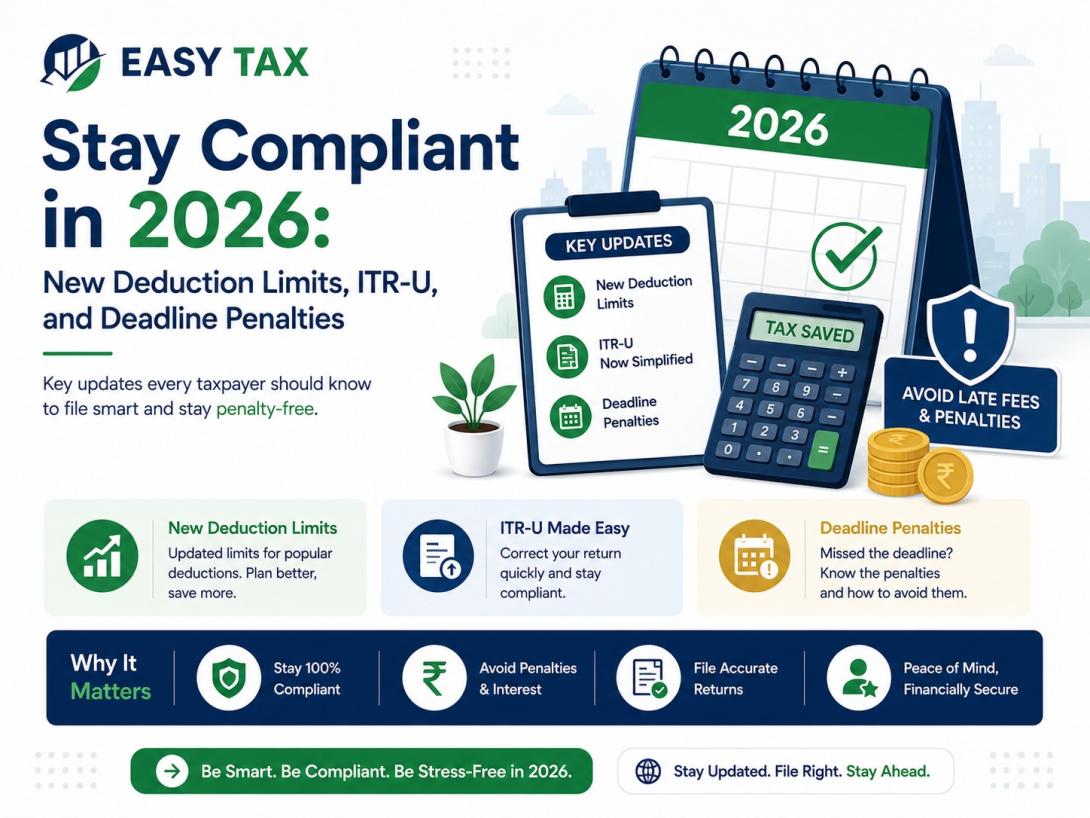
Stay Compliant in 2026: New Deduction Limits, ITR-U, and Deadline Penalties
The Indian fiscal landscape has undergone a monumental shift. With the discontinuing of the six-decade-old 1961 Act the Income Tax Act 2025 and the accompanying Income Tax Rules 2026 are now the law of the land. For taxpayers navigating Tax Year 2026-27 filing the environment is designed for digital-first compliance but it carries sharper consequences for those who miss the mark.
Whether you are a salaried professional or a freelancer, staying ahead of the new deduction limits 2026 and understanding the safety net of ITR-U (Updated Return) online filing is no longer optional—it is a financial necessity.
The New Era: Income Tax Act 2025 Filing Rules
One of the most significant structural changes in the new Act is the replacement of the confusing "Assessment Year" and "Previous Year" system with a unified Tax Year.Under the new rules the year you earn the income is the same year you report it simplifying the timeline for millions.
The Income Tax Act 2025 filing rules also emphasize digital transparency. The traditional Form 16 has been renamed to Form 130, and the familiar Form 26AS is now Form 168. These documents are more comprehensive than ever, pulling data from the Annual Information Statement (AIS) to ensure that your reported income matches the government’s records in real-time.
Maximizing the New Deduction Limits 2026
The government continues to push the New Tax Regime as the default option, making it more attractive through a significant overhaul of exemptions. Here is how the limits look for the current year-
No Taxability of Income under the New Regime: In the New Regime, after applying the Section 87A rebate of ₹60,000, the effective tax-free income limit for resident individuals has been increased to ₹12 lakh.
Enhanced Standard Deduction: For paid employees the standard deduction has been increased to ₹75,000.This implies that the tax liability may be absolutely nothing if your income is up to ₹12.75 lakh.
A very welcome move, 2026 Rules after long awaited: The Rules for 2026 have been made some minor allowances for inflation after a long wait. The allowance for children has been increased from a paltry ₹100 to ₹3,000 per month and the Hostel Allowance has been raised to ₹9,000 per month.
Senior Citizen Relief: Section 80TTB of the income tax act has been updated and the interest income deduction ceiling has been doubled to ₹1 lakh providing much relief for senior citizens.
The Old Tax Regime is available as well, but is mainly advantageous for those who have high interest on their home loan or high insurance premiums.The wide brackets of the New Regime provide disposable income that is better for most people.
Don't Miss the Window: Belated Return Filing Fee 2026
The Golden Rule of Financial Discipline is to file on time. The last date to file ITR online for most individual taxpayers is 31st July 2026. This is not just a notice that will follow with no action taken, it will be a financial loss from the get-go.
The belated return filing fee 2026 (under Section 234F) is made up of the following:
For taxpayers whose total income is more than ₹5 lakh, there is a surcharge of ₹5,000.
₹1000 for people earning less than ₹5 lakh.
In addition to the flat fee, late filers will also be subjected to Section 234A of the ITA 1961 which states that interest shall be paid at 1% per month on unpaid tax. Perhaps more importantly, filing a belated return strips you of the right to carry forward losses (except house property loss). If you had a bad year in the stock market, filing late could cost you thousands in future tax offsets.
The Safety Net: ITR-U (Updated Return) Online Filing -
What happens if the deadline passes and you realize you made a massive error? Or worse, what if you forgot to declare a specific income source entirely?
Enter ITR-U (Updated Return). This provision is designed as a "voluntary compliance" tool, allowing you to fix errors or omissions for up to four years from the end of the relevant tax year. It is a way to come clean before the Department flags a mismatch through its AI-driven auditing systems.
However, "coming clean" isn't free. ITR-U online filing comes with an additional tax penalty depending on when you file:
Within 12 months: 25% extra on the aggregate of tax and interest.
Within 24 months: 50% extra.
Up to 48 months: The penalty scales up to 70%.
It is important to note that you cannot use ITR-U to claim a refund, increase an existing refund, or report a loss for the first time. It is strictly for increasing tax liability or correcting underreported income.
Conclusion: Strategy for Tax Year 2026-27
Tax compliance in 2026 is no longer about just "submitting a form." It is about managing a digital financial profile. To stay compliant and keep your hard-earned money follow this three-step strategy:
Reconcile Early: Check your Form 168 (the new 26AS) at least once a quarter to ensure your TDS is being recorded correctly.
Optimize the New Regime: With the ₹12 lakh tax-free limit, many middle-income earners no longer need to scramble for last-minute insurance policies just to save tax. Focus on high-yield investments instead.
Respect the July 31st Deadline: Avoid the belated return filing fee and the 1% monthly interest.
The Income Tax Act 2025 rewards the organized taxpayer. By staying informed of these new rules and utilizing tools like ITR-U only as a last resort, you can navigate this tax season with confidence and clarity.
