

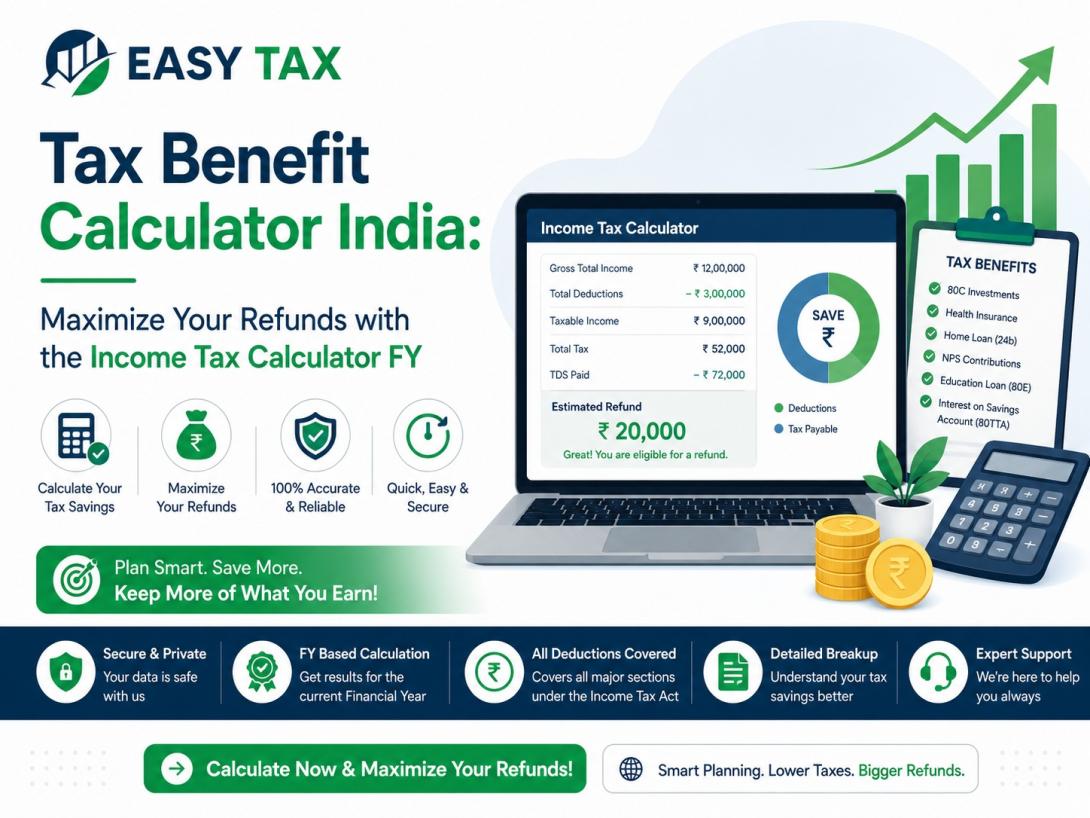
Tax Benefit Calculator India: Make the Most of Your Refunds with the Income Tax Calculator FY 2025-26 Indian taxpayers are at a crucial financial juncture as May 2026 approaches.
The rules governing personal finance have completely changed since the Income Tax Act 2025 went into full effect, overhauling the 1961 legislation that had been in place for decades.
The stakes are high for the current Assessment Year (AY 2026–2027): selecting the incorrect tax course could result in needless payments of thousands of dollars. A strong Tax Benefit Calculator India is now more than just a digital tool for navigating this; it is a vital tool in your financial toolbox. Whether you are a small business owner in Jaipur, a freelancer in Mumbai, or a salaried professional in Bengaluru, knowing how to use an Income Tax Calculator FY 2025-26 efficiently can mean the difference between a large tax bill and a sizable refund.
The Great Debate: Old vs New Tax Regime Calculator 2026
The centerpiece of tax planning this year is the intensified competition between the two regimes. The government has made the New Tax Regime the "default" choice, but "default" does not always mean "cheapest." This is where an Old vs New Tax Regime Calculator 2026 becomes invaluable.
The New Regime Advantage (FY 2025-26):
In the 2026-27 cycle, the New Tax Regime is more attractive than ever for the middle class. Thanks to the enhanced Section 87A rebate, individuals with a taxable income of up to ₹12 Lakh now pay zero tax. When you factor in the increased Standard Deduction of ₹75,000 for salaried employees, your effective "zero-tax" window stretches up to an annual income of ₹12.75 Lakh.
The Old Regime Resilience:
Despite the push toward the new system, the Old Tax Regime remains a powerhouse for those with specific financial commitments. If you are paying off a home loan (Section 24b) investing heavily in PPF or ELSS (Section 80C), and maintaining comprehensive health insurance (Section 80D) your total deductions might outweigh the lower rates of the new system. Only a side-by-side comparison using a dedicated Tax Benefit Calculator India can give you the definitive answer.
Decoding the Income Tax Slabs AY 2026-27
To use any e-Filing Tax Calculator accurately, you must understand the updated slab structures. For AY 2026-27, the slabs have been widened to mitigate "bracket creep" caused by inflation.
New Tax Regime Slabs (Default):
Up to ₹4 Lakh: Nil
₹4 Lakh – ₹8 Lakh: 5%
₹8 Lakh – ₹12 Lakh: 10%
₹12 Lakh – ₹16 Lakh: 15%
₹16 Lakh – ₹20 Lakh: 20%
₹20 Lakh – ₹24 Lakh: 25%
Above ₹24 Lakh: 30%
The "sweet spot" in 2026 is the 10% bracket which covers a significant portion of the Indian workforce. By utilizing an Income Tax Calculator FY 2025-26 you can see exactly how your income is distributed across these brackets and where you can potentially save through marginal relief.
How to Maximize Your Refunds Using an e-Filing Tax Calculator
A common mistake taxpayers make is treating the e-Filing Tax Calculator as a one-time tool used in July. In reality, May is the perfect time to run your numbers. If your employer is deducting TDS (Tax Deducted at Source) based on the Old Regime, but you’ve realized the New Regime saves you more, you can adjust your declarations now or prepare to claim a significant refund.
1. Account for New Perquisites:
The 2026 Act has updated the valuation of rent-free accommodation and car perquisites. Ensure your Income Tax Calculator FY 2025-26 includes these updated valuations so your "Gross Total Income" is accurate.
2. Marginal Relief Calculation:
One of the most complex areas of the 2026 tax code is Marginal Relief. If you earn just slightly over the ₹12.75 Lakh threshold (say, ₹13 Lakh), you shouldn't have to pay tax that exceeds your extra income. High-quality Tax Benefit Calculator India tools now automatically compute this relief for you.
3. Standard Deduction for Pensioners:
Family pensioners and retirees should ensure their calculator accounts for the specialized standard deduction limits updated for this assessment year.
Strategic Planning Beyond the Numbers
While an Old vs New Tax Regime Calculator 2026 provides the numbers, your strategy should be holistic.
If you choose the New Regime: Focus your excess cash on high-yield investments like Equity or Gold, as you are no longer forced to lock money into low-interest 80C instruments just for tax savings.
If you choose the Old Regime: Use the calculator to find the "Break-even Point." TTo make the Old Regime less expensive than the New one, you must deduct precisely this much. This break-even point is approximately ₹4.25 lakh in total deductions for the majority of earners in the ₹15 lakh range. The Bottom Line: In 2026, data-driven decision-making will replace manual paperwork in taxation.
You take charge of your financial story by using an Income Tax Calculator FY 2025–2026. Keeping up with the Income Tax Slabs AY 2026–2027 and regularly comparing your liability to a Tax Benefit Calculator India guarantees that you are both financially efficient and completely compliant.
Don't put your hard-earned money at risk. Get your financial peace of mind for the upcoming year by logging into your favorite e-Filing Tax Calculator and performing the comparison. Log into your preferred e-Filing Tax Calculator today, run the comparison, and secure your financial peace of mind for the year ahead.
Conclusion:
The transition to the New Income Tax Act has made the system simpler, but the choice between regimes remains personal. Use the tools available to ensure that when the July 31st deadline arrives, you aren't just filing a return—you are claiming your rightful savings.
