

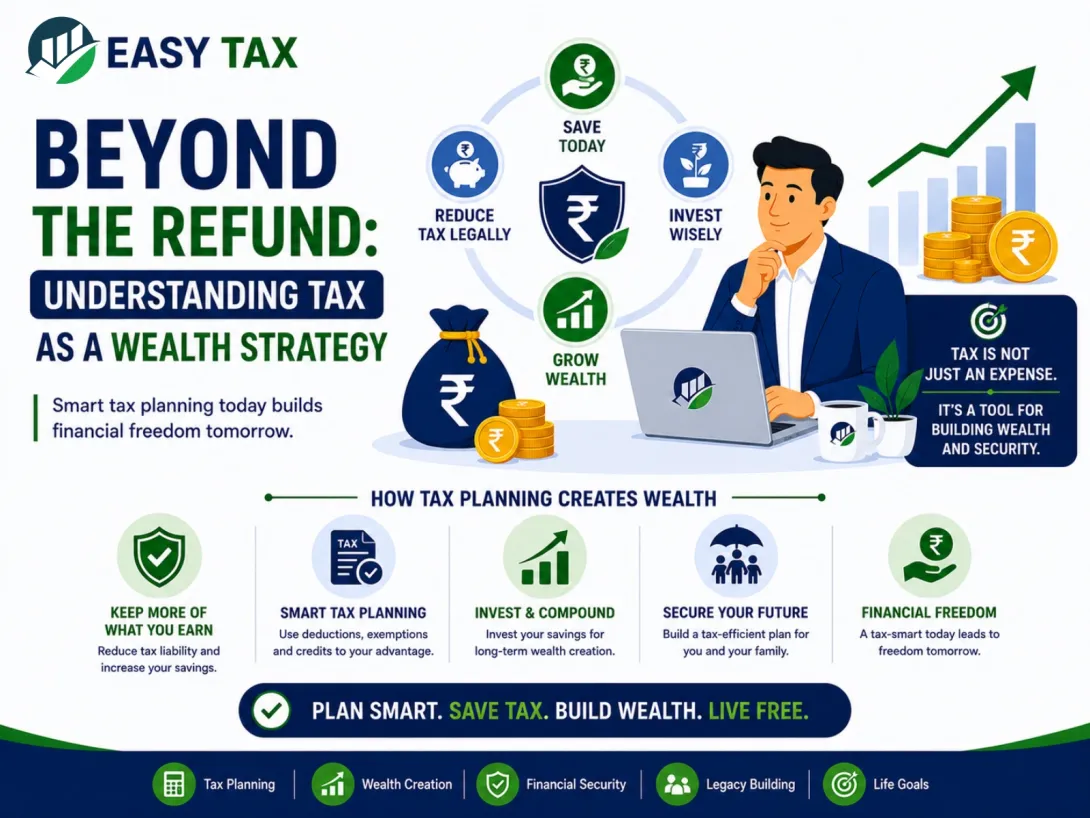
Tax Planning in 2026: How to Build Wealth Beyond Tax Refunds
For many people, tax season feels stressful. Most taxpayers focus only on one thing — getting a refund. But smart financial planning in 2026 is no longer just about filing returns or waiting for money back from the government.
Today, strategic tax planning has become an important part of long-term wealth creation.
Instead of treating taxes as a yearly burden, successful professionals, freelancers, business owners, and investors are now using tax planning as a tool for wealth preservation, investment growth, and financial efficiency.
This guide explains how tax-efficient investing, asset location, deductions, automation, and strategic filing can help improve long-term financial growth.
In investing, the term “alpha” refers to extra returns generated beyond normal market performance.
Similarly:
Tax Alpha
means increasing your overall wealth by reducing unnecessary tax leakage through smarter financial planning and tax efficiency.
In simple terms:
- it is not only about how much you earn,
- but how much you actually keep after taxes.
Effective tax planning can improve long-term wealth accumulation without increasing investment risk.
Why Large Tax Refunds Are Not Always Ideal
Many taxpayers feel happy after receiving a large refund. However, a refund usually means extra money was already deducted during the year.
That money could have potentially been:
- invested,
- saved,
- used for business growth, or
- allocated toward financial goals.
Strategic tax planning focuses on:
- accurate tax estimation,
- better cash flow management,
- smarter investments, and
- wealth preservation.
Tax-Efficient Investing Strategies
Investment returns can be significantly affected by taxes over time.
Even small tax inefficiencies may reduce long-term compounding benefits.
Common Tax-Efficient Investment Strategies
Long-Term Investing
Long-term capital gains are often taxed differently than short-term gains depending on applicable tax laws and investment type.
Holding investments longer may improve overall tax efficiency.
Dividend Planning
Some investment structures and dividend categories may receive more favorable tax treatment compared to ordinary income.
Tax-Efficient Funds
Index funds and low-turnover investments may help reduce taxable events compared to actively traded portfolios.
Asset Allocation vs Asset Location
Most investors understand:
Asset Allocation
which means dividing investments between:
- stocks,
- bonds,
- mutual funds,
- cash, or
- other assets.
However, many people ignore:
Asset Location
Asset location refers to:
- where investments are held for tax efficiency.
Strategic placement of assets across different account types may improve after-tax returns.
Tax-Deferred Accounts
Retirement-focused accounts may allow investments to grow with deferred taxation depending on applicable laws and account structure.
These accounts are commonly used for:
- income-generating investments,
- bonds,
- REITs,
- retirement planning assets.
Tax-Free or Tax-Advantaged Accounts
Certain investment vehicles may offer:
- tax exemptions,
- tax deductions,
- or tax-free withdrawals subject to regulations.
These accounts are often preferred for:
- growth-focused investments,
- long-term wealth creation,
- retirement compounding.
Taxable Investment Accounts
Taxable accounts are commonly used for:
- equity investing,
- index funds,
- liquid investments,
- flexible capital access.
Proper tax planning may help reduce taxable gains and improve efficiency.
Tax-Loss Harvesting Explained
One increasingly popular strategy in 2026 is:
Tax-Loss Harvesting
This involves offsetting investment gains using eligible investment losses.
Example
If:
- one investment generates profit,
- while another investment records a loss,
the loss may potentially reduce taxable capital gains subject to applicable tax rules.
Tax-loss harvesting is widely used in:
- stock portfolios,
- crypto investments,
- digital asset management,
- automated investing platforms.
Automation and Smart Tax Planning
Modern financial tools now automate:
- expense tracking,
- portfolio analysis,
- investment reports,
- tax summaries,
- bookkeeping,
- and filing workflows.
Automation can help:
- reduce filing errors,
- improve deduction tracking,
- simplify compliance,
- and support better financial planning.
Tax Planning for Freelancers & Digital Professionals
In 2026, freelancers and digital business owners are treated more like formal businesses than casual side-income earners.
Common Digital Professions Include
- Freelance coders
- YouTubers
- Influencers
- Affiliate marketers
- WhatsApp automation businesses
- Digital consultants
- Online educators
- Content creators
Proper bookkeeping and expense tracking may help identify legitimate business deductions.
Common Business Expenses That May Be Claimed
Depending on applicable tax laws and business structure, eligible expenses may include:
- Laptop and computer systems
- Internet bills
- Home office expenses
- Editing software
- Camera equipment
- Office subscriptions
- Utility expenses
- Marketing costs
Maintaining proper invoices and records is important for compliance.
Retirement Planning and Tax Strategy
Tax planning and retirement planning are deeply connected.
Choosing between:
- immediate deductions,
- future tax-free withdrawals,
- or long-term retirement growth
can significantly affect wealth over time.
Retirement-focused investing may help:
- improve compounding,
- reduce taxable income,
- and create long-term financial stability.
Wealth-Focused Tax Planning Checklist
Organize Financial Data Early
Track:
- income,
- expenses,
- investments,
- deductions,
- and bank records throughout the year.
Review Investment Tax Efficiency
Evaluate whether investments are placed in the most tax-efficient structure possible.
Track Eligible Deductions
Freelancers and business owners should carefully maintain:
- invoices,
- subscriptions,
- equipment bills,
- and operational expenses.
Use Financial Automation Tools
Modern accounting and tax software can simplify:
- reporting,
- compliance,
- and financial analysis.
Consult a Tax Professional
For higher income levels or complex investments, professional guidance may improve tax efficiency and long-term planning.
Common Tax Planning Mistakes
Avoid these common financial mistakes:
- Waiting until the last minute to file taxes
- Ignoring investment tax impact
- Poor expense tracking
- Mixing personal and business finances
- Missing eligible deductions
- Not planning for advance taxes
- Overlooking retirement planning
Why Tax Planning Matters in 2026
The financial system is becoming increasingly digital and data-driven.
Governments and financial institutions now use:
- automated reporting,
- transaction tracking,
- AI-based compliance systems,
- and integrated financial databases.
As a result, proper financial documentation and tax planning are more important than ever.
Conclusion
Tax filing should not be viewed as a once-a-year emergency. In 2026, smart taxpayers are treating tax planning as an essential part of wealth management and long-term financial growth.
By improving tax efficiency, tracking deductions, optimizing investments, and using automation tools, individuals and businesses can preserve more of their income and strengthen long-term financial stability.
The real goal is not simply getting a large refund.
The real goal is building sustainable long-term wealth through smarter financial planning and tax-efficient decision-making.
