

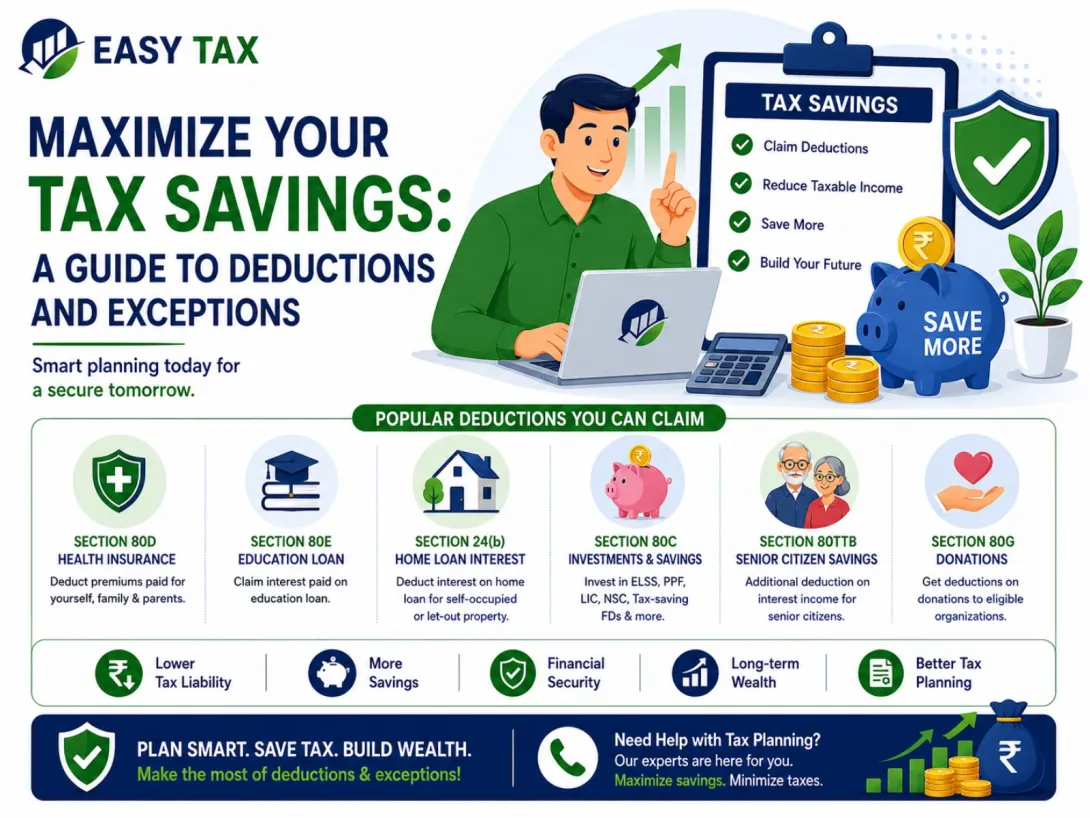
Maximize Your Tax Savings: Complete Guide to Deductions and Exemptions in Income Tax (2026)
Saving tax is not just about filing returns—it is about smart financial planning throughout the year. Every taxpayer in India can legally reduce their taxable income by using available deductions and exemptions under the Income Tax Act.
Understanding these provisions helps individuals:
- Reduce tax liability
- Increase savings
- Improve financial planning
- Build long-term wealth
In this guide, we will explain all major tax deductions, exemptions, and smart tax-saving strategies that can help you maximize savings effectively.
What Are Tax Deductions and Exemptions?
Before understanding sections, it is important to know the difference:
✔ Tax Deductions
Deductions reduce your taxable income, which lowers the total tax payable.
Example:
If your income is ₹8,00,000 and you claim ₹1,50,000 deduction, tax is calculated on ₹6,50,000.
✔ Tax Exemptions
Exemptions are specific incomes that are fully or partially not taxed.
Example:
HRA (House Rent Allowance) is partially or fully exempt under certain conditions.
Key Income Tax Deductions in India
1. Section 80C – Most Popular Tax Saving Section
Section 80C allows deduction up to ₹1.5 lakh per year.
Eligible investments include:
- Public Provident Fund (PPF)
- Employee Provident Fund (EPF)
- Equity Linked Savings Scheme (ELSS)
- National Savings Certificate (NSC)
- Life Insurance Premium
- Sukanya Samriddhi Yojana
✔ This is the most widely used tax-saving section in India.
2. Section 80D – Health Insurance Deduction
You can claim deductions on health insurance premiums:
- Up to ₹25,000 for self and family
- Up to ₹50,000 for senior citizens
Additional preventive health check-up benefits are also available.
✔ Encourages financial protection against medical emergencies.
3. Section 24(b) – Home Loan Interest Deduction
If you have a home loan, you can claim:
👉 Up to ₹2,00,000 per year on interest paid
This applies to self-occupied property.
✔ One of the biggest benefits for homeowners.
4. Section 80E – Education Loan Interest
Interest paid on education loans is fully deductible.
✔ No upper limit
✔ Available for higher education in India or abroad
5. Section 80G – Donations
Donations made to approved charities and relief funds are eligible for deduction.
✔ 50% or 100% deduction depending on the institution
Major Tax Exemptions in India
1. House Rent Allowance (HRA)
HRA exemption is available for salaried individuals living in rented houses.
It depends on:
- Salary
- Rent paid
- City of residence
✔ Helps reduce taxable salary significantly.
2. Leave Travel Allowance (LTA)
LTA allows tax exemption on travel expenses within India.
Conditions:
- Can be claimed twice in a block of 4 years
- Only travel cost is covered (not hotel/food)
3. Agricultural Income
Income from agriculture is fully exempt from tax under certain conditions.
✔ However, it may affect tax slab calculation in some cases.
4. Gratuity and Pension Benefits
Retirement benefits like:
- Gratuity
- Pension commutation
are partially or fully exempt depending on eligibility.
Smart Ways to Maximize Tax Savings
1. Start Tax Planning Early
Do not wait until March.
✔ Invest in tax-saving instruments throughout the year
✔ Avoid last-minute decisions
2. Maintain Proper Financial Records
Keep documents for:
- Investments
- Insurance premiums
- Loan statements
- Rent receipts
✔ Helps in accurate deduction claims
3. Choose Between Old and New Tax Regime
Before filing ITR:
- Compare old vs new regime
- Choose the one with maximum benefit
✔ Many deductions are available only in the old regime
4. Use Professional Tax Assistance
Using expert services like Easy Tax ensures:
- Maximum deductions claimed
- Error-free filing
- Better tax planning
5. Combine Multiple Tax Saving Options
Instead of relying on one section:
- Combine 80C + 80D + HRA + LTA
✔ This significantly reduces tax burden
Common Mistakes Taxpayers Should Avoid
- Not investing in 80C early
- Missing deduction proofs
- Ignoring health insurance benefits
- Choosing wrong tax regime
- Not updating income sources
✔ These mistakes can increase tax liability unnecessarily
Tax planning is not just about saving money—it is about building financial discipline.
Benefits include:
- Higher savings
- Better investment planning
- Long-term wealth creation
- Reduced financial stress
How Easy Tax Helps You Save More Tax
Easy Tax provides expert guidance to help individuals and businesses:
✔ Identify all eligible deductions
✔ File accurate income tax returns
✔ Compare tax regimes
✔ Optimize investment strategy
✔ Avoid penalties and errors
With professional support, taxpayers can maximize legal savings and stay fully compliant.
Frequently Asked Questions (FAQs)
1. What is the maximum deduction under Section 80C?
You can claim up to ₹1.5 lakh per financial year.
2. Can I claim both HRA and home loan benefits?
Yes, if conditions are satisfied.
3. Are deductions available in the new tax regime?
Most deductions are not available in the new regime.
4. What is the best tax-saving investment?
ELSS mutual funds and PPF are popular long-term options.
5. How can I reduce my taxable income legally?
By using deductions under 80C, 80D, 80E, and exemptions like HRA and LTA.
Conclusion
Understanding tax deductions and exemptions is essential for every taxpayer in India. With proper planning, you can significantly reduce your tax liability while building long-term financial stability.
Sections like 80C, 80D, 24(b), 80E, and 80G provide powerful tools to save tax legally and efficiently.
Smart taxpayers plan early, invest wisely, and take professional guidance when needed.
For expert assistance in tax planning and filing, Easy Tax helps ensure you maximize savings and stay compliant with ease.
