

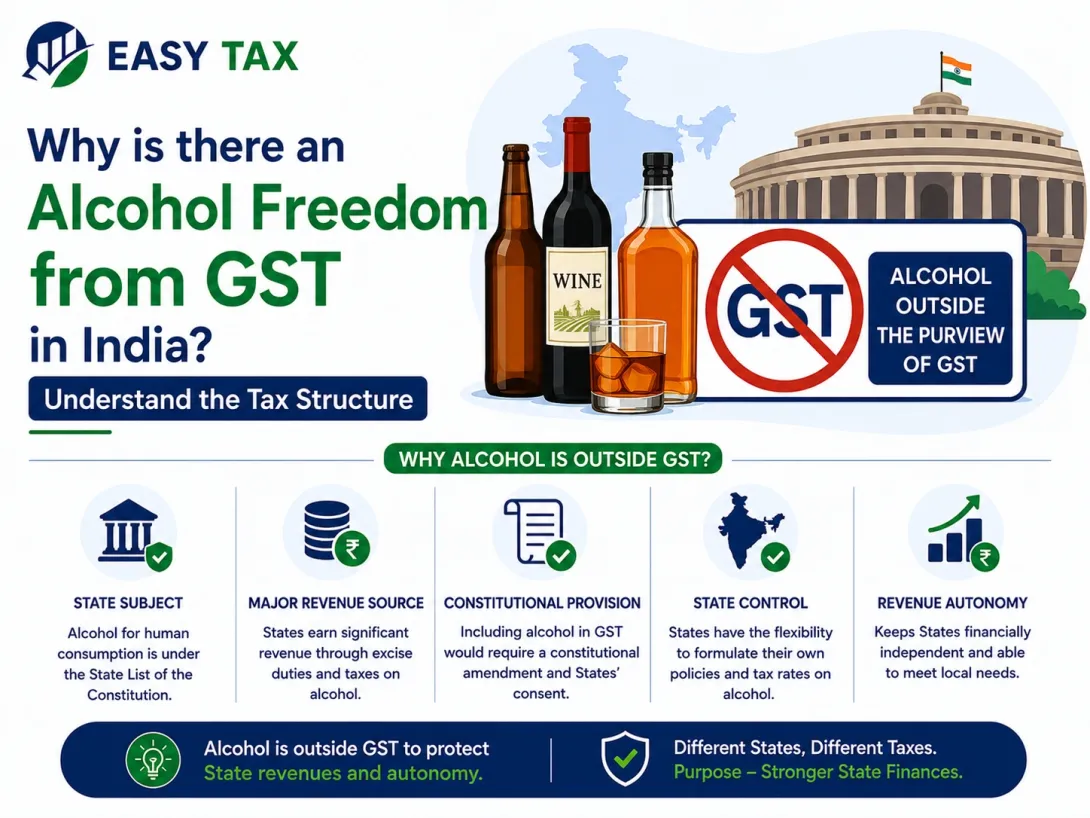
Why Is Alcohol Excluded from GST in India? Complete Guide to Alcohol Taxation, State Excise Duty, VAT, and Compliance in 2026
The Goods and Services Tax (GST) was introduced in India on 1 July 2017 with the objective of creating a unified indirect tax system. GST replaced multiple central and state taxes, simplified tax compliance, and improved transparency in the taxation process. Today, GST applies to most goods and services across the country.
However, one major product category remains outside the GST framework: alcohol for human consumption.
Many taxpayers, business owners, restaurant operators, liquor retailers, and consumers often ask why alcohol is not covered under GST when most other products are. The answer lies in India's unique tax structure and the significant revenue generated by state governments from alcohol taxation.
Alcohol is one of the largest sources of revenue for many states. Instead of GST, alcoholic beverages are taxed through state excise duty, Value Added Tax (VAT), license fees, and various state-specific charges. As a result, alcohol taxation in India remains significantly different from the taxation of most other products.
In this comprehensive guide, we explain why alcohol is excluded from GST, how alcohol taxation works, the impact on businesses and consumers, and whether alcohol could be brought under GST in the future.
Understanding GST in India
GST was introduced to simplify India's indirect tax structure by replacing taxes such as:
- Central Excise Duty
- Service Tax
- Value Added Tax (VAT) on most goods
- Entry Tax
- Luxury Tax
- Entertainment Tax
The objective was to create a "One Nation, One Tax" system that would improve ease of doing business and eliminate tax cascading.
While GST successfully integrated most goods and services into a single tax framework, alcohol for human consumption was deliberately kept outside its scope.
Why Is Alcohol Excluded from GST?
The primary reason is state government revenue.
Before GST was implemented, states earned substantial income from alcohol taxes. When GST was introduced, states agreed to transfer many taxation powers to the GST system. However, they retained control over alcohol taxation because it contributes significantly to state finances.
For many states, alcohol taxes represent one of the largest sources of non-GST revenue.
If alcohol were included under GST:
- States would lose independent control over tax rates.
- Revenue would need to be shared with the central government.
- State budgets could be affected significantly.
Because of these concerns, alcohol continues to remain outside the GST regime.
Constitutional Position of Alcohol Under GST
The Constitution of India allows states to levy taxes on alcohol for human consumption.
While GST applies to most products and services, alcohol is specifically excluded from the GST framework.
This gives state governments the authority to:
- Determine tax rates.
- Collect excise duty.
- Regulate liquor sales.
- Issue licenses.
- Manage alcohol-related revenue.
As a result, alcohol taxation differs from state to state.
How Is Alcohol Taxed in India?
Since GST does not apply to alcohol for human consumption, several other taxes are imposed.
1. State Excise Duty
State excise duty is the primary tax imposed on alcohol.
Each state determines:
- Excise rates
- Licensing requirements
- Distribution regulations
- Retail sale permissions
Excise duty contributes a substantial portion of state government revenue.
2. Value Added Tax (VAT)
Many states also levy VAT on alcohol sales.
Unlike GST, VAT rates vary significantly across states.
This is one of the reasons why the price of the same liquor brand differs from one state to another.
3. License Fees
Businesses involved in alcohol production and sales must obtain various licenses.
These may include:
- Manufacturing licenses
- Wholesale licenses
- Retail licenses
- Bar licenses
- Restaurant liquor permits
License fees can be substantial depending on the state and business category.
4. Additional State Levies
Some states impose:
- Special excise duties
- Surcharges
- Additional cess
- Welfare charges
These additional taxes further increase alcohol prices.
Why Do Alcohol Prices Differ Across States?
Many consumers notice that alcohol prices vary significantly across India.
The same bottle may cost:
- One price in Rajasthan
- Another price in Delhi
- A different price in Maharashtra
- A completely different amount in Karnataka
This happens because each state independently determines:
- Excise duty rates
- VAT rates
- Additional charges
- Licensing costs
The absence of a uniform GST structure leads to substantial price differences.
Impact on Consumers
The exclusion of alcohol from GST directly affects consumers.
Higher Prices
Alcohol remains one of the most heavily taxed products in India.
Taxes often represent a large portion of the final retail price.
Price Variations
Consumers pay different prices depending on their state.
Limited Uniformity
Unlike GST products, alcohol pricing lacks national consistency.
Impact on Businesses
Businesses operating in the alcohol sector face several compliance challenges.
Multiple Tax Structures
Companies operating in multiple states must understand different tax regulations.
Complex Licensing Requirements
Each state has separate:
- Registration procedures
- Licensing requirements
- Renewal rules
Higher Compliance Costs
Businesses often require specialized accounting and tax support.
No Input Tax Credit (ITC)
One of the biggest disadvantages is the inability to claim Input Tax Credit on alcohol sales.
Under GST, businesses can generally claim ITC on eligible purchases. Since alcohol is outside GST, these benefits are limited.
Challenges Faced by Alcohol Businesses
Regulatory Complexity
Every state has unique rules.
Frequent Policy Changes
Excise policies may change annually.
Compliance Burden
Businesses must maintain extensive records and documentation.
Tax Planning Difficulties
Operating across multiple states creates additional complexity.
Because of these factors, many businesses seek professional tax advisory services.
Could Alcohol Be Included Under GST in the Future?
The possibility of bringing alcohol under GST has been discussed for several years.
However, implementation remains uncertain.
Potential Benefits
If alcohol were included under GST:
Simplified Tax Structure
A uniform tax system could reduce complexity.
Easier Compliance
Businesses would deal with fewer tax frameworks.
Better Transparency
A standardized taxation system would improve clarity.
Input Tax Credit Benefits
Businesses could potentially claim ITC more effectively.
Uniform Pricing
Price differences across states could decrease.
Challenges
Despite these advantages, significant obstacles remain.
State Revenue Concerns
States depend heavily on alcohol tax revenue.
Revenue Sharing Issues
GST would require sharing tax collections with the central government.
Political Considerations
Any major change would require broad agreement among states.
Because of these challenges, alcohol is unlikely to be brought under GST in the immediate future.
Alcohol Taxation and Business Compliance
Businesses involved in alcohol manufacturing, distribution, or retail must ensure compliance with:
- Excise regulations
- State taxation rules
- Licensing requirements
- Accounting standards
- Record maintenance obligations
Failure to comply can result in:
- Financial penalties
- License suspension
- Legal disputes
- Business disruptions
Proper compliance management is therefore essential.
Importance of Professional Tax Advisory
Alcohol taxation is one of the most regulated areas of business taxation in India.
Professional tax advisors can help businesses:
- Understand state-specific laws
- Manage compliance requirements
- Maintain accurate records
- Plan tax strategies
- Avoid penalties
Expert guidance becomes especially important for businesses operating across multiple states.
Frequently Asked Questions (FAQs)
Why is alcohol not covered under GST?
Alcohol is excluded from GST because state governments rely heavily on revenue generated from excise duty and VAT on liquor.
Is GST charged on alcohol in India?
No. Alcohol for human consumption is currently outside the GST framework.
What taxes apply to alcohol?
Alcohol is generally subject to state excise duty, VAT, license fees, and additional state-specific levies.
Can businesses claim Input Tax Credit on alcohol?
No. Since alcohol is outside GST, businesses generally cannot claim GST-related Input Tax Credit on alcohol sales.
Why are alcohol prices different in every state?
Each state sets its own excise duty, VAT, and licensing charges, leading to price variations.
Will alcohol come under GST in the future?
While discussions continue, there is currently no confirmed plan to include alcohol under GST.
Conclusion
Alcohol remains one of the few major products excluded from India's GST regime. The primary reason is the significant revenue that state governments generate through excise duty, VAT, and other alcohol-related taxes. While bringing alcohol under GST could simplify compliance and create a more uniform taxation structure, concerns regarding state revenue continue to prevent such a change.
For businesses involved in the alcohol industry, understanding state-specific tax laws and maintaining proper compliance is essential. As regulations continue to evolve, professional tax guidance can help businesses navigate complex alcohol taxation rules efficiently and avoid costly compliance issues.
