

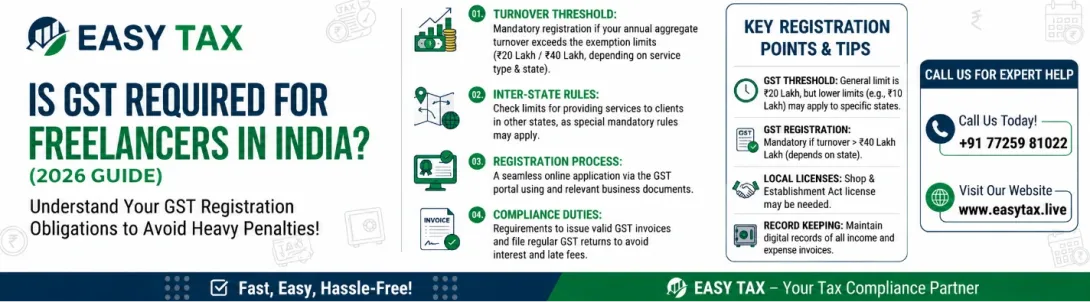
Is GST Required for Freelancers in India? (2026 Guide)
GST Guide
Is GST Required for Freelancers in India? 2026 Rules & Limits
If you work independently as a freelancer in India, you may be wondering whether you need GST registration. The answer depends on your aggregate turnover, the nature and location of your services, and whether a specific compulsory-registration rule applies to your business.
This guide explains the general GST position for independent consultants, designers, developers, writers, digital marketers, coaches and other service providers. It focuses on the law applicable in India and the registration framework relevant in 2026.
Who needs GST registration in India?
Freelancing is not a separate GST exemption. If you independently provide services for consideration in the course or furtherance of business, your activity may be a supply under GST law.
However, being a freelancer does not automatically mean that you must register. The registration decision generally depends on:
- Your aggregate turnover during the financial year.
- The State or Union Territory from which you make your supplies.
- Whether your services are supplied within India or across State borders.
- Whether your work qualifies as an export of services.
- Whether a compulsory-registration provision or specific exemption applies.
A freelance graphic designer, software developer or marketing consultant should therefore review the actual services and transactions rather than relying only on their job title.
GST turnover threshold for freelancers in 2026
Section 22 of the Central Goods and Services Tax Act, 2017 sets the general registration threshold at ₹20 lakh of aggregate turnover in a financial year for suppliers in States other than the specified special-category States. The threshold under the section is ₹10 lakh for supplies made from the specified special-category States.
| Supplier's State category | General threshold | Relevant rule |
|---|---|---|
| States other than specified special-category States | ₹20 lakh | CGST Act, section 22 |
| Specified special-category States | ₹10 lakh | CGST Act, section 22 |
These are general thresholds, not a universal answer for every business. Other provisions, notifications, exemptions and the nature of the transactions must also be considered.
What counts as aggregate turnover?
GST registration is based on aggregate turnover, not simply the amount deposited into one bank account or the profit remaining after expenses.
Under section 2(6) of the CGST Act, aggregate turnover is calculated on an all-India basis for persons having the same PAN. It generally includes:
- Taxable supplies.
- Exempt supplies.
- Exports of goods or services.
- Inter-State supplies.
The statutory definition excludes specified taxes and certain inward supplies on which tax is payable under reverse charge. The exact calculation should be checked against the definition and the nature of each transaction.
Example: domestic and foreign freelance income
| Type of supply | Amount |
|---|---|
| Services supplied to Indian clients | ₹8,00,000 |
| Services supplied to foreign clients | ₹12,00,000 |
| Illustrative aggregate turnover | ₹20,00,000 |
The export turnover is not automatically ignored when calculating aggregate turnover. It is included in the all-India aggregate-turnover calculation, subject to the statutory definition.
In this example, turnover reaches ₹20 lakh; it does not exceed ₹20 lakh. That distinction matters under the ordinary section 22 threshold. However, the freelancer must still check whether another registration provision applies and whether the supplies qualify for an exemption.
Do freelancers need GST for clients in other States?
Not automatically. Section 24(i) of the CGST Act refers to persons making inter-State taxable supplies. However, Notification No. 10/2017–Integrated Tax specifically exempts persons making inter-State supplies of taxable services whose all-India aggregate turnover does not exceed ₹20 lakh in a financial year, or ₹10 lakh in the specified special-category States.
This notification is important for independent service providers who work remotely for clients in other Indian States.
For example, a freelancer based in Rajasthan who provides ordinary consulting services to a client in Maharashtra should not assume that GST registration is compulsory merely because the client is in another State. The turnover threshold and the applicable notification must be considered along with any other registration trigger.
Do freelancers need GST when working with foreign clients?
Working for a client outside India does not automatically make GST registration compulsory. The correct analysis has two separate parts:
- Whether you are required to obtain GST registration under the applicable registration provisions.
- Whether a particular service transaction qualifies as an export of services and, if you are registered, how it should be reported.
These are different questions. A transaction may qualify as an export of services, but that does not mean every unregistered freelancer must obtain GST registration solely to file an LUT.
If you are already registered, the export procedure, return reporting, invoicing and zero-rated supply rules need to be followed as applicable.
For a more focused discussion of overseas customers, see our guide to GST for freelancers serving foreign clients .
When does a freelance service qualify as an export?
Section 2(6) of the Integrated Goods and Services Tax Act, 2017 sets out five conditions. A service qualifies as an export of services only when all five conditions are satisfied:
- The supplier of the service is located in India.
- The recipient of the service is located outside India.
- The place of supply of the service is outside India.
- Payment is received in convertible foreign exchange, or in Indian rupees wherever permitted by the Reserve Bank of India.
- The supplier and recipient are not merely establishments of a distinct person under the explanation to section 8 of the IGST Act.
A foreign billing address or payment from an overseas bank is not enough on its own. The place-of-supply rules must also be checked.
Why place of supply matters
Under section 13(2) of the IGST Act, the general place-of-supply rule for cross-border services is the location of the recipient. However, sections 13(3) to 13(13) contain exceptions for specified services.
One important example is intermediary services. Section 13(8)(b) provides that the place of supply for intermediary services is the location of the supplier. Whether a freelancer is actually providing an intermediary service depends on the contractual role and the substance of the work; it should not be assumed merely because the freelancer communicates with multiple parties.
Services involving goods made physically available, immovable property, events and other specified categories can also have special place-of-supply rules.
What is LUT and when does a freelancer need it?
LUT means Letter of Undertaking. Under Rule 96A of the CGST Rules, a registered person who chooses to export goods or services without payment of integrated tax generally furnishes a bond or Letter of Undertaking in FORM GST RFD-11, subject to the applicable conditions.
Export of services is a zero-rated supply under section 16 of the IGST Act. Zero-rated supply is not the same as an ordinary exempt supply. The law provides specific treatment for input tax credit and refunds, subject to the applicable conditions and restrictions.
Does every freelancer receiving foreign payments need an LUT?
No. The LUT procedure described in Rule 96A applies to a registered person choosing the export-without-payment-of-IGST route. A person who is not required to register and has not voluntarily registered should not assume that they must file an LUT merely because they receive payments from overseas customers.
A registered exporter should check the current GST Portal procedure, the applicable LUT validity period, invoice requirements and return reporting obligations before making export supplies.
How can a freelancer register for GST?
If the applicable registration rules require you to register, the application is made through the official GST Portal.
- Open the official GST Portal.
- Go to Services, then Registration, then New Registration.
- Select the appropriate taxpayer type and enter the requested details.
- Provide the PAN, contact details and State information requested by the portal.
- Complete OTP verification and continue with the application.
- Enter business and principal-place-of-business details.
- Upload the documents applicable to your business constitution and premises.
- Submit the application using the prescribed verification method.
- Track the application status and respond to any notice or clarification request.
Documents that may be needed
The documents depend on the applicant's legal constitution, premises, authorised signatory and the information requested in the application. Depending on the case, the portal may ask for:
- PAN and identity details of the proprietor or relevant persons.
- Photograph of the proprietor or authorised signatory, where applicable.
- Proof of constitution of business, where applicable.
- Proof of principal place of business, such as an ownership, rent or consent document as appropriate.
- Authorisation documents for an authorised signatory, where required.
- Bank account details or other information requested under the current registration procedure.
Do not treat this list as a universal mandatory document list. Use the current GST Portal registration document checklist and follow the live application requirements for your business type.
Invoices and records freelancers should maintain
Good records help establish what service was supplied, who received it, when it was supplied and how the payment was received. Maintain appropriate records whether or not you are registered.
- Client contracts, statements of work and purchase orders.
- Invoices and credit notes, where applicable.
- Client names, addresses and country details.
- Descriptions of the services supplied.
- Payment confirmations and bank statements.
- Foreign remittance advice and relevant bank certificates or records.
- GST registration, returns and LUT records, if registered.
- Expense records and supporting documents.
A registered freelancer should issue tax invoices in accordance with the applicable GST invoice rules. An unregistered freelancer must not collect GST as though registered or issue a GST tax invoice.
Practical examples: when might a freelancer need GST?
Example 1: Freelancer below the general threshold
A service provider has aggregate turnover of ₹9 lakh in a financial year and supplies ordinary services to Indian clients. If no other compulsory-registration provision applies and the relevant exemption conditions are satisfied, the provider may not need GST registration merely because they are freelancing.
Example 2: Freelancer exceeds ₹20 lakh
A service provider in a State subject to the general ₹20 lakh threshold has aggregate turnover of ₹23 lakh in a financial year. The provider should assess registration liability under section 22 and apply within the statutory time limit if liable. Section 25 generally requires an application within 30 days from the date the person becomes liable.
Example 3: Freelancer works for clients in other States
A freelancer supplies services to customers in several Indian States. The freelancer should check Notification No. 10/2017–Integrated Tax before concluding that inter-State services automatically require registration. The notification provides an exemption for qualifying inter-State service suppliers up to the stated aggregate-turnover threshold.
Example 4: Freelancer serves a client outside India
A developer in India works remotely for a company outside India. The developer must check all five export-of-services conditions, including place of supply and payment. If the developer is registered, the applicable zero-rated export procedure must also be considered. If not registered, the registration question must be assessed independently under the applicable threshold and other rules.
Foreign payments: a separate FEMA point
GST treatment and foreign-exchange compliance are separate legal questions. A freelancer receiving money from overseas should retain invoices, payment records and the information requested by their authorised dealer bank.
RBI's Foreign Exchange Management (Export and Import of Goods and Services) Regulations, 2026 took effect on 1 October 2026. The September 2026 amendment changed the general period for realisation and repatriation of export proceeds to nine months from the relevant date, and provides a twelve-month period where exports are invoiced and/or settled in Indian rupees, subject to the applicable rules and permitted extensions.
The RBI's 20 November 2026 FAQ also explains that the EDF procedure differs for resident individuals and persons other than resident individuals. Check the current process with your authorised dealer bank rather than assuming that every individual freelancer must submit the same form.
GST and income tax are different
GST registration and income-tax reporting are separate obligations. A freelancer may have income-tax responsibilities even when GST registration is not required.
The Income-tax Act, 2025 applies from 1 April 2026. For income earned from FY 2026–27 onwards, the Income Tax Department uses the term "Tax Year" in place of the earlier "previous year" terminology. Earlier tax periods and pending proceedings remain subject to the applicable transitional provisions.
The income-tax treatment of freelance receipts depends on the taxpayer's residential status, the source and nature of the income, and the applicable provisions. Do not assume that every overseas payment has the same tax treatment.
Frequently asked questions
1. Is GST mandatory for every freelancer in India?
No. GST registration depends on aggregate turnover, the nature and location of supplies, and applicable registration provisions and exemptions. Freelancing by itself does not automatically require registration.
2. What is the general GST threshold for a freelancer?
The general section 22 threshold for suppliers in States other than specified special-category States is ₹20 lakh in a financial year. The threshold is ₹10 lakh for supplies from the specified special-category States. Other rules and exemptions must also be considered.
3. Do I need GST registration if my clients are in other Indian States?
Not necessarily. Notification No. 10/2017–Integrated Tax exempts qualifying inter-State suppliers of taxable services up to the applicable all-India aggregate-turnover threshold. Check whether you meet the notification's conditions and whether another compulsory-registration rule applies.
4. Do freelancers with foreign clients always need GST registration?
No. Foreign-client work does not automatically require registration. First determine whether registration is required under the applicable threshold and other rules. Separately determine whether each transaction satisfies the export-of-services conditions.
5. Is an LUT compulsory for every freelancer?
No. Under Rule 96A, the LUT or bond procedure applies to a registered person choosing to export without payment of integrated tax, subject to the applicable rules. An unregistered freelancer should not assume an LUT is required merely because the client is overseas.
6. Do foreign-client receipts count towards aggregate turnover?
Exports of services are included in the statutory definition of aggregate turnover under section 2(6) of the CGST Act. The calculation is made on an all-India basis for persons having the same PAN.
7. Can I issue a GST invoice without GST registration?
An unregistered person must not collect GST as though registered or issue a GST tax invoice. Use appropriate commercial invoices and obtain advice if your registration status changes.
8. Is GST registration the same as income-tax registration?
No. GST and income tax are separate tax systems with different registration, reporting and payment requirements.
Official government sources
The following primary and official materials support the legal explanations in this article. Readers should check the current consolidated law and amendments before acting.
- Central Goods and Services Tax Act, 2017 — sections 2(6), 22, 23, 24 and 25.
- Notification No. 10/2017–Integrated Tax — exemption for qualifying inter-State suppliers of taxable services.
- Integrated Goods and Services Tax Act, 2017 — section 2(6), section 13 and section 16.
- CBIC Circular No. 202/14/2023-GST — permitted INR receipts through Special Rupee Vostro Accounts.
- CBIC Circular No. 4/4/2017-GST — Rule 96A and FORM GST RFD-11 for registered exporters using the LUT/bond route.
- CGST Rules forms, including FORM GST RFD-11 — official form reference.
- GST Portal registration document checklist — documents relevant to GST registration applications.
- RBI FEMA 23(R)/2026-RB — Foreign Exchange Management (Export and Import of Goods and Services) Regulations, 2026, as amended.
- RBI amendment dated 22 September 2026 — changes to export-proceeds realisation periods effective 1 October 2026.
- RBI FAQ dated 20 November 2026 — operational guidance on EDF for service exports.
- Income Tax Department: New Act FAQs — commencement of the Income-tax Act, 2025 and Tax Year terminology.
Need help reviewing your GST position?
Your registration position can depend on the type of services you provide, your aggregate turnover, client locations and any special registration rules. Get your facts reviewed before applying or issuing GST invoices.
Disclaimer: This article is for general educational information and is not individual tax or legal advice. GST treatment depends on the facts of each supply, the taxpayer's circumstances and the law applicable to the relevant period. Have your contracts, turnover calculation and registration position reviewed by a qualified GST professional before taking action.
Editorial review: {{VERIFIED_CA_REVIEWER_NAME}}. This reviewer attribution and the review date must be completed only after the named professional has approved this exact version.







EasyTax • Jaipur
GST Return Filing & Compliance
Timely GSTR-1 & GSTR-3B filing, 100% ITC matching and department notice defense by certified GST experts.