

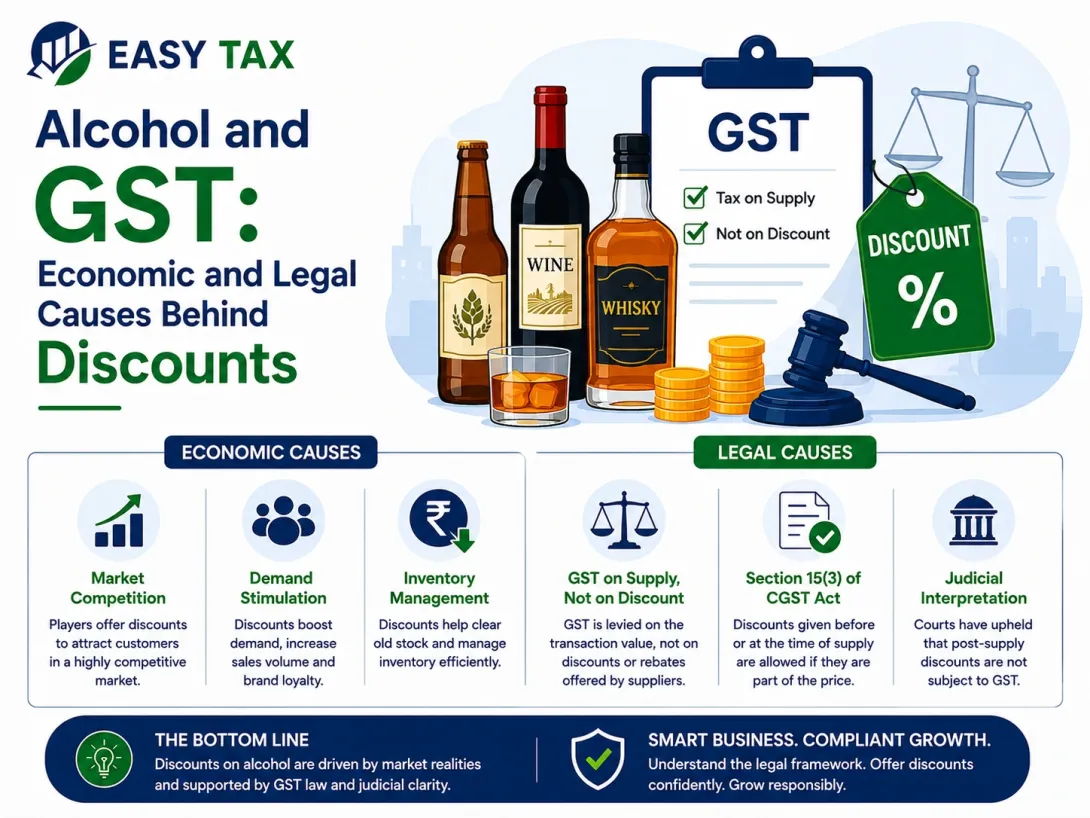
Why Is Alcohol Excluded from GST in India? Economic, Legal, and Tax Structure Explained (2026 Guide)
Alcohol is one of the few major products in India that remains outside the Goods and Services Tax (GST) system. While GST has unified most indirect taxes across the country, alcohol for human consumption continues to be taxed separately by state governments.
This raises an important question for businesses, consumers, and taxpayers: Why is alcohol excluded from GST in India, and how is it taxed instead?
In this article, we break down the legal framework, economic reasons, tax structure, and business impact behind alcohol’s exclusion from GST.
What Is GST in India?
The Goods and Services Tax (GST) was introduced to simplify India’s indirect taxation system by replacing multiple central and state taxes into one unified structure.
GST applies to most goods and services such as:
- Electronics
- Food products
- Transport services
- Manufacturing goods
- Professional services
However, certain items like alcohol for human consumption, petroleum products, and electricity (in some cases) are excluded from GST.
Why Is Alcohol Not Included in GST?
Alcohol is excluded from GST due to legal, economic, and constitutional reasons.
1. Major Source of Revenue for States
Alcohol taxation is one of the biggest revenue sources for state governments in India.
States earn revenue through:
- Excise duty
- Value Added Tax (VAT)
- Licensing fees
If alcohol were included under GST:
- States would lose direct control over pricing
- Revenue would need to be shared with the central government
- State budgets could face financial pressure
This is the primary reason for exclusion.
2. Constitutional Provisions
Under the Indian Constitution:
- States have exclusive power to tax alcohol for human consumption
- GST applies only to goods and services covered under the GST Council framework
Alcohol taxation remains under state jurisdiction, not the GST Council.
3. Economic and Pricing Structure
Each state in India has its own alcohol tax policy.
This results in:
- Different excise duty rates
- Different VAT structures
- Different retail prices
If GST were applied:
- A uniform national tax rate would be required
- States would lose pricing flexibility
- Revenue distribution would become complex
4. State Policy Control
States also use alcohol taxation as a policy tool to:
- Control consumption
- Regulate availability
- Generate revenue for welfare programs
Removing this control would limit state policy flexibility.
5. Political and Federal Consensus Issues
Bringing alcohol under GST would require:
- Agreement from all states
- Compensation for revenue loss
- Constitutional amendments or major GST Council decisions
Since states rely heavily on alcohol revenue, consensus is difficult.
How Alcohol Is Taxed in India Today
Since alcohol is outside GST, it is taxed separately through state systems.
1. State Excise Duty
A major tax imposed on production and sale of alcohol.
2. Value Added Tax (VAT)
Applied during sale of alcohol to consumers.
3. License Fees
Businesses must pay for:
- Manufacturing licenses
- Distribution licenses
- Retail licenses
- Bar/restaurant permits
4. Additional State Taxes
Some states also impose:
- Cess
- Special surcharges
- Welfare levies
Why Alcohol Prices Differ Across States
Alcohol prices vary widely across India due to:
- Different excise duty rates
- Different VAT percentages
- State-specific policies
For example:
- A premium whisky may cost significantly more in one state than another
- Border states often see price differences that encourage cross-border purchase
Economic Impact of Alcohol’s GST Exclusion
1. Higher Consumer Prices
Alcohol is one of the most heavily taxed consumer products in India.
Taxes often make up a large portion of the final price.
2. Interstate Trade Issues
Different tax structures create:
- Price gaps
- Cross-border purchasing
- Illegal trade risks in some regions
3. Business Compliance Complexity
Businesses must manage:
- Multiple state laws
- Separate tax systems
- Different licensing rules
This increases compliance costs significantly.
Legal Structure Behind Alcohol Taxation
GST Law
Alcohol for human consumption is explicitly excluded from GST.
State Authority
States retain full control over:
- Tax rates
- Licensing
- Regulation
- Revenue collection
This ensures financial independence for state governments.
Will Alcohol Ever Come Under GST?
There is ongoing discussion, but no immediate implementation plan.
Possible Benefits
If included under GST:
- Uniform pricing across India
- Simplified compliance
- Transparent taxation
- Possible Input Tax Credit benefits
Major Challenges
- High dependence of states on alcohol revenue
- Revenue-sharing conflicts
- Need for national consensus
- Constitutional limitations
Therefore, GST inclusion is unlikely in the near future.
Impact on Businesses
Businesses dealing in alcohol face:
- Multiple licensing requirements
- High compliance burden
- Separate tax structures in every state
- No GST Input Tax Credit benefits
This makes expert tax guidance essential.
Role of Professional Tax Advisors
Due to complex regulations, businesses benefit from professional support in:
- State excise compliance
- VAT calculations
- Licensing procedures
- Tax planning strategies
Expert advisory services help reduce compliance risks and improve efficiency.
FAQs
Why is alcohol not taxed under GST?
Because state governments rely heavily on excise duty and VAT for revenue.
Is GST applicable on alcohol in India?
No, alcohol for human consumption is excluded from GST.
Who controls alcohol taxation in India?
State governments regulate and tax alcohol independently.
Why do alcohol prices vary between states?
Due to different excise duty and VAT rates across states.
Can alcohol come under GST in the future?
It is possible but unlikely due to revenue and political challenges.
Conclusion
Alcohol remains outside the GST system in India due to strong economic dependence of states, constitutional provisions, and policy control requirements.
While GST has simplified taxation for most sectors, alcohol continues to follow a separate taxation model based on state excise duty and VAT.
For businesses operating in this sector, understanding state-wise taxation and maintaining compliance is essential for smooth operations.
With proper tax planning and expert guidance, businesses can navigate this complex system efficiently and reduce compliance risks.
