

Quick Answer
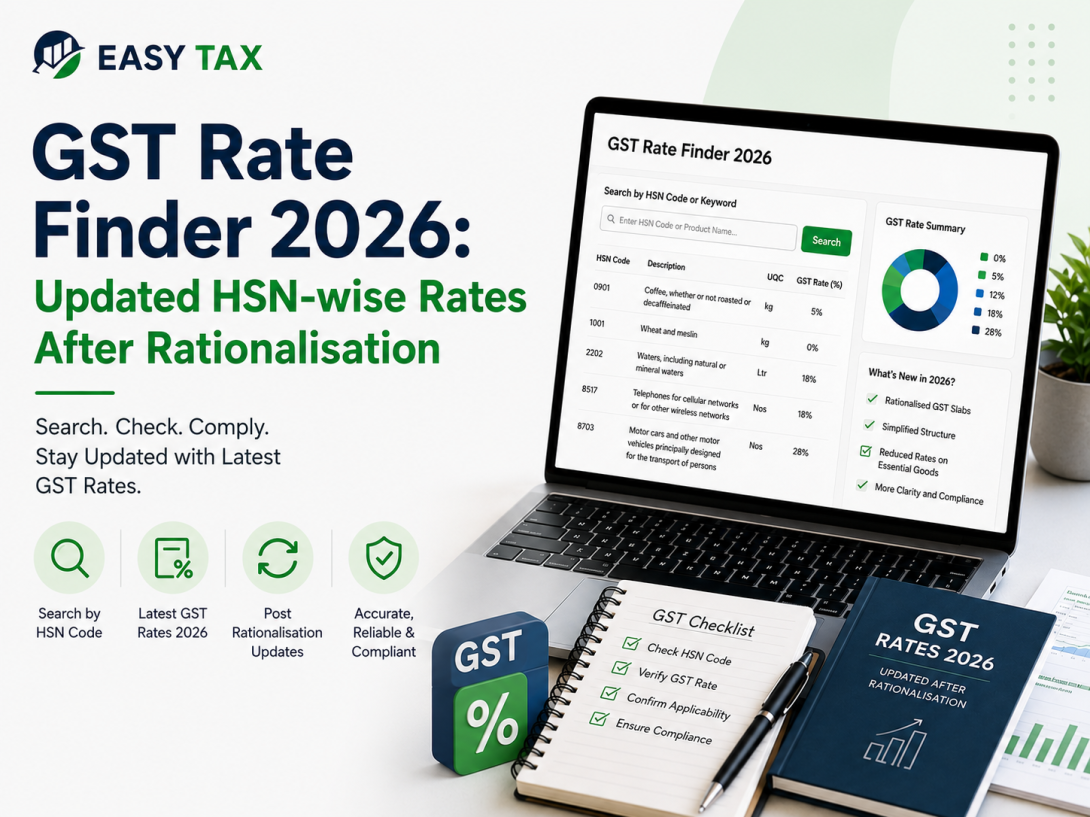
A GST Rate Finder helps you check the current GST rate for any product or service using its HSN code, SAC code, or name. After the 2025 rate rationalisation, India moved to a simplified two-slab structure — 5% and 18% — plus a 40% special rate on select luxury and sin goods. Most essentials are now nil or 5%, while standard goods and services sit at 18%. Always confirm the exact figure against the latest CBIC notification for your specific HSN code.
If you've ever stared at an invoice wondering whether an item should carry 5%, 18%, or something else entirely, you're not alone. For years, finding the correct GST rate meant digging through dozens of notifications and a maze of four different tax slabs. The 2025 GST rationalisation changed that — it stripped India's GST down to a cleaner, simpler structure that's far easier to apply. This guide shows you exactly how to find any GST rate by HSN code, product name, or service in 2026, and walks through what actually changed.
What is a GST Rate Finder?
A GST Rate Finder is a lookup tool that returns the applicable GST rate for a good or service. You search by one of three things:
- HSN code — the Harmonized System of Nomenclature code used for goods.
- SAC code — the Services Accounting Code used for services.
- Product or service name — a plain-language search like "toothpaste" or "consulting".
Getting the rate right matters for more than just the invoice total. The correct HSN and rate flow into your GSTR-1 HSN summary, your e-invoice, and your input tax credit records. A wrong classification can trigger notices and mismatches down the line.
The Updated GST Rate Structure in 2026
Approved at the 56th GST Council meeting in September 2025 and effective from 22 September 2025, the rationalisation collapsed the old four-slab system (5%, 12%, 18%, 28%) into a leaner structure. Here's how the slabs look now:
| Slab | Applies to |
|---|---|
| Nil (0%) | Essential food, several life-saving medicines, individual health & life insurance |
| 5% (Merit rate) | Daily-use and mass-consumption goods and services |
| 18% (Standard rate) | Most other goods and services, including many items that were at 28% |
| 40% (Special rate) | Luxury and sin goods — tobacco, pan masala, aerated drinks, high-end vehicles |
The headline effect: the 12% and 28% slabs are largely gone. Everyday items got cheaper as they shifted to 5%, and many consumer durables that once sat at 28% dropped to 18%. For the fuller picture of how the tax is built, see our overview of the GST structure in India.
How to Find a GST Rate by HSN Code
Finding a rate is a quick, repeatable process once you know the steps:
- Identify the product and its HSN code (or search by product name if you don't know it).
- Enter the code or name into a GST rate finder.
- Match the description carefully — small wording differences can change the slab.
- Note the applicable rate (CGST + SGST for intra-state, or IGST for inter-state).
- Cross-check against the latest GST notifications before applying it.
HSN vs SAC Codes: What's the Difference?
Both are classification codes, but they serve different purposes. HSN codes classify goods; SAC codes classify services and always begin with "99".
| Basis | HSN Code | SAC Code |
|---|---|---|
| Used for | Goods | Services |
| Format | 4, 6 or 8 digits | 6 digits, starts with 99 |
| Digits required | 4 digits if turnover ≤ ₹5 cr; 6 digits if above | 6 digits on tax invoices |
Reporting the right number of HSN digits is a common compliance slip. It also ties in with your Unit Quantity Code (UQC) when you file returns.
EasyTax experts classify your goods and services correctly — and keep your filings notice-proof.
GST Rates on Common Goods (2026)
The table below shows widely-reported post-rationalisation rates for everyday categories. Treat it as a quick reference — always verify the exact figure for your specific HSN code before invoicing.
| Category | Typical GST Rate |
|---|---|
| Fresh & unbranded staples (milk, vegetables, grains) | Nil |
| Packaged foods, soaps, toothpaste, hair oil | 5% |
| Apparel & footwear (mass segment) | 5% |
| TVs, ACs, refrigerators, cement, small cars | 18% |
| Tobacco, pan masala, aerated drinks, luxury cars | 40% |
GST Rates on Common Services (2026)
| Service | Typical GST Rate |
|---|---|
| Healthcare & education (specified) | Exempt |
| Standalone restaurants, passenger transport (specified) | 5% |
| Professional, IT, telecom & most other services | 18% |
What Changed in the 2025 Rationalisation
The reform wasn't just cosmetic. Some of the most talked-about changes include:
- Individual health and life insurance premiums exempted from GST.
- Many life-saving drugs moved to nil or 5%.
- Consumer durables (TVs, ACs, dishwashers) shifted from 28% to 18%.
- Cement and small cars reduced to 18%, lowering construction and mobility costs.
- A new 40% special rate introduced for luxury and sin goods.
Because rates keep evolving through Council decisions, it's worth bookmarking our GST Council updates and latest GST news pages to stay current.
Tips for Using a GST Rate Finder Accurately
- Read the full item description — not just the first matching line.
- Check whether conditions or thresholds apply (e.g., branded vs unbranded).
- Use the correct number of HSN/SAC digits for your turnover.
- Recalculate totals with our GST amount calculator.
- Confirm against the latest notification before finalising an invoice.
Frequently Asked Questions
How many GST slabs are there in 2026?
After the 2025 rationalisation, the main slabs are 5% and 18%, alongside a nil category for essentials and a 40% special rate for luxury and sin goods. The old 12% and 28% slabs were largely removed.
How do I find the GST rate for a product?
Search by the product's HSN code or name in a GST rate finder, match the description precisely, and confirm the rate against the latest CBIC notification.
What is the difference between HSN and SAC codes?
HSN codes classify goods, while SAC codes classify services and always start with "99". Both determine the applicable GST rate.
Is GST applicable on health insurance in 2026?
Individual health and life insurance premiums were exempted from GST under the 2025 rationalisation, making cover more affordable for policyholders.
Why did my HSN code show a different rate this year?
Many items were reclassified during the 2025 rationalisation — several moved from 28% to 18% or from 18% to 5%. Always check the current notification for your HSN code.
Conclusion
The 2025 rationalisation made GST simpler than it has been in years — fewer slabs, cheaper essentials, and a clearer path from HSN code to rate. Still, classification remains the part that trips people up, and getting it wrong can be costly. Use a reliable GST rate finder, match descriptions carefully, and verify against the latest notification every time. When a product sits on the edge of two slabs, a quick expert check before you invoice is the cheapest insurance you'll ever buy.
From classification to GST returns, EasyTax handles it end-to-end.
Reviewed by CA Pritam Sharma. This article is for general information and does not constitute tax advice. GST rates are governed by CBIC notifications and are subject to change; verify the current rate for your specific HSN/SAC code before filing.

