

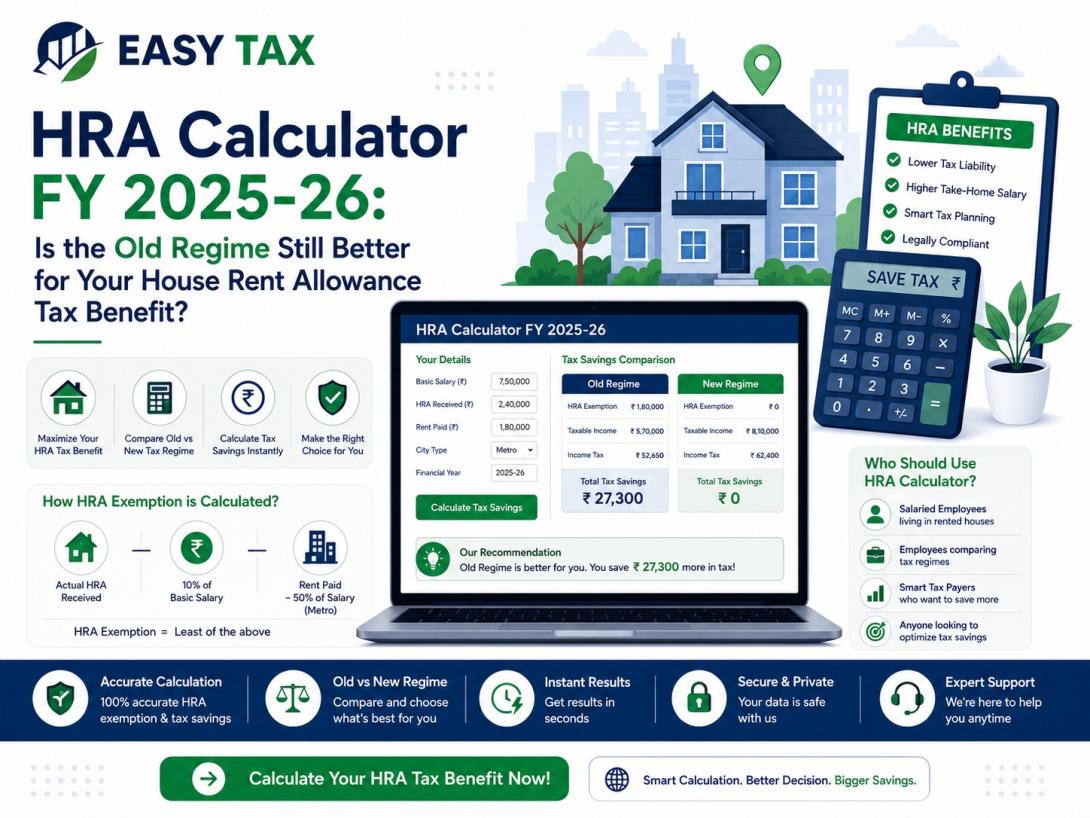
HRA Calculator FY 2025-26: Is Old Regime More Beneficial For Your HRA?
Fast forward to May 2026, as you cross the threshold of salaried life in India right now. The default feature of the New Tax Regime became a reality for every taxpayer with the full force of Income Tax Act 2025. For the people residing in high-rent cities like Bengaluru, Mumbai or Delhi however, a big question hovers over the filing season: Does the House Rent Allowance Tax Benefit India offer enough savings to justify opting back into the Old Tax Regime?
To answer this, you need more than just guesswork; you need a precise Income Tax Section 10(13A) Calculator. Navigating the HRA Exemption Rules 2026 is the only way to ensure you aren't leaving substantial savings on the table.
Exploring the HRA Scenario By the Year 2026 The House Rent Allowance (HRA) forms an integral part in most of the overall salary structures of each and every Indian. The Old Tax Regime under Section 10(13A) permits employees to exempt a part of this allowance from their taxable income. Wrt 2026, this is still one of the very few powerful tax planning tools available but with a huge caveat: HRA exemptions are not given under New Tax Regime.
If you choose the New Regime for its lower tax slabs, your entire HRA component becomes fully taxable. This is why using an HRA Calculator FY 2025-26 is the first step in your tax-saving journey. You must weigh the "slab benefit" of the New Regime against the "deduction benefit" of the Old Regime.
How the Income Tax Section 10(13A) Calculator Works
The calculation for HRA exemption isn't a flat percentage. According to the HRA Exemption Rules 2026, the exempt amount is always the least of the following three figures:
Actual HRA Received: The total HRA amount provided by your employer as per your salary slip.
Rent Paid Minus 10% of Salary: Your annual rent paid minus 10% of your "Basic Salary + Dearness Allowance."
City-Based Limit:
50% of Salary:If you reside in a Metro city (Delhi, Mumbai, Kolkata, Chennai and as of April 2026, recently elevated cities like Bengaluru and Hyderabad).
40% of Salary: For all other non-metro cities.
An accurate HRA Exemption Calculator AY 2026-27 will take these variables into account to show you exactly how much of your taxable income can be slashed.
The 2026 Update: New Metro Classifications
A significant shift occurred on April 1, 2026, when the government updated the city classifications for HRA purposes. Growing tech and commercial hubs—specifically Bengaluru, Pune, Hyderabad, and Ahmedabad—have finally been recognized as "Metros" for tax calculations.
This means if you live in Bengaluru, you can now claim up to 50% of your basic salary as an exemption limit, up from the previous 40%. This 10% jump is a game-changer for high-earning individuals in the tech sector and may be the deciding factor that makes the Old Tax Regime more profitable than the New one.
Documenting Your Claim: HRA Exemption Rules 2026
The tax department has increased its scrutiny of high-value HRA claims this year. To successfully use your HRA Exemption Calculator AY 2026-27 result in your actual filing, you must ensure your documentation is airtight:
Rent Receipts: Required for all claimsMust have a revenue stamp if the rent is more than ₹5000/month.
Landlord’s PAN: If the rent paid by you during the financial year is more than ₹1,00,000 in total then it becomes mandatory to provide the landlord’s PAN.
Rent Agreement: For rentals higher than ₹50,000 in 2026, it is advisable to get a registered rent agreement to avoid impersonalized notices for automated scrutiny.
Digital Footprints: With the 2026 AI-driven audit systems, paying rent via bank transfer or UPI is much safer than cash, as it provides an indisputable trail for the tax authorities.
Old vs. New: The "Break-Even" Analysis
So, the Old Regime better after all? For the sake of an example let us set a 2026 scenario.
Consider a scenario of a professional with an annual income of ₹18 Lakh paying monthly rent of ₹45,000 in Bengaluru.
New Regime They still come under ₹12.75 Lakh zero tax slab (₹12 lkh s—₹60K— standard deduction, ₹15k rebate) but their Rent income of 5.4L a year is Zero benefit.
In the Old Regime: By using the House Rent Allowance Tax Benefit India, they might exempt nearly ₹3 Lakh from their income. When combined with Section 80C and 80D, their taxable income could drop significantly lower than the New Regime's effective rates.
A Tax Liability Calculator combined with your HRA Calculator FY 2025-26 will show you the "Tipping Point." Generally, if your total deductions (HRA + 80C + 24b) exceed ₹4.5 Lakh, the Old Regime usually wins.
Common Pitfalls to Avoid
Fake HRA Claims: The AI-driven e-Filing Tax Calculator 2026 portal now cross-references your rent payment with your landlord's income tax return. If your landlord doesn't report the rent you claim to pay, you will likely receive a notice.
Shared Accommodation: If you share a flat, you can only claim HRA for the portion of the rent you actually pay.
Rent to Parents: This is legal in 2026, but only if there is a formal agreement, actual bank transfers, and the parent includes that rent in their own income tax return.
Conclusion
The decision to choose between regimes in 2026 is a math problem, not a matter of opinion. While the New Regime offers simplicity, the House Rent Allowance Tax Benefit India remains a formidable reason to stick with the Old Regime for those facing high urban living costs.
By utilizing a precise Income Tax Section 10(13A) Calculator and staying updated with the HRA Exemption Rules 2026, you ensure that your hard-earned money stays in your pocket rather than going to the tax man. Before you click "Submit" on your return this May, run your numbers through an HRA Calculator FY 2025-26. Those ten minutes of calculation could save you a month's salary in taxes.
