

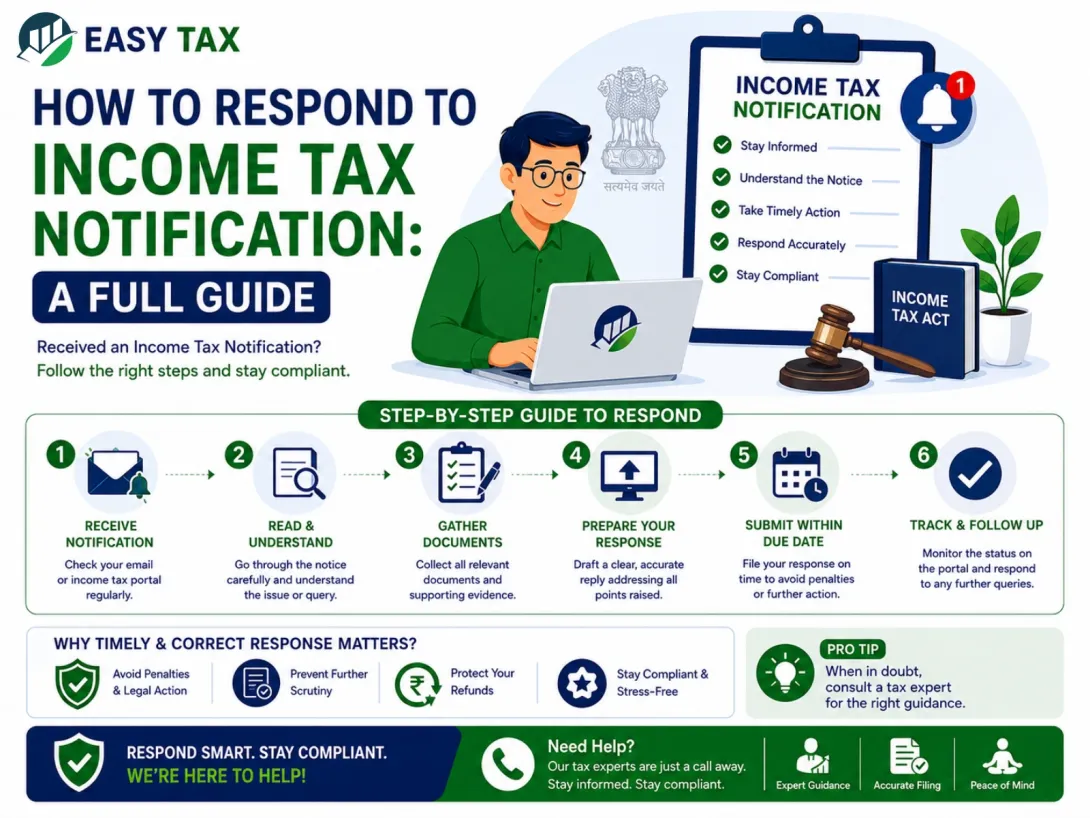
How to Respond to an Income Tax Notice in India: Complete Step-by-Step Guide (2026)
Receiving an income tax notice can be stressful for individuals and businesses. However, it is important to understand that a tax notice does not always mean wrongdoing. In many cases, it is simply a communication from the Income Tax Department seeking clarification, additional information, or correction of discrepancies.
Understanding the type of notice and responding correctly within the deadline is essential to avoid penalties, interest, or legal complications.
This guide explains how to respond to an income tax notice in India, the types of notices issued, and the correct step-by-step process to handle them efficiently.
What is an Income Tax Notice?
An income tax notice is an official communication issued by the Income Tax Department to a taxpayer for various reasons such as:
- Mismatch in income details
- Non-filing of Income Tax Return (ITR)
- Underreporting of income
- Demand for additional tax
- Verification of financial information
It is issued under different sections of the Income Tax Act, 1961 depending on the situation.
Common Types of Income Tax Notices and Their Meaning
Understanding the type of notice is the first and most important step in responding correctly.
1. Notice under Section 142(1) – Inquiry Before Assessment
This notice is issued when:
- You have not filed your income tax return
- The department needs additional documents or clarification
How to respond:
- File your pending ITR immediately
- Submit required documents such as income proof, bank statements, and financial records
- Provide written explanation if needed
2. Notice under Section 143(1) – Intimation After Return Processing
This is not a penalty notice. It is a summary of your return after processing.
It may show:
- Tax payable
- Refund amount
- Calculation adjustments
How to respond:
- Verify details carefully
- If correct, no action is needed
- If incorrect, file a rectification request
3. Notice under Section 143(2) – Scrutiny Assessment Notice
This is issued when your return is selected for detailed scrutiny.
Reasons may include:
- High-value transactions
- Mismatch in income reporting
- Random selection for audit
How to respond:
- Submit all supporting documents
- Provide explanations for income sources
- Respond within the given timeline
4. Notice under Section 148 – Income Escaping Assessment
This notice is issued when the department believes:
- You have not disclosed some income
- Income has escaped taxation
How to respond:
- Review your financial records carefully
- Submit revised or updated return if required
- Provide supporting documentation
5. Notice under Section 156 – Demand Notice
This notice indicates:
- Outstanding tax liability
- Interest or penalty payable
How to respond:
- Pay the demand if correct
- File an appeal if you disagree
- Respond within deadline to avoid recovery action
Step-by-Step Guide to Respond to Income Tax Notice
Handling an income tax notice properly requires a structured approach.
Step 1: Read the Notice Carefully
Do not ignore or panic. Carefully check:
- Section under which notice is issued
- Reason for notice
- Deadline for response
- Required documents
Understanding the notice type is the foundation of correct response.
Step 2: Verify Your Income Tax Records
Cross-check the notice with:
- Filed Income Tax Return
- Form 16 / Form 26AS
- AIS (Annual Information Statement)
- Bank statements
- Investment proofs
This helps identify mismatches or errors.
Step 3: Identify the Issue Clearly
Determine whether the issue is:
- Missing income
- Incorrect calculation
- Document mismatch
- Late filing
- TDS mismatch
Accurate identification helps in preparing the correct response.
Step 4: Collect Supporting Documents
Prepare all required documents such as:
- Income proof
- Salary slips
- Business invoices
- Bank statements
- Investment proof
- Expense records
Proper documentation is critical for successful resolution.
Step 5: Prepare Your Response
You can respond in different ways depending on the notice:
- Submit explanation letter
- Upload documents online
- File revised return
- Accept and pay tax demand
Make sure your response is clear and supported by evidence.
Step 6: Submit Response Online
Responses are generally submitted through the Income Tax e-Filing portal:
- Login to income tax portal
- Go to “e-Proceedings” or “Pending Actions”
- Select the notice
- Upload documents and submit response
Step 7: Track Status Regularly
After submission:
- Monitor portal updates
- Check for further queries
- Respond promptly if additional clarification is requested
Important Tips to Handle Income Tax Notices
1. Do Not Ignore Notices
- Penalties
- Interest charges
- Legal proceedings
2. Always Respond Within Deadline
Late response may result in:
- Adverse assessment
- Additional tax liability
3. Maintain Proper Financial Records
Good record-keeping helps avoid:
- Errors in tax filing
- Mismatches in data
4. Verify AIS and Form 26AS
Always ensure:
- Income matches department records
- TDS credits are correctly reflected
5. Seek Professional Help if Needed
Complex notices require expert handling to avoid mistakes.
Common Mistakes While Responding to Tax Notices
- Ignoring the notice
- Submitting incomplete documents
- Providing incorrect explanations
- Missing deadlines
- Not verifying AIS data
Avoiding these mistakes ensures smooth resolution.
How Easy Tax Helps in Responding to Income Tax Notices
Handling tax notices can be complex. Easy Tax provides professional assistance to taxpayers in India.
Services include:
- Notice analysis and interpretation
- Drafting professional responses
- Document preparation and verification
- Online submission support
- Representation before tax authorities
- Assistance in rectification or appeal cases
Benefits of Professional Support:
- Accurate response preparation
- Reduced risk of penalties
- Faster resolution
- Compliance assurance
When Should You Take Expert Help?
You should consult a tax professional if:
- Notice involves high tax demand
- Scrutiny under Section 143(2)
- Income mismatch is complex
- Multiple financial sources exist
- You are unsure how to respond
Frequently Asked Questions (FAQs)
1. What should I do if I receive an income tax notice?
Read it carefully, understand the reason, and respond within the deadline.
2. Can I ignore an income tax notice?
No. Ignoring can lead to penalties and legal action.
3. How do I reply to a tax notice online?
Log in to the Income Tax portal and respond under “e-Proceedings.”
4. Can I revise my return after a notice?
Yes, in certain cases you can file a revised return.
5. What if I disagree with the notice?
You can submit an explanation or file an appeal.
Conclusion
Responding to an income tax notice in India requires careful analysis, proper documentation, and timely action. Each notice has a different purpose, and understanding it correctly is the key to avoiding penalties and complications.
By following a structured response process—reviewing the notice, verifying records, collecting documents, and submitting an accurate reply—you can handle tax notices efficiently.
However, if the situation is complex, professional assistance can make the process smooth and error-free. Expert support ensures compliance, accuracy, and peace of mind.
Easy Tax helps individuals and businesses respond to income tax notices efficiently, ensuring proper resolution and full compliance with Indian tax laws.
