

Section 143(1) of the Income Tax Act is one of the most common notices taxpayers receive after filing an Income Tax Return in India. If you file ITR online through the income tax portal, your return is electronically processed by the Centralised Processing Centre (CPC), and an intimation under Section 143(1) may be issued.
Many salaried employees, freelancers, investors, and business owners panic after receiving this email because they assume it is a tax notice or legal action. In reality, Section 143(1) is often a routine communication showing whether your filed return matches the department’s records.
This guide explains:
- what Section 143(1) means,
- why you receive it,
- how to read the intimation,
- common Section 143(1) adjustments,
- how to respond,
- and what mistakes taxpayers should avoid in 2026.
What is Section 143(1) of the Income Tax Act?
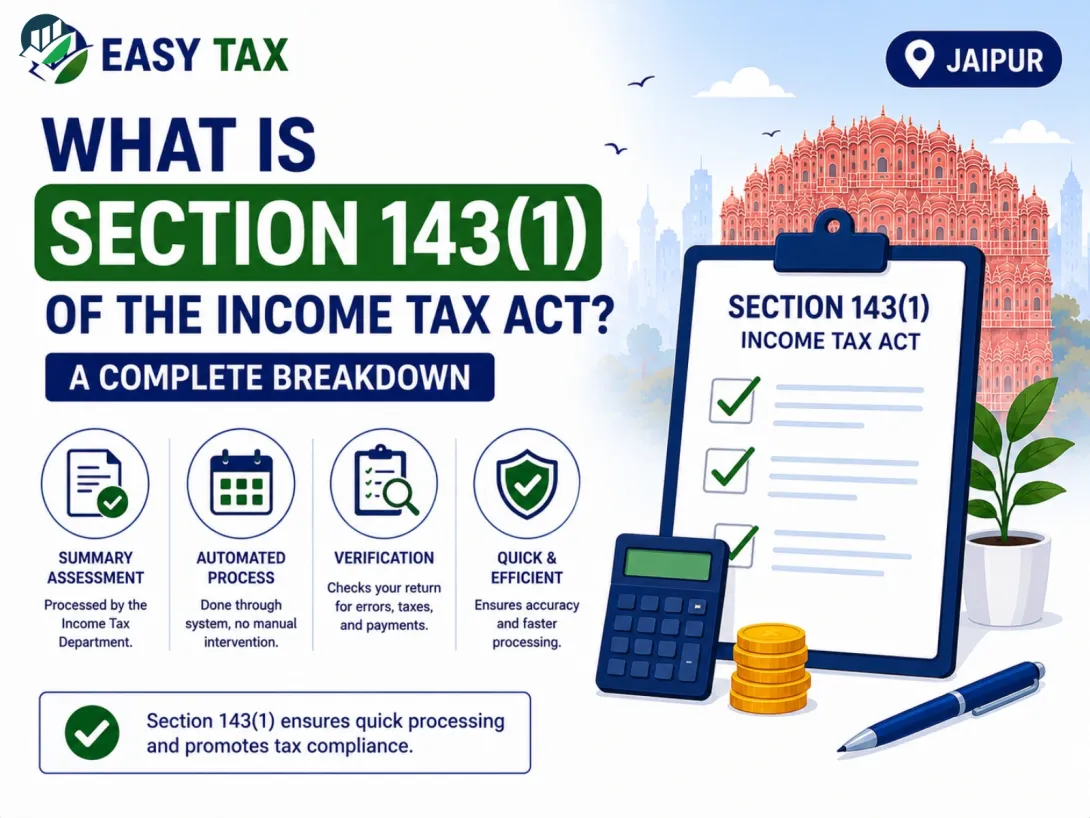
Section 143(1) of the Income Tax Act is an automated preliminary assessment of your Income Tax Return by the Income Tax Department.
This section allows the department to compare your filed ITR with available tax records like Form 26AS, AIS (Annual Information Statement), TDS details, and salary information. After verification, the department issues an intimation showing whether your return is accepted, adjusted, refunded, or tax is payable.
The processing is usually done electronically by CPC Bengaluru without human intervention. The system checks:
- calculation errors,
- incorrect deduction claims,
- TDS mismatches,
- underreported income,
- and tax payment differences.
For example, if you claim ₹80,000 under Section 80C but your documents reflect only ₹50,000, the system may make a Section 143(1) adjustment.
As per the Income Tax Department’s processing framework, Section 143(1) is not full scrutiny assessment under Section 143(3).
Why do you receive an intimation under Section 143(1)?
You receive an intimation under Section 143(1) after your Income Tax Return is processed by the department.
The Income Tax Department uses Section 143(1) to communicate the result of ITR processing. The intimation informs you whether:
- your return matches tax records,
- you are eligible for refund,
- additional tax is payable,
- or adjustments have been made.
A Section 143(1) notice may contain:
- “No Demand No Refund”
- Refund amount
- Outstanding tax demand
- Adjustment details
Most taxpayers receive this intimation within a few months after ITR verification.
For example: A salaried employee in Jaipur files ITR-1 showing ₹25,000 refund. After CPC verification, the department confirms the refund and sends Section 143(1) intimation.
What details are mentioned in a Section 143(1) intimation?
A Section 143(1) intimation contains processed income details, tax calculations, deductions, and refund or demand information.
The notice compares:
- income declared by you,
- income computed by the department,
- deductions claimed,
- taxes paid,
- and final tax liability.
| Section | Details |
|---|---|
| Return Filed | Income declared by taxpayer |
| Processed Return | Income calculated by department |
| Tax Paid | TDS, advance tax, self-assessment tax |
| Adjustments | Disallowed deductions or mismatches |
| Final Outcome | Refund, demand, or no change |
You should carefully check all calculations because mismatches may create unnecessary tax demands.
What are the common Section 143(1) adjustments?
Section 143(1) adjustments usually happen because of mismatches between your ITR and department records.
The Income Tax Department automatically compares your filed return with AIS, Form 26AS, employer TDS returns, and bank-reported transactions. If differences are found, adjustments may be made under Section 143(1).
Common adjustments include:
- incorrect deduction claims,
- mismatch in TDS,
- wrong tax calculation,
- unreported FD interest,
- duplicate deductions,
- or incorrect exemption claims.
Common Section 143(1) Adjustment Types
| Adjustment Type | Reason |
|---|---|
| TDS mismatch | Incorrect TDS claim |
| Deduction disallowed | Unsupported deduction |
| Income mismatch | Income missing in ITR |
| Tax mismatch | Incorrect tax calculation |
| Refund reduction | Outstanding demand adjustment |
For example: An investor in Mumbai earns ₹18,000 FD interest but forgets to report it in ITR. The AIS reflects the interest, leading to Section 143(1) adjustment.
How can you check a Section 143(1) notice online?
You can check your Section 143(1) notice through the income tax portal login dashboard.
The notice is available under: “e-Proceedings” or “View Filed Returns” section on the official income tax portal.
Steps to check Section 143(1) intimation online
- Visit the income tax portal
- Login using PAN and password
- Go to “e-File”
- Open “Income Tax Returns”
- Click “View Filed Returns”
- Select assessment year
- Download Section 143(1) intimation PDF
The password-protected PDF usually opens using:
- PAN in lowercase
- date of birth in DDMMYYYY format
Example: If PAN is ABCDE1234F and DOB is 15 August 1995: Password = abcde1234f15081995
Does a Section 143(1) notice mean scrutiny?
No, Section 143(1) notice does not automatically mean scrutiny assessment.
| Section | Meaning | Purpose |
|---|---|---|
| Section 143(1) | Automated intimation | Return processing |
| Section 143(2) | Scrutiny notice | Detailed investigation |
Section 143(2) involves detailed examination by an Assessing Officer, while Section 143(1) is mainly system-generated.
How should you respond to a Section 143(1) notice?
You should first verify whether the adjustment or demand shown in the notice is correct.
You should compare the notice with:
- Form 26AS,
- AIS,
- salary slips,
- deduction proofs,
- and filed ITR details.
Steps to respond to Section 143(1)
- Download the notice
- Compare filed and processed data
- Identify mismatch reason
- Verify TDS and deductions
- Rectify mistake if required
- Pay outstanding demand if valid
- File rectification request if incorrect
If the adjustment is wrong, you can file online rectification under Section 154.
What happens if you ignore a Section 143(1) notice?
Ignoring a valid Section 143(1) tax demand may result in penalties, interest, or future recovery action.
The department may:
- charge interest,
- adjust future refunds,
- or initiate recovery proceedings.
However, if the notice only says: “No Demand No Refund” then no action is required.
What mistakes should taxpayers avoid while filing ITR?
| Mistake | Possible Result |
|---|---|
| Wrong TDS claim | Tax demand |
| Missing FD interest | Income mismatch |
| Incorrect deduction | Adjustment notice |
| Wrong bank details | Refund delay |
| Unverified ITR | Return invalid |
FAQs
What is Section 143(1) notice in simple words?
Section 143(1) notice is an intimation sent after your Income Tax Return is processed by the Income Tax Department.
Is Section 143(1) notice serious?
Section 143(1) notice is usually not serious because it is mainly an automated processing intimation.
Can I get refund after Section 143(1)?
Yes, many taxpayers receive refunds through Section 143(1) intimation.
What is Section 143(1) adjustment?
Section 143(1) adjustment means the Income Tax Department modified certain values while processing your return.
How can I respond to Section 143(1) demand notice?
You can respond by checking whether the tax demand is correct.
What happens if I ignore Section 143(1)?
Ignoring Section 143(1) demand notices may result in interest, penalties, or adjustment of future refunds.
Is Section 143(1) different from scrutiny notice?
Yes, Section 143(1) is different from scrutiny notice under Section 143(2).
How long does CPC take to process ITR?
CPC Bengaluru usually processes simple ITRs within a few weeks or months after verification.
Conclusion
Section 143(1) of the Income Tax Act is mainly an automated communication sent after your ITR is processed.
EasyTax helps salaried individuals, investors, and taxpayers with ITR filing, Section 143(1) notice review, rectification support, and tax compliance assistance across India.
