
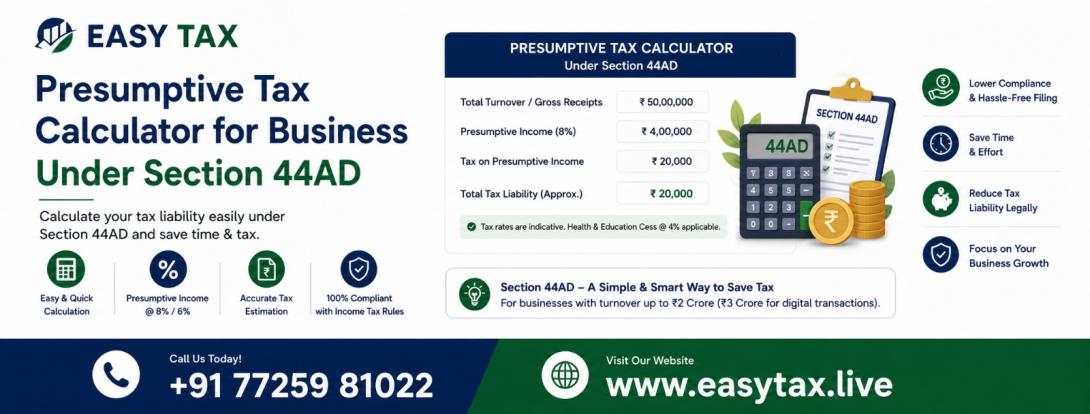
Presumptive Tax Calculator for Business Under Section 44AD
Section 44AD Presumptive Tax Calculator for Business in India (2026–27)
The presumptive taxation scheme can simplify income calculation for certain small businesses in India. This guide explains who may qualify, how the 6% and 8% rates work, the turnover limits and how to estimate presumptive business income using the calculator below.
Which provision applies to your income?
- FY 2025–26 / AY 2026–27: the Income-tax Act, 1961 applies. The business presumptive scheme is section 44AD.
- FY 2026–27 / Tax Year 2026–27: the Income-tax Act, 2025 applies. The corresponding business scheme is section 58(2), Table entry 1.
Do not treat AY 2026–27 and Tax Year 2026–27 as the same period.
Presumptive business income calculator
Use this calculator to estimate presumptive business profit under the general business scheme. It does not calculate your final income-tax liability.
Calculation result
This is an educational estimate for the general business category. It does not determine eligibility in complex cases, compute tax on salary or other income, apply tax slabs, rebates, surcharge or cess, or replace a review of your records by a qualified tax professional.
How presumptive taxation works
Under presumptive taxation, eligible taxpayers calculate business income using a prescribed percentage or amount instead of computing profit by separately deducting ordinary business expenses from turnover.
For a general eligible business under section 58(2), Table entry 1 of the Income-tax Act, 2025, the presumptive amount is based on specified banking or online-mode receipts and the remaining turnover. The amount claimed as actual profit is compared with the presumptive amount; the higher amount is taken into account under the provision.
The corresponding earlier provision was section 44AD of the Income-tax Act, 1961. For income earned in FY 2025–26, check the earlier law and the applicable return-year guidance.
Who can use the presumptive scheme for general businesses?
For the general business category in section 58(2), Table entry 1, an eligible assessee must satisfy the statutory conditions. In broad terms, the eligible assessee is:
- A resident individual;
- A resident Hindu Undivided Family (HUF); or
- A resident partnership firm other than a limited liability partnership (LLP).
The eligible-assessee definition also excludes a person who:
- Has claimed a deduction under Chapter VIII-C for the relevant tax year;
- Carries on a specified profession covered by the separate professional scheme;
- Earns income in the nature of commission or brokerage; or
- Carries on an agency business.
A business description alone does not establish eligibility. Review the legal form, residential status, nature of receipts and all statutory conditions before choosing the scheme.
Turnover limits under the presumptive business scheme
The general business turnover ceiling is determined by the amount of cash receipts during the relevant period.
| Cash-receipt condition | Maximum turnover / gross receipts |
|---|---|
| Cash receipts do not exceed 5% of total turnover or gross receipts | ₹3 crore |
| Cash receipts exceed 5% of total turnover or gross receipts | ₹2 crore |
The 5% condition is a test for the higher turnover ceiling. It does not mean that every receipt which is not cash automatically qualifies for the 6% rate. The 6% rate has its own specified banking or online-mode condition.
If turnover exceeds the applicable ceiling, the general business presumptive scheme is not available for that business for the relevant period.
How the 6% and 8% presumptive rates work
For the general business category under section 58(2), Table entry 1:
- 6%: turnover or gross receipts received through a specified banking or online mode during the tax year or by the applicable return due date referred to in section 263(1).
- 8%: the remaining turnover or gross receipts not covered by the qualifying 6% category.
The law also compares this calculation with the profit claimed to have actually been earned. The higher amount applies.
Do not automatically classify every bank transfer, card receipt, wallet receipt or other non-cash receipt as eligible for 6%. Confirm that the payment method and receipt timing meet the applicable statutory and prescribed conditions.
Example: calculating presumptive business income
Assume an eligible resident business has total turnover of ₹40,00,000. Of this amount, ₹30,00,000 meets the specified banking or online-mode condition for the 6% rate. The remaining ₹10,00,000 is subject to the 8% rate.
| Particulars | Amount | Calculation |
|---|---|---|
| Qualifying specified-mode receipts | ₹30,00,000 | ₹30,00,000 × 6% = ₹1,80,000 |
| Remaining receipts | ₹10,00,000 | ₹10,00,000 × 8% = ₹80,000 |
| Presumptive business income | ₹2,60,000 | ₹1,80,000 + ₹80,000 |
If the taxpayer claims that actual business profit is higher than ₹2,60,000, the higher actual-profit amount is relevant under the provision. This example assumes the taxpayer independently meets all eligibility and turnover conditions.
₹2,60,000 is the estimated presumptive business income in this example. It is not necessarily the taxpayer's final total income or final income-tax liability. Other income and applicable tax provisions must be considered separately.
Books of account and tax audit: important conditions
Presumptive taxation simplifies the computation of business income, but it does not remove every record-keeping or audit obligation in every situation.
When a taxpayer claims lower actual profit
Section 58(3) addresses a case where the taxpayer claims that actual profits are lower than the amount computed under the presumptive table. If the taxpayer's total income exceeds the maximum amount not chargeable to tax, the provision requires books and documents under section 62 and an audit under section 63.
When the scheme is discontinued
Section 58(7) contains a continuity restriction for an eligible assessee who uses the general business presumptive scheme and subsequently declares profits in a manner contrary to the prescribed provision during the relevant five succeeding tax years. The restriction can prevent the taxpayer from claiming the benefit for five tax years after the year of the breach.
The related books and audit consequences are addressed in section 58(8). The effect depends on the taxpayer's facts and should be checked before leaving the scheme.
Advance tax under presumptive taxation
Under section 408(2) of the Income-tax Act, 2025, an assessee using the presumptive taxation scheme under section 58 is required to discharge the entire advance-tax liability in one instalment on or before 15 March of the relevant financial year.
This is the advance-tax payment timetable for the presumptive scheme. The calculator above does not determine whether you have an advance-tax liability or calculate the amount payable. That requires your complete tax position, including other income, tax deducted at source, tax regime and applicable tax rates.
Refer to the official Income Tax Department tax-payment FAQ for the applicable period and payment-year selection.
Records and information to keep ready
The exact documents needed depend on the business and the taxpayer's circumstances. The following records are useful when checking eligibility and preparing the return:
- Sales register or turnover summary;
- Invoices and bills issued to customers;
- Bank statements and payment settlement reports;
- Details of cash receipts;
- Details of receipts through specified banking or online modes;
- Details of non-account-payee cheques or bank drafts, where relevant;
- Details of other income, tax deducted at source and advance tax paid;
- Prior-year income-tax returns and presumptive-scheme history.
Keep the supporting records required under the applicable law and rules. This list is a practical preparation aid, not a complete statutory document checklist for every taxpayer.
Frequently asked questions
Is Section 44AD still applicable in 2026–27?
Section 44AD applies to the relevant periods governed by the Income-tax Act, 1961, including FY 2025–26 / AY 2026–27. For Tax Year 2026–27 onwards, the corresponding resident presumptive taxation provisions are consolidated in section 58 of the Income-tax Act, 2025.
What is the turnover limit for the general business scheme?
The general limit is ₹2 crore. It increases to ₹3 crore where cash receipts do not exceed 5% of total turnover or gross receipts, subject to the other eligibility conditions.
Is the presumptive income always 8% of turnover?
No. The general business calculation uses 6% for qualifying specified banking or online-mode receipts and 8% for the remaining turnover or gross receipts. The actual profit claimed is compared with the presumptive calculation; the higher amount applies.
Can an agency business use the general business scheme?
An assessee carrying on an agency business is excluded from the eligible-assessee definition for the general business category. Commission or brokerage income is also excluded. Review the exact facts before choosing a different tax treatment.
Can an LLP use the general business presumptive scheme?
No. The eligible-assessee definition for the general business category includes a resident firm other than an LLP, along with resident individuals and resident HUFs.
Does the calculator show my final income tax?
No. It estimates presumptive business income only. Final tax depends on total income, other income sources, the applicable tax regime, tax rates, deductions, rebates, surcharge and cess, where relevant.
Can I claim ordinary business expenses again after using the scheme?
Section 58(4) does not allow a loss, allowance or deduction under the Act against income computed under the presumptive method in section 58(2). The calculation should not be reduced again by ordinary operating expenses.
When is advance tax payable under the presumptive scheme?
For an assessee using section 58, section 408(2) provides for the entire advance-tax liability to be paid in one instalment on or before 15 March of the relevant financial year, subject to the applicable advance-tax provisions.
Does choosing presumptive taxation mean I never need books or an audit?
No. Section 58(3) and section 58(7)–(8) provide specific circumstances in which books and audit requirements can apply. Review these provisions before declaring profits below the presumptive amount or discontinuing the scheme.
Is this calculator suitable for professionals or goods-carriage businesses?
No. This calculator is designed for the general business category only. Specified professions and goods-carriage businesses have separate entries under section 58 and require different calculations.
Need help preparing your income-tax return?
Review the income-tax filing options available through EasyTax if you need help with your return or want to understand the next steps for your business income.
Official sources and legal references
The following primary government sources support the statutory explanations in this article. Check the applicable period and current amendments before relying on a provision for a return.
- Income-tax Act, 2025 — section 58: Special provision for computing profits and gains of business or profession on a presumptive basis in the case of certain residents. Refer particularly to section 58(2), Table entry 1, and subsections (3), (4), (7), (8), (9) and (11). Read section 58 on the Income Tax Department's official site .
- Income Tax Department — Objective and scope of the new Act FAQs: Effective date, transition from the 1961 Act, Tax Year and consolidation of presumptive-taxation provisions into section 58. Read the official FAQs .
- Income Tax Department — ITR-4 FAQs: Earlier section 44AD eligibility, exclusions, turnover limits and presumptive-taxation guidance relevant to AY 2026–27. Read the ITR-4 FAQs .
- Income Tax Department — Tax Payments FAQs: Advance-tax payment for presumptive taxpayers under section 408(2) of the Income-tax Act, 2025. Read the Tax Payments FAQs .
- Income Tax Department — Income Tax Forms FAQs: Tax audit provisions under section 63, corresponding forms and related compliance information. Read the Income Tax Forms FAQs .






EasyTax • Jaipur
GST Return Filing & Compliance
Timely GSTR-1 & GSTR-3B filing, 100% ITC matching and department notice defense by certified GST experts.