

Quick Answer
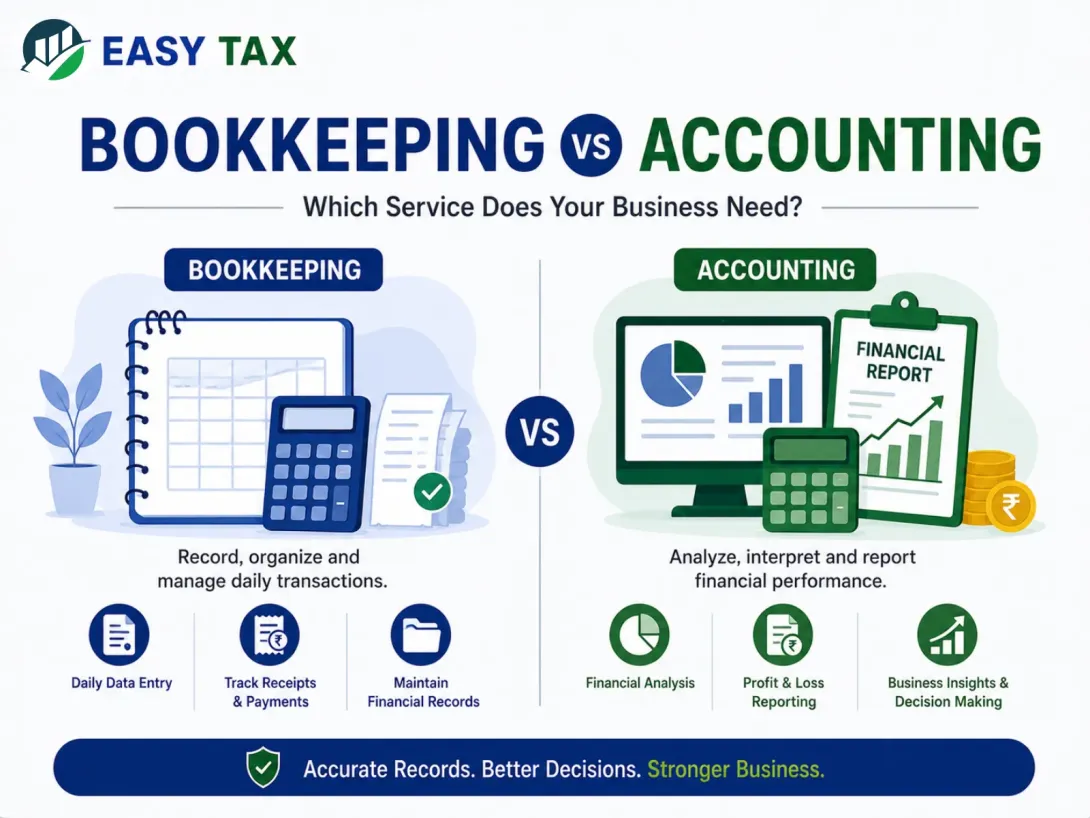
Bookkeeping and accounting are closely related but serve different purposes. Bookkeeping focuses on recording daily financial transactions such as sales, purchases, receipts, and payments. Accounting goes a step further by analyzing financial data, preparing reports, ensuring compliance, and supporting business decisions. Most businesses need both bookkeeping and accounting services to maintain accurate records, manage taxes, improve cash flow, and achieve sustainable growth.
Introduction
Every successful business relies on accurate financial information. Whether you run a startup, retail shop, manufacturing unit, consultancy, or e-commerce business, managing finances properly is essential for profitability and compliance.
Many business owners use the terms bookkeeping and accounting interchangeably. While they are closely connected, they are not the same.
Bookkeeping focuses on maintaining accurate financial records, whereas accounting helps interpret those records to make informed business decisions.
Understanding the difference between bookkeeping and accounting can help you choose the right financial support for your business and avoid costly mistakes. For broader context on how these services fit together, you can also read about EasyTax's full range of tax, GST registration, and compliance services.
What Is Bookkeeping?
Bookkeeping is the process of recording, organizing, and maintaining a business's day-to-day financial transactions.
It serves as the foundation of a company's financial management system. Without proper bookkeeping, businesses may struggle with tax compliance, cash flow management, and financial reporting.
Meaning of Bookkeeping
Bookkeeping involves systematically recording all financial activities of a business, including:
- Sales transactions
- Purchase transactions
- Cash receipts
- Cash payments
- Bank transactions
- Expense records
- Customer payments
- Supplier payments
The primary goal is to ensure every financial transaction is properly documented and categorized.
Purpose of Bookkeeping
The purpose of bookkeeping is to:
- Maintain accurate financial records.
- Track income and expenses.
- Support tax compliance.
- Monitor cash flow.
- Facilitate financial reporting.
- Provide data for accounting and analysis.
Importance of Bookkeeping
Accurate bookkeeping helps businesses:
- Maintain Financial Accuracy — Proper records reduce errors and discrepancies.
- Manage Cash Flow — Business owners can track money coming in and going out.
- Prepare for Taxes — GST returns, TDS filings, and income tax returns depend on accurate records.
- Improve Decision-Making — Reliable financial data helps owners understand business performance.
- Meet Compliance Requirements — Regulatory filings become easier when records are maintained properly.
Daily Activities Included in Bookkeeping
Bookkeepers typically handle:
- Recording sales invoices.
- Entering purchase bills.
- Updating bank transactions.
- Tracking business expenses.
- Managing accounts receivable.
- Managing accounts payable.
- Performing bank reconciliations.
- Maintaining ledgers.
- Organizing financial documents.
Example of Bookkeeping
Suppose a retail store makes:
- Sales of ₹50,000.
- Purchases of ₹20,000.
- Rent payment of ₹10,000.
A bookkeeper records these transactions accurately in the accounting system so that financial reports can later be prepared.
What Is Accounting?
Accounting is the process of analyzing, classifying, summarizing, interpreting, and reporting financial information to support business decisions and compliance requirements.
Accounting uses data generated through bookkeeping and transforms it into meaningful financial insights.
Meaning of Accounting
Accounting involves:
- Financial analysis.
- Financial reporting.
- Tax planning.
- Compliance management.
- Business performance evaluation.
Accountants use bookkeeping records to prepare financial statements and provide strategic guidance.
Purpose of Accounting
The purpose of accounting is to:
- Measure business performance.
- Prepare financial statements.
- Ensure legal compliance.
- Support business planning.
- Improve profitability.
- Assist in tax planning.
Financial Analysis in Accounting
Accounting helps answer important questions such as:
- Is the business profitable?
- Are expenses increasing?
- Is cash flow healthy?
- What is the business's financial position?
- How can taxes be optimized legally?
Financial Reporting
Accountants prepare key financial reports such as:
- Profit and Loss Statement — Shows business income and expenses.
- Balance Sheet — Shows assets, liabilities, and owner's equity.
- Cash Flow Statement — Tracks movement of cash.
- Financial Ratios — Measures profitability, liquidity, and efficiency.
Compliance and Tax Reporting
Accounting supports GST compliance, income tax compliance, TDS compliance, MCA compliance, and audit requirements. When records are well maintained, it also becomes far easier to respond correctly to an income tax notice should one arrive.
Example of Accounting
Using bookkeeping records, an accountant may determine:
- Annual profit = ₹12 lakh.
- Gross margin = 35%.
- GST liability = ₹1.5 lakh.
- Cash flow concerns in certain months.
The accountant can then advise the business owner on corrective actions.
Bookkeeping vs Accounting: Key Differences
Bookkeeping focuses on recording transactions, while accounting focuses on analyzing and interpreting financial information.
| Basis | Bookkeeping | Accounting |
|---|---|---|
| Purpose | Record transactions | Analyze and interpret financial data |
| Focus | Daily financial records | Financial reporting and decision-making |
| Scope | Data entry and record keeping | Analysis, planning, and compliance |
| Skills Required | Record maintenance | Financial expertise and analytical skills |
| Reports Generated | Ledgers and transaction records | Financial statements and management reports |
| Decision Making | Limited | Extensive |
| Tax Planning | Usually not involved | Major responsibility |
| Compliance | Supports compliance | Manages compliance |
| Software Used | Tally, Zoho Books, Busy | Tally, Zoho Books, ERP systems, financial tools |
| Strategic Advice | No | Yes |
Why Are Both Bookkeeping and Accounting Important?
Bookkeeping and accounting work together to provide accurate financial information and support business growth.
Without bookkeeping, accountants would not have reliable data to analyze. Without accounting, businesses would struggle to convert data into meaningful decisions.
Financial Accuracy
Bookkeeping ensures transactions are recorded correctly, and accounting verifies and analyzes those records.
Compliance
Both functions help businesses comply with GST laws, income tax regulations, TDS requirements, and MCA compliance obligations.
Tax Planning
Accurate records help accountants calculate taxes correctly, identify deductions, avoid penalties, and improve tax efficiency. Salaried business owners and professionals can also benefit from these tax-saving tips under the new regime.
Cash Flow Management
Bookkeeping tracks cash movement, while accounting identifies trends and recommends improvements.
Business Growth
Together, bookkeeping and accounting help businesses increase profitability, improve budgeting, control costs, secure funding, and scale operations effectively.
Services Included in Bookkeeping
Bookkeeping services focus on recording and organizing financial transactions.
| Service | Purpose |
|---|---|
| Sales Entry Recording | Track revenue |
| Purchase Entry Recording | Track expenses |
| Expense Recording | Monitor business spending |
| Bank Reconciliation | Match books with bank records |
| Cash Book Maintenance | Record cash transactions |
| Accounts Receivable Management | Track customer payments |
| Accounts Payable Management | Track supplier payments |
| Ledger Maintenance | Organize financial records |
| Invoice Recording | Maintain transaction history |
| Document Management | Preserve supporting records |
Services Included in Accounting
Accounting services help businesses understand financial performance and maintain compliance.
| Service | Purpose |
|---|---|
| Financial Statement Preparation | Measure business performance |
| Profitability Analysis | Evaluate earnings |
| Tax Planning | Reduce tax risks |
| GST Compliance | Meet indirect tax obligations |
| Budgeting | Plan future spending |
| Cash Flow Analysis | Improve liquidity |
| Ratio Analysis | Assess financial health |
| Financial Forecasting | Support growth planning |
| Compliance Reporting | Meet legal requirements |
| Business Advisory Services | Strategic decision-making support |
Key Takeaway
Bookkeeping records the financial story of your business, while accounting interprets that story and helps you make informed decisions. Most growing businesses require both functions to ensure compliance, profitability, and long-term success.
Bookkeeper vs Accountant: Roles and Responsibilities
Bookkeepers and accountants perform different but complementary roles. A bookkeeper focuses on recording financial transactions, while an accountant analyzes financial data, prepares reports, and provides strategic advice. If you are weighing whether to bring in professional expertise, this guide on why your business needs a chartered accountant is worth reading.
| Basis | Bookkeeper | Accountant |
|---|---|---|
| Primary Function | Record transactions | Analyze financial data |
| Qualification | Accounting knowledge | Professional accounting expertise |
| Daily Tasks | Data entry, reconciliation | Reporting, analysis, compliance |
| Financial Statements | Generally not prepared | Prepared and reviewed |
| Tax Planning | Limited role | Major role |
| Compliance Advisory | Basic support | Advanced support |
| Decision Making | Transaction-focused | Strategy-focused |
| Business Advisory | No | Yes |
| Audit Support | Maintains records | Handles audit and reporting |
| Software Usage | Tally, Zoho Books, Busy | ERP, Tally, Zoho Books, Excel |
Which Businesses Need Bookkeeping Services?
Almost every business, regardless of size, requires bookkeeping services to maintain accurate financial records.
Startups
Startups need bookkeeping to track expenses, manage cash flow, maintain investor records, and prepare for taxation. Founders can explore our dedicated CA services for startups to understand what professional support covers.
Small Businesses
Small businesses require bookkeeping for recording daily transactions, GST compliance, managing customer payments, and monitoring profitability.
E-Commerce Businesses
Online sellers deal with multiple payment gateways, inventory records, and marketplace settlements. Accurate bookkeeping helps simplify operations.
Freelancers and Professionals
Freelancers need bookkeeping to track receipts, separate personal and business expenses, and prepare tax returns.
MSMEs
MSMEs use bookkeeping for working capital management, loan applications, compliance reporting, and business growth planning.
Which Businesses Need Accounting Services?
Accounting becomes increasingly important as businesses grow and face more complex financial and compliance requirements.
Growing Companies
Accounting helps growing companies measure profitability, control costs, and plan expansion. As ambitions scale toward fundraising or even public markets — as seen in high-profile journeys like the SpaceX IPO story — robust accounting and investor-ready financials become non-negotiable.
Private Limited Companies
Companies require accounting for statutory compliance, financial statements, audit requirements, and MCA filings.
Manufacturers
Manufacturing businesses need accounting for cost analysis, inventory valuation, and profitability monitoring.
Service Businesses
Service providers benefit from accounting through revenue analysis, tax planning, and cash flow management.
Large Enterprises
Accounting supports internal controls, MIS reporting, financial forecasting, and strategic decisions.
Bookkeeping vs Accounting for Small Businesses
Small businesses generally require both bookkeeping and accounting, though the extent may vary depending on size and complexity.
Example 1: Startup
A startup may need bookkeeping (recording expenses, maintaining invoices, bank reconciliation) and accounting (financial statements, tax planning, investor reporting).
Example 2: Retail Shop
Bookkeeping records daily sales, purchases, and expenses. Accounting helps determine profits, manage GST compliance, and analyze growth opportunities.
Example 3: Service Provider
Bookkeeping tracks client invoices, receivables, and payments. Accounting provides profit analysis, cash flow forecasting, and tax optimization.
Benefits of Outsourcing Bookkeeping and Accounting
Outsourcing bookkeeping and accounting enables businesses to focus on operations while experts manage financial records and compliance.
| Benefit | Advantage |
|---|---|
| Cost Savings | No need for full-time staff |
| Better Accuracy | Reduced errors |
| Professional Expertise | Access to experienced professionals |
| Improved Compliance | Timely GST and tax filings |
| Business Focus | More time for growth |
| Scalability | Support as business grows |
| Better Reporting | Timely financial information |
| Risk Reduction | Lower compliance risks |
Common Financial Mistakes Businesses Make
Many businesses face cash flow problems and tax issues because of poor bookkeeping and accounting practices.
| Mistake | Impact | Solution |
|---|---|---|
| Mixing Personal and Business Expenses | Inaccurate records | Separate bank accounts |
| Delayed Entries | Missing transactions | Update records regularly |
| Ignoring Bank Reconciliation | Errors remain unnoticed | Monthly reconciliation |
| Poor Invoice Management | Delayed collections | Automated invoicing |
| Lack of Expense Tracking | Cost overruns | Monitor expenses regularly |
| Missing GST Records | Compliance issues | Maintain proper records |
| No Cash Flow Monitoring | Liquidity problems | Prepare cash flow reports |
| Delayed Tax Filing | Penalties and interest | Timely compliance |
| Manual Record Keeping | Higher risk of errors | Use accounting software |
| Ignoring Financial Reports | Poor decisions | Review reports periodically |
A frequent and avoidable consequence of delayed tax filing is missing key deadlines — if you are unsure about cut-off dates, see our explainer on whether you can file your ITR on 15th September.
Software Used for Bookkeeping and Accounting
Modern accounting software simplifies record keeping, tax compliance, and financial reporting.
Tally
Tally is one of India's most popular accounting solutions, offering GST compliance, inventory management, financial reporting, and payroll management. It suits traders, manufacturers, and MSMEs.
Zoho Books
Zoho Books is a cloud-based accounting solution with automated invoicing, bank reconciliation, expense tracking, and GST filing support. It suits startups, service providers, and small businesses.
QuickBooks
QuickBooks provides bookkeeping automation, expense management, financial reporting, and cash flow tracking. It suits freelancers, consultants, and small businesses.
Busy Accounting Software
Busy is widely used by Indian businesses and offers GST billing, inventory management, MIS reporting, and barcode support. It suits traders, distributors, and wholesalers.
How Technology Improves Financial Management
Modern software helps businesses reduce manual errors, improve accuracy, automate invoicing, generate financial reports quickly, maintain GST compliance, and monitor cash flow effectively.
Key Takeaway
Bookkeepers and accountants serve different roles, but together they create a strong financial foundation for businesses. Outsourcing these services and using modern software can improve efficiency, accuracy, and profitability.
How EasyTax Helps Businesses
EasyTax provides end-to-end bookkeeping and accounting services to help businesses maintain accurate records, ensure compliance, and make informed financial decisions.
Whether you are a startup, MSME, trader, freelancer, or growing company, our experts help you streamline financial management and focus on business growth. Businesses in Rajasthan can also connect with the best GST consultant in Jaipur through our team.
Our Bookkeeping Services
- Sales and purchase entry recording.
- Expense tracking.
- Bank reconciliation.
- Accounts payable management.
- Accounts receivable management.
- Ledger maintenance.
- Financial record organization.
Our Accounting Services
- Preparation of financial statements.
- Profitability analysis.
- Cash flow management.
- Budgeting and forecasting.
- Financial reporting.
- MIS reporting.
- Business advisory services.
GST Compliance Support
- GST registration.
- GST return filing.
- ITC reconciliation.
- E-way bill compliance.
- GST advisory services.
Tax Planning and Compliance
- Income tax planning.
- TDS compliance.
- Advance tax planning.
- Audit support.
- Annual compliance.
Why Choose EasyTax?
EasyTax combines accounting expertise with technology and personalized support to provide reliable financial solutions for businesses.
| Benefit | Advantage |
|---|---|
| 15+ Years of Experience | Trusted professional support |
| Dedicated Experts | Personalized solutions |
| End-to-End Services | One-stop compliance support |
| Timely Reporting | Better business decisions |
| Cloud-Based Processes | Secure and efficient operations |
| GST & Tax Expertise | Reduced compliance risks |
| Affordable Pricing | Cost-effective outsourcing |
| Scalable Services | Support as your business grows |
Practical Examples
Example 1: Startup Business
Situation: A software startup with limited staff struggles to maintain financial records and GST compliance.
Solution: EasyTax provides monthly bookkeeping, GST return filing, and financial reporting.
Result: The founders focus on growth while maintaining compliance and accurate records.
Example 2: Retail Shop
Situation: A retail business faces cash flow issues and inconsistent expense tracking.
Solution: EasyTax helps with daily bookkeeping, bank reconciliation, and profitability analysis.
Result: Improved cash flow and better inventory management.
Example 3: Service Company
Situation: A consulting company needs regular financial reports and tax planning.
Solution: EasyTax manages accounting, GST compliance, and financial statement preparation.
Result: Improved decision-making and reduced tax risks.
Frequently Asked Questions (FAQs)
1. What is bookkeeping?
Bookkeeping is the process of recording and maintaining daily financial transactions.
2. What is accounting?
Accounting involves analyzing financial data and preparing reports to support business decisions.
3. What is the difference between bookkeeping and accounting?
Bookkeeping records transactions, while accounting analyzes and interprets financial information.
4. Does a small business need both bookkeeping and accounting?
Yes. Most businesses benefit from both services for compliance and financial management.
5. Can bookkeeping replace accounting?
No. Bookkeeping provides data, while accounting converts that data into meaningful insights.
6. Which service comes first?
Bookkeeping comes first because accounting relies on accurate financial records.
7. Should startups maintain books of accounts?
Yes. Proper bookkeeping supports growth and compliance.
8. Is outsourcing bookkeeping beneficial?
Yes. Outsourcing improves efficiency and reduces costs.
9. Which software is commonly used?
Popular software includes Tally, Zoho Books, QuickBooks, and Busy.
10. How often should bookkeeping be updated?
Ideally, daily or weekly.
11. Why is bank reconciliation important?
It helps identify errors and maintain accurate records.
12. Can accounting help reduce taxes?
Yes. Proper tax planning helps optimize tax liabilities legally.
13. Is GST compliance part of accounting?
Yes. Accounting supports GST reporting and compliance.
14. Do freelancers need bookkeeping?
Yes. Freelancers should maintain proper income and expense records.
15. Can accountants prepare financial statements?
Yes. Preparing financial statements is one of their key responsibilities.
16. Why are financial reports important?
They help evaluate profitability and support business decisions.
17. Can bookkeeping help with cash flow management?
Yes. Accurate records improve cash flow monitoring.
18. Is accounting mandatory for companies?
Yes. Companies are required to maintain books and prepare financial statements.
19. Can EasyTax handle bookkeeping and accounting together?
Yes. EasyTax provides comprehensive bookkeeping and accounting solutions.
20. Which businesses benefit the most from outsourcing?
Startups, MSMEs, e-commerce businesses, freelancers, and growing companies can benefit significantly.
Key Takeaways
- Bookkeeping and accounting are different but complementary functions.
- Bookkeeping focuses on recording transactions.
- Accounting focuses on analysis and decision-making.
- Most businesses require both services.
- Accurate financial records improve compliance and profitability.
- Outsourcing saves time and reduces costs.
- Accounting software enhances efficiency and accuracy.
- Professional support helps businesses scale confidently.
Conclusion
Bookkeeping and accounting are essential pillars of every successful business. While bookkeeping ensures that day-to-day transactions are recorded accurately, accounting transforms those records into meaningful financial insights that support growth and decision-making.
Businesses that maintain proper books and use accounting strategically are better positioned to manage cash flow, comply with tax laws, secure funding, and improve profitability.
Whether you are a startup, trader, freelancer, e-commerce seller, or established company, investing in professional bookkeeping and accounting services can provide long-term financial stability and peace of mind.
Need Professional Bookkeeping and Accounting Services?
EasyTax helps businesses with bookkeeping, accounting, GST compliance, financial reporting, and tax planning to ensure smooth business operations and informed decision-making.
Our Services Include:
- Daily and Monthly Bookkeeping
- Accounting and Financial Reporting
- GST Compliance and Return Filing
- Bank Reconciliation
- Tax Planning and Advisory
- Profitability Analysis
- MIS Reporting
- End-to-End Compliance Support
Written By: EasyTax Editorial Team
Reviewed By: CA Pritam Sharma — Chartered Accountant (ICAI), 15+ Years Experience
Last Updated: June 2026
Simplify Your Business Finances with EasyTax
Accurate bookkeeping and expert accounting are not expenses—they are investments in the future of your business. EasyTax helps businesses maintain financial clarity, improve compliance, and make smarter decisions with reliable bookkeeping and accounting services.
