

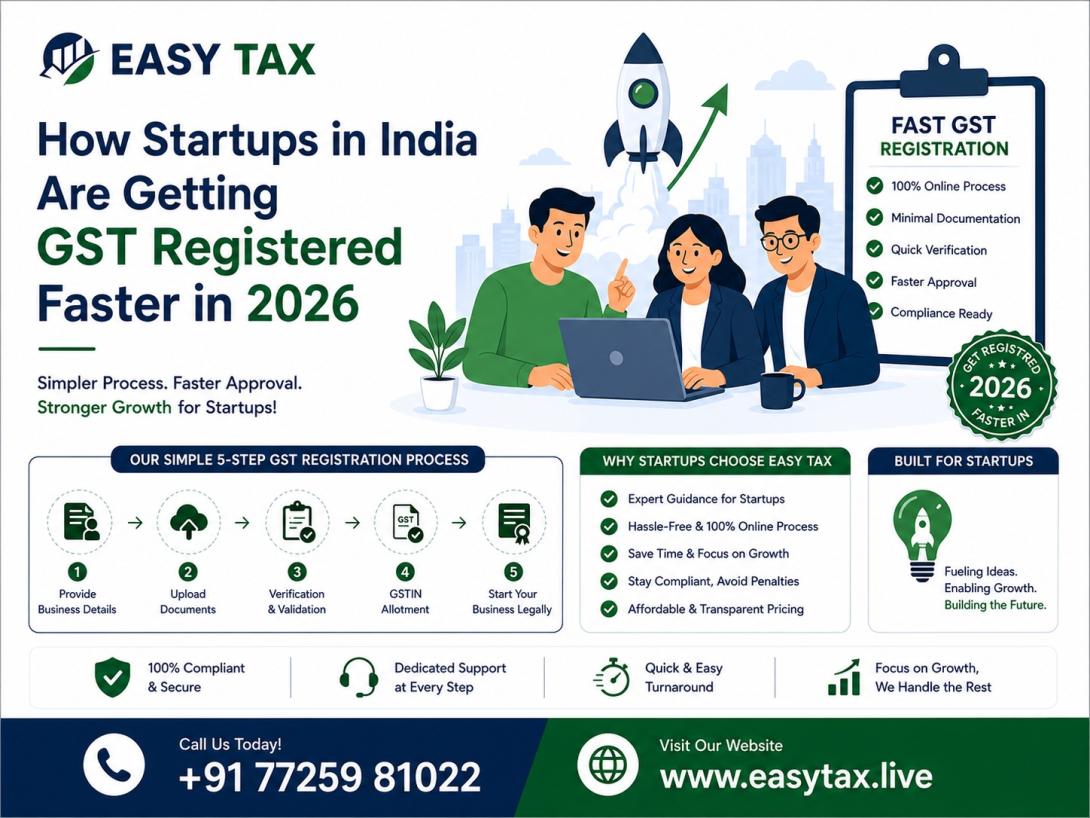
How Startups in India Are Getting Faster GST Registration in 2026
India’s startup ecosystem is growing rapidly. From ecommerce brands and digital agencies to SaaS startups, freelancers, consultants, and D2C businesses, thousands of new startups are launching every month across the country.
With the increasing digitalization of businesses, GST registration has become one of the first and most important legal requirements for startups in India. In many cases, GST registration is necessary for startups that want to sell online, work with corporate clients, raise funding, or operate professionally.
In 2026, the GST registration process has become faster, more digital, and better organized than before. However, many startup founders still face confusion regarding eligibility, documentation, compliance rules, and approval timelines.
Understanding how startups in India are getting faster GST registration in 2026 can help new business owners avoid mistakes and complete the registration process smoothly.
This detailed guide explains the Startup GST Registration Process in India, required documents, latest GST rules, compliance tips, and practical strategies startups are using to get GST approval quickly.
Importance of GST Registration for Startups
Many startup founders believe GST registration is only required for large companies. However, in today’s business environment, GST registration plays an important role in building a professional and scalable business.
Benefits of GST Registration for Startups
Startups can benefit from GST registration in several ways:
- Operate legally
- Sell products online
- Work with large clients
- Claim Input Tax Credit (ITC)
- Improve business credibility
- Expand across India
- Register on ecommerce marketplaces
- Maintain proper tax compliance
This is why GST Registration for Startups India 2026 is becoming increasingly important.
Why Startups Want Faster GST Registration
In the startup ecosystem, speed is extremely important. Businesses often want to launch quickly without waiting for lengthy approval processes.
Delays in GST registration can affect:
- Ecommerce seller onboarding
- Client invoicing
- Marketplace approvals
- Payment processing
- Business launch timelines
Because of this, many founders now focus on Fast GST Registration for Startups India.
How GST Registration Has Become Faster in 2026
Over the last few years, the government has significantly improved digital verification systems and online processing.
Major Improvements in Digital GST Registration India 2026
Online Processing
Almost the entire GST registration process is now fully online.
Faster Aadhaar Verification
OTP-based Aadhaar authentication helps speed up approvals.
Improved GST Portal
The GST portal has become more user-friendly and automated.
Reduced Manual Processing
Digital systems have reduced paperwork and physical office visits.
Faster Document Verification
Properly uploaded documents help applications get approved quickly.
These improvements are helping startups complete Quick GST Registration Online India much faster.
GST Registration for New Startups
GST registration requirements vary depending on the startup’s business model and activities.
Startups Commonly Requiring GST Registration
Ecommerce Startups
Businesses selling through platforms like:
- Amazon
- Flipkart
- Meesho
- Shopify
usually require GST registration.
Service-Based Startups
Agencies, consultants, freelancers, and SaaS businesses may require GST depending on turnover and interstate services.
Product-Based Startups
Manufacturing and trading startups commonly require GST registration.
Interstate Businesses
Businesses supplying goods or services across multiple states may require GST registration even at lower turnover levels.
Understanding Startup GST Rules India 2026 helps founders avoid compliance mistakes.
GST Registration Process Step by Step for Startups
The GST registration process is fully online and can often be completed within a few working days if documents are properly prepared.
Step 1: Visit the GST Portal
Go to the official GST registration portal.
Step 2: Submit Basic Details
Enter:
- PAN number
- Mobile number
- Email ID
- State
OTP verification is completed during this stage.
Step 3: Receive Temporary Reference Number (TRN)
A TRN is generated for continuing the application process.
Step 4: Fill Startup Business Details
Provide details such as:
- Business name
- Business structure
- Business address
- Nature of business
- Bank details
Step 5: Upload Required Documents
Upload all required documents carefully.
Step 6: Aadhaar Authentication
OTP-based Aadhaar verification helps speed up approval.
Step 7: ARN Generation
After submission, an Application Reference Number (ARN) is generated.
Step 8: GST Approval
Once verification is completed successfully, GSTIN is issued.
This is the standard GST Registration Process Step by Step for Startups in India.
GST Registration Documents for Startups
Proper documentation is one of the biggest reasons some startups receive faster approvals while others face delays.
Basic Documents Required
Personal Documents
- PAN card
- Aadhaar card
- Passport-size photograph
Business Documents
- Business address proof
- Electricity bill or rent agreement
- NOC from property owner (if rented)
Banking Documents
- Cancelled cheque
- Bank statement
Company Documents
For companies or LLPs:
- Incorporation certificate
- MOA/AOA
- Partnership deed (if applicable)
Correct and clear documentation helps startups complete Easy GST Registration for Startups India quickly.
Common Reasons for GST Registration Delays
Many startups unknowingly make mistakes during the registration process.
Common GST Registration Problems
Incorrect PAN Details
Mismatch between PAN data and application details may delay approval.
Wrong Business Address
Incomplete or mismatched address proof often creates verification issues.
Poor Document Upload Quality
Blurred or unclear documents commonly lead to rejection.
Incorrect Business Classification
Wrong business activity selection may create future compliance complications.
Aadhaar Verification Failure
Failed OTP authentication can slow down approval.
Avoiding these mistakes helps startups complete Instant GST Registration India 2026 faster.
Online GST Registration for Startups
Most startup founders now prefer online GST registration because it offers speed and convenience.
Benefits of Online GST Registration
Faster Processing
Digital applications move more quickly.
No Physical Visits
The entire process can be completed remotely.
Easy Document Upload
Online uploads simplify paperwork.
Better Tracking
The ARN helps track application status online.
Time and Cost Saving
Founders can focus more on business operations.
This is why Online GST Registration for Startups is becoming the preferred option in 2026.
GST Compliance for Startups India
Getting GST registration is only the first step. Startups must also maintain proper GST compliance regularly.
Important GST Compliance Requirements
GST Return Filing
Businesses must file GST returns on time.
Invoice Management
Invoices should include:
- GSTIN
- Tax breakup
- Proper serial numbering
Input Tax Credit Management
Maintain purchase records properly for ITC claims.
Record Maintenance
Businesses should maintain:
- Sales records
- Purchase records
- Expense documents
- GST returns
Good GST Compliance for Startups India helps avoid penalties and notices.
GST Registration for Small Startups
Small startups and home-based businesses often think GST registration is complicated or expensive.
However, many Fast Online GST Registration Services India now make the process affordable and simple.
Why Small Startups Need GST
GST registration helps small startups:
- Work professionally
- Sell online
- Expand across states
- Improve customer trust
- Maintain proper financial records
Even small businesses can benefit from early GST compliance.
How Professional Services Help Startups Get GST Faster
Many startups now prefer professional GST consultants instead of handling registration themselves.
Benefits of Professional GST Support
Accurate Application Filing
Reduces mistakes and rejection risk.
Faster Document Verification
Experts help organize documents properly.
Compliance Guidance
Startups receive ongoing GST support.
Business Structure Advice
Proper business setup improves future compliance.
Faster Approval Chances
Well-prepared applications often process more smoothly.
This is why demand for Best GST Registration Services for Startups India is increasing rapidly.
GST Rules for Startups in 2026
The government is continuously strengthening digital tax systems and improving compliance monitoring.
Major Startup GST Trends in 2026
Stronger Verification Systems
Authorities are becoming stricter about fake registrations.
Increased Ecommerce Monitoring
Online businesses are more visible to tax systems.
Better Digital Tracking
Invoice and transaction monitoring is improving.
Simplified Online Processes
Genuine businesses are receiving approvals faster.
Understanding Startup GST Rules India 2026 helps founders remain compliant from the beginning.
Tips to Get GST Registration Faster
Use Correct Information
Always match PAN, Aadhaar, and business details carefully.
Upload Clear Documents
High-quality scanned documents improve verification speed.
Complete Aadhaar Authentication
Successful OTP verification reduces delays.
Choose Correct Business Activity
Select accurate business classification.
Review Before Submission
Avoid last-minute corrections.
Use Professional Guidance
Experienced consultants can help avoid technical errors.
These practical tips help startups complete Fast GST Registration for Startups India smoothly.
Conclusion
Understanding how startups in India are getting GST registered faster in 2026 is extremely important for founders planning to launch or scale their businesses professionally.
With digital verification systems, Aadhaar authentication, improved online portals, and simplified processing, GST registration has become faster and more accessible than ever before. However, startups must still ensure proper documentation, accurate application filing, and ongoing compliance management.
Whether you are starting an ecommerce business, digital agency, SaaS company, consultancy, or online startup, GST registration helps build a legally compliant and growth-ready business foundation.
By following the correct Startup GST Registration Process India, preparing proper documents, and understanding GST compliance rules carefully, startups can complete quick GST registration and confidently focus on growing their business in 2026.
