

Introduction
ITR-1 vs ITR-4 is one of the most common tax filing questions among salaried employees, freelancers, consultants, and small business owners in India. Many taxpayers file the wrong form simply because they do not understand the difference between salary income and presumptive business income.
Choosing the correct ITR form is important because the Income Tax Department verifies your income type, deductions, and compliance eligibility during processing. Filing the wrong return can lead to defective return notices, delayed refunds, or additional scrutiny.
This guide explains what is ITR-1, what is ITR-4, who should use each form, income limits, eligibility rules, presumptive taxation, and practical filing examples for Financial Year 2025–26 and Assessment Year 2026–27.
What is ITR-1 and who should file it?
ITR-1, also called Sahaj, is an Income Tax Return form for salaried individuals with simple income sources.
ITR-1 is suitable if you earn salary, pension, one house property income, or interest income, and your total annual income is up to ₹50 lakh. According to Income Tax Department guidelines, this form is meant for resident individuals with straightforward tax situations and no business income.
ITR-1 meaning refers to the simplest Income Tax Return form available for resident individuals in India. It is commonly used by salaried employees, pensioners, and first-time taxpayers.
You can generally file ITR-1 if your income includes:
- Salary or pension
- One house property
- Savings account interest
- Fixed deposit interest
- Agricultural income up to ₹5,000
For example, a software employee in Bengaluru earning ₹14 lakh annually with salary income and savings account interest can usually file ITR-1.
Who cannot file ITR-1?
You cannot use ITR-1 if you have business income, capital gains, foreign assets, or income above ₹50 lakh.
Many taxpayers wrongly choose ITR-1 even when they earn freelance income, stock trading profits, or rental income from multiple properties. According to CBDT filing rules, such taxpayers must use other applicable ITR forms instead of Sahaj.
You should avoid ITR-1 if you:
- Run a business
- Work as a freelancer
- Have foreign assets
- Earn capital gains from stocks or crypto
- Own more than one house property
This is one of the most common filing mistakes among beginners.
What is ITR-4 and who should file it?
ITR-4, also called Sugam, is an Income Tax Return form for taxpayers using presumptive taxation schemes under Sections 44AD, 44ADA, or 44AE.
ITR-4 is designed for small business owners, freelancers, consultants, and professionals who want simplified taxation without maintaining detailed books of accounts. Under presumptive taxation, a fixed percentage of income is treated as taxable profit as per Income Tax Act provisions.
ITR-4 meaning refers to simplified business tax filing for eligible taxpayers.
This form is commonly used by:
- Freelancers
- Digital marketers
- Doctors
- Consultants
- Small shop owners
- Agencies
- Traders
For example, a freelance graphic designer in Jaipur earning ₹18 lakh annually may use ITR-4 under Section 44ADA if eligible.
What is presumptive taxation in ITR-4?
Presumptive taxation allows eligible taxpayers to declare income at a fixed percentage without maintaining detailed accounting records.
Under Sections 44AD and 44ADA of the Income Tax Act, the government allows small businesses and professionals to simplify tax compliance by estimating profits instead of calculating exact net income through full bookkeeping.
Common presumptive taxation sections
| Section | Applicable To | Presumed Income |
|---|---|---|
| 44AD | Small businesses | 6% or 8% of turnover |
| 44ADA | Professionals | 50% of receipts |
| 44AE | Transport businesses | Fixed vehicle-based calculation |
This system reduces compliance burden for smaller taxpayers.
What is the main difference between ITR-1 and ITR-4?
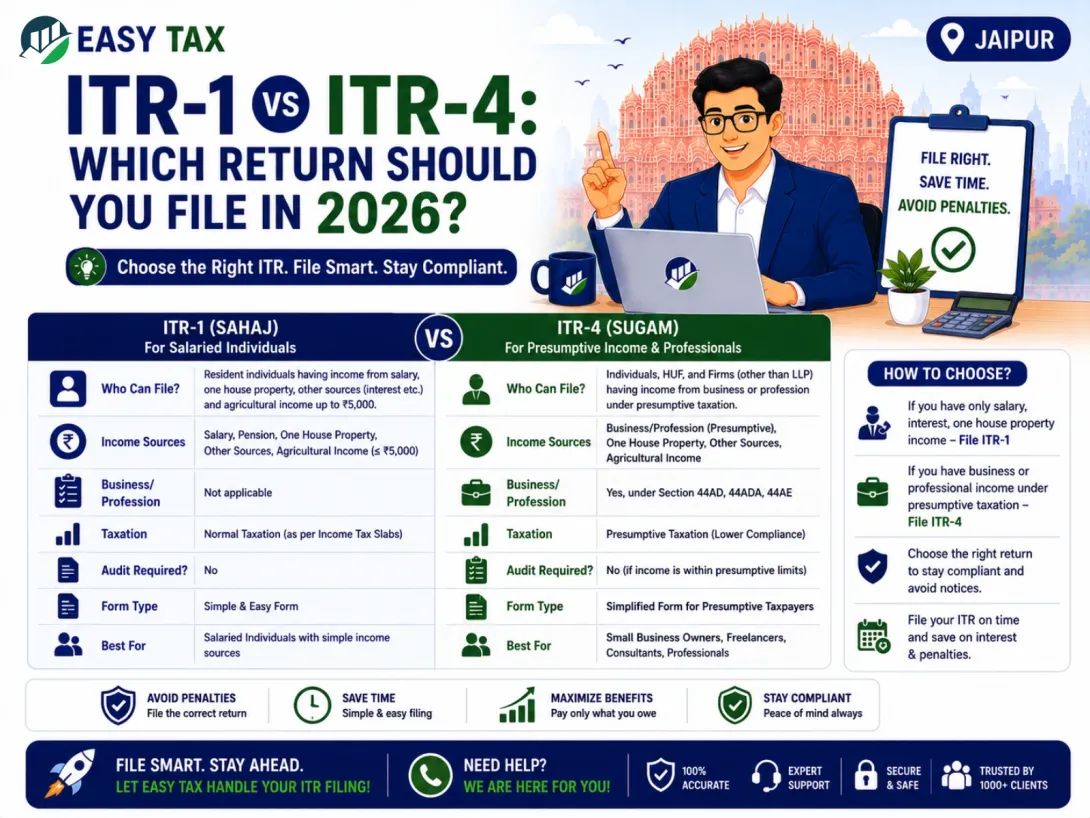
The main difference between ITR-1 and ITR-4 is that ITR-1 is for salary-based income, while ITR-4 is for presumptive business or professional income.
Many taxpayers compare ITR-1 vs ITR-4 because both forms appear simple, but they apply to completely different income categories. Your income source determines the correct form, not simply your total income amount.
Here is a detailed comparison:
| Feature | ITR-1 | ITR-4 |
|---|---|---|
| Form Name | Sahaj | Sugam |
| Suitable For | Salaried individuals | Freelancers & businesses |
| Income Type | Salary, pension | Business/professional income |
| Presumptive Taxation | Not allowed | Allowed |
| Income Limit | Up to ₹50 lakh | Up to ₹50 lakh |
| Books of Accounts | Not applicable | Simplified compliance |
A salaried HR manager in Mumbai usually files ITR-1, while a freelance web developer earning project income may file ITR-4.
Which ITR form should you file in 2026?
You should choose your ITR form based on your actual income source, not only your profession or income amount.
Many taxpayers mistakenly select forms based on assumptions rather than eligibility rules. According to Income Tax Department guidelines, salary income, professional income, business turnover, and presumptive taxation eligibility determine which form is correct for you.
Choose ITR-1 if you:
- Earn salary or pension
- Have one house property
- Earn bank interest
- Have no business income
- Have no foreign assets
Choose ITR-4 if you:
- Run a small business
- Work as a freelancer
- Operate under presumptive taxation
- Want simplified compliance
- Earn professional receipts under Section 44ADA
Quick decision table
| Your Situation | Recommended Form | Why |
|---|---|---|
| Salaried employee | ITR-1 | Simple salary income |
| Freelancer | ITR-4 | Professional income |
| Shop owner | ITR-4 | Business turnover |
| Pensioner | ITR-1 | Pension treated as salary |
| Consultant | ITR-4 | Presumptive taxation allowed |
Which is better: ITR-1 or ITR-4?
Neither form is universally better because both serve different taxpayer categories.
ITR-1 is easier for salaried individuals with simple income, while ITR-4 provides tax and compliance benefits for eligible businesses and professionals under presumptive taxation. The correct form depends entirely on your income structure.
ITR-1 is usually simpler because:
- fewer disclosures are required,
- income sources are limited,
- and compliance is straightforward.
ITR-4 can be more beneficial for freelancers and professionals because:
- bookkeeping requirements reduce,
- presumptive taxation simplifies filing,
- and compliance becomes easier.
For example, a freelance content writer in Delhi may prefer ITR-4 because maintaining full books for small projects becomes unnecessary under Section 44ADA.
How does ITR-4 help freelancers and small businesses?
ITR-4 helps freelancers and small businesses reduce compliance burden through simplified taxation rules.
Small business owners often struggle with accounting, bookkeeping, and profit calculations. Presumptive taxation under ITR-4 allows eligible taxpayers to declare estimated income without maintaining detailed profit-and-loss records.
This is especially useful for:
- digital marketers,
- YouTubers,
- designers,
- consultants,
- and local business owners.
Benefits of ITR-4
- Simplified tax filing
- Reduced bookkeeping requirements
- Faster return preparation
- Easier compliance management
- Lower accounting costs
However, you should still maintain:
- invoices,
- bank statements,
- and payment records.
What documents are required for ITR-1 and ITR-4 filing?
Both ITR-1 and ITR-4 require PAN, Aadhaar, bank details, and income records, but business taxpayers usually need additional documents.
Proper documentation helps avoid filing mismatches and notice risks. As per Income Tax Department requirements, taxpayers should verify all financial records before submitting returns for Assessment Year 2026–27.
Documents for ITR-1
| Document | Purpose |
|---|---|
| PAN Card | Identity verification |
| Aadhaar Card | e-Verification |
| Form 16 | Salary details |
| Bank statements | Interest verification |
| Investment proofs | Deduction claims |
Documents for ITR-4
| Document | Purpose |
|---|---|
| PAN & Aadhaar | Identity verification |
| Bank statements | Income tracking |
| Business invoices | Revenue records |
| GST details | Business compliance |
| Expense records | Financial review |
What mistakes should you avoid while choosing ITR forms?
Filing the wrong ITR form is one of the biggest mistakes taxpayers make during online tax filing.
Incorrect ITR selection may lead to defective return notices under Section 139(9) of the Income Tax Act. Many taxpayers confuse salary income with freelance or professional income, especially when side income exists.
Common mistakes taxpayers make
Ignoring freelance income
A salaried employee doing side freelancing cannot always continue using ITR-1.
Choosing ITR-1 for business income
Even small freelance earnings may require ITR-4 depending on the income structure.
Not checking presumptive taxation eligibility
Some taxpayers wrongly use ITR-4 despite ineligibility under Sections 44AD or 44ADA.
Ignoring AIS mismatches
AIS (Annual Information Statement), a detailed financial reporting statement from the Income Tax Department, should always be reviewed before filing.
How can you file ITR-1 or ITR-4 online in India?
You can file both ITR-1 and ITR-4 online through the official Income Tax e-Filing portal.
The online filing process has become easier in 2026 because the portal now pre-fills many taxpayer details automatically. However, verifying income type and selecting the correct return form remains your responsibility.
Step-by-step filing process
- Login to the Income Tax portal
- Select “File Income Tax Return”
- Choose AY 2026–27
- Select correct ITR form
- Verify pre-filled details
- Add deductions and income
- Submit and e-verify return
Always verify:
- PAN-Aadhaar linking,
- bank details,
- and TDS information before submission.
FAQs
Can freelancers file ITR-1 in India?
Freelancers usually cannot file ITR-1 if they earn professional or business income.
Freelance income is generally treated as professional income under the Income Tax Act. Most freelancers should use ITR-4 if eligible for presumptive taxation under Section 44ADA. Filing ITR-1 despite freelance income may create compliance issues. Always classify your income correctly before choosing a return form.
What is the income limit for ITR-1 and ITR-4?
Both ITR-1 and ITR-4 generally have an income limit of ₹50 lakh under current filing rules.
However, eligibility depends not only on income amount but also on income type. A salaried employee and a freelancer with the same income may still require different ITR forms. Income source matters more than total earnings. Always check updated CBDT guidelines before filing.
Which is better for freelancers: ITR-1 or ITR-4?
ITR-4 is usually better for freelancers because it supports presumptive taxation for professional income.
Freelancers such as designers, developers, consultants, and digital marketers commonly use ITR-4 under Section 44ADA. This reduces bookkeeping requirements and simplifies filing. However, eligibility conditions still apply. If unsure, professional tax advice is recommended.
Can salaried employees file ITR-4?
Salaried employees can file ITR-4 only if they also have eligible business or professional income.
For example, a salaried employee with freelance consulting income may qualify for ITR-4 depending on total income structure. Pure salary income taxpayers usually continue using ITR-1. Choosing the correct form helps avoid notices and filing errors. Mixed income situations should be reviewed carefully.
What happens if you file the wrong ITR form?
Filing the wrong ITR form may result in defective return notices or delayed processing.
Under Section 139(9), the Income Tax Department may mark your return as defective if incorrect filing categories are used. Refunds may also get delayed. In some cases, you may need to revise the return completely. Reviewing eligibility before filing is extremely important.
Is ITR-4 compulsory for small business owners?
ITR-4 is not compulsory for all business owners, but it is commonly used by eligible taxpayers under presumptive taxation.
If you choose presumptive taxation under Sections 44AD or 44ADA, ITR-4 becomes relevant. Some businesses may need other ITR forms depending on turnover, audit requirements, or accounting methods. Tax structure determines applicability. Proper classification is essential.
What is the meaning of Sahaj and Sugam in ITR forms?
Sahaj refers to ITR-1, while Sugam refers to ITR-4.
The government uses these simplified names because both forms are designed for easier tax filing. Sahaj focuses on simple salary income taxpayers. Sugam supports simplified business taxation for eligible professionals and businesses. These names are commonly used during online filing.
Which ITR form is best for beginners?
The best ITR form for beginners depends entirely on their income source.
A first-time salaried employee usually files ITR-1 because the structure is simpler. Freelancers and small business owners may prefer ITR-4 if eligible under presumptive taxation. Beginners should focus on choosing the correct category rather than the “easiest” form. Wrong filing can create future compliance issues.
Conclusion
ITR-1 vs ITR-4 is not about choosing the easier form. It is about selecting the correct return based on your actual income type and tax eligibility. Salaried employees with straightforward income usually file ITR-1, while freelancers, consultants, and small business owners commonly benefit from ITR-4 and presumptive taxation.
Before filing your return for Assessment Year 2026–27, review your:
- salary income,
- freelance earnings,
- business receipts,
- and compliance eligibility carefully.
If you are unsure which ITR form applies to your situation, EasyTax can help you choose the correct return type and complete your filing accurately without confusion or unnecessary notices.


