
Reviewed by CA Pritam Sharma, Chartered Accountant | ICAI Member • Last Updated: June 2026
Executive Summary: Which Tax Regime Saves the Most Tax?
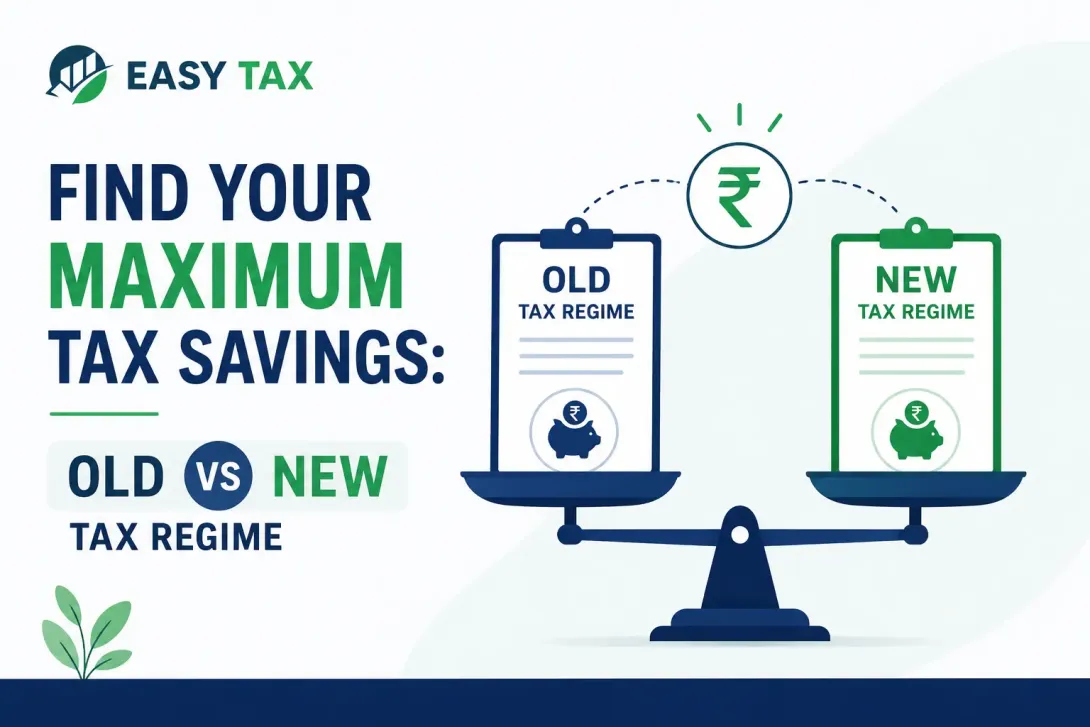
To find your maximum tax savings under the Income Tax Act, 1961, the choice between the Old and New Tax Regime relies on a specific mathematical break-even point. For Assessment Year (AY) 2026-27, the New Tax Regime functions as the default framework, presenting significantly lower progressive tax slabs and an enhanced standard deduction of ₹75,000. However, it strips away more than 70 traditional exemptions and deductions.
The Old Tax Regime remains highly lucrative if your cumulative deductions—including House Rent Allowance (HRA) exemptions under Section 10(13A), home loan interest under Section 24(b), Section 80C investments (PPF, ELSS, EPF), and Section 80D medical premiums—exceed a specific threshold. For an income bracket between ₹10 lakh and ₹20 lakh, if your total deductions are greater than ₹3,75,000 to ₹4,25,000, the Old Tax Regime will yield the maximum tax savings.
Taxpayers earning up to ₹12.75 lakh per annum as salaried individuals find an absolute zero-tax liability under the New Tax Regime due to the standard deduction coupled with the enhanced tax rebate under Section 87A. For middle-to-high income earners without massive structural debts or long-term rental obligations, the New Tax Regime minimizes compliance complexity and delivers optimal in-hand liquidity.
Key Takeaways for Tax Planning
- Default System: The New Tax Regime is the default tax mechanism across India. Explicit action via the e-Filing portal or employer declaration is required to opt for the Old Tax Regime.
- Break-Even Threshold: If your total customized deductions under the old regime sit below ₹3.75 lakh, the New Tax Regime is mathematically your best tax regime.
- Standard Deduction Boost: For AY 2026-27, the standard deduction under the New Tax Regime stands at ₹75,000, while the Old Tax Regime limits it to ₹50,000.
- Zero Tax Limit: Net taxable income up to ₹12,00,000 under the New Tax Regime incurs zero tax after applying the Section 87A rebate mechanism.
- Loss of Incentives: Opting for the new regime means permanently forfeiting Section 80C, Section 80D, HRA, LTA, and self-occupied housing loan interest deductions.
- Flexibility for Salaried: Salaried individuals can dynamically switch between regimes every single fiscal year at the time of return submission.
- Lock-In for Businesses: Freelancers, consultants, and business owners filing ITR-3 or ITR-4 can only switch out of the new regime once in their professional lifetime.
- Documentary Relief: The New Tax Regime requires zero proof of investments, cutting down the compliance load and preventing automated scrutiny notices for document mismatches.
At a Glance: Tax Regime Comparison Matrix
Every tax season in India brings back a classic dilemma for taxpayers: **how to find your maximum tax savings** without triggering a compliance nightmare. Ever since the Ministry of Finance introduced the alternate tax framework under Section 115BAC, salary tax planning has transformed from standard asset allocation into an analytical exercise. Taxpayers can no longer rely on universal rule-of-thumb principles.
As we navigate the current financial updates, the Central Board of Direct Taxes (CBDT) has made its intentions clear: the tax ecosystem is steadily transitioning away from complex exemptions toward a clean, lower-rate paradigm. Yet, for thousands of high earners, abandoning historical deduction frameworks means letting go of massive tax-saving options. This guide acts as your specialized financial blueprint to navigate this choice with precision.
What is the Old Tax Regime?
The Old Tax Regime refers to the historical, multi-layered income tax structure in India that combines higher progressive tax rates with a comprehensive framework of exemptions and deductions under the Income Tax Act, 1961. Its primary purpose is to incentivize social engineering and long-term personal savings by offering direct tax relief when citizens invest in specified avenues.
Under this framework, your gross total income undergoes a series of reductions before arriving at the net taxable income. For instance, if you pay rent, a portion is exempted under Section 10(13A). If you protect your family with medical insurance, it is deducted under Section 80D. The most prominent feature remains Section 80C, which allows a deduction of up to ₹1,50,000 for structured savings in vehicles like the Public Provident Fund (PPF), Equity Linked Savings Schemes (ELSS), and the Employees' Provident Fund (EPF).
CA's Professional Insight: The Old Tax Regime functions essentially as an expense-matching system. It is heavily optimized for taxpayers who are in the middle of major life milestones—such as paying down a primary home loan or funding long-term children's education. If your lifestyle naturally involves high mandatory outlays that qualify for exemptions, the old regime acts as a significant legal shield against the 30% tax bracket.
What is the New Tax Regime?
The New Tax Regime is the default income tax framework introduced under Section 115BAC of the Income Tax Act, 1961, featuring significantly lower, restructured tax slabs in exchange for the near-total removal of traditional exemptions and deductions. It was brought forward to simplify personal finance by eliminating the complex documentation required to prove compliance.
Recent legislative amendments have made the New Tax Regime highly competitive. For the current assessment year, it features a progressive structure with seven distinct tiers, keeping tax rates low for lower income brackets. Additionally, it offers a distinct advantage to the salaried class by raising the standard deduction to ₹75,000 (compared to ₹50,000 in the old framework). It also provides a robust tax rebate under Section 87A, making net taxable income up to ₹12 lakh completely tax-free for resident individuals.
By choosing this pathway, you no longer need to worry about lock-in periods or track your Annual Information Statement (AIS) and Form 26AS for missing investment credits. The income you report on the Income Tax e-Filing portal is processed using direct calculations, maximizing immediate in-hand liquidity.
Ready to discover your precise break-even numbers?
Let our expert team run a comparative tax analysis on your salary structure.
Old Tax Regime vs New Tax Regime: The Complete Breakdown
To make an informed decision, you must understand exactly what you gain and what you forfeit. While the New Tax Regime offers lower percentages across broader income bands, it strips away the traditional tax-shielding tools. Here is the definitive, line-by-line comparison of the Old vs New Tax Regime for AY 2026-27.
| Tax Component | Old Tax Regime | New Tax Regime |
|---|---|---|
| Standard Deduction (Salary) | ₹50,000 | ₹75,000 |
| Section 80C (PPF, ELSS, EPF, Life Insurance) | Allowed up to ₹1,50,000 | Not Allowed |
| Section 80D (Health Insurance) | Allowed (₹25,000 to ₹75,000) | Not Allowed |
| House Rent Allowance (HRA) | Allowed under Sec 10(13A) | Not Allowed |
| Home Loan Interest (Self-Occupied) | Allowed up to ₹2,00,000 | Not Allowed |
| Leave Travel Allowance (LTA) | Allowed | Not Allowed |
| Section 80CCD(1B) (Voluntary NPS) | Allowed up to ₹50,000 | Not Allowed |
| Section 80CCD(2) (Employer NPS) | Allowed (10% or 14% of Basic) | Allowed (10% or 14% of Basic) |
| Section 87A Tax Rebate Limit | Tax-free up to ₹5 Lakhs | Tax-free up to ₹12 Lakhs |
| Filing Complexity & Documentation | High (Needs rent receipts, proofs) | Low (Minimal proofs required) |
Latest Income Tax Slabs (AY 2026–27 / FY 2025–26)
To calculate your exact liability, you must apply the correct slab rates. The New Tax Regime features a highly streamlined six-tier structure. The Old Tax Regime rates vary depending on whether the taxpayer is under 60 years of age, a senior citizen (60-80 years), or a super senior citizen (>80 years).
New Tax Regime Slabs (Default for All Age Groups)
| Net Taxable Income Bracket | Applicable Tax Rate |
|---|---|
| Up to ₹4,00,000 | Nil |
| ₹4,00,001 to ₹8,00,000 | 5% |
| ₹8,00,001 to ₹12,00,000 | 10% |
| ₹12,00,001 to ₹16,00,000 | 15% |
| ₹16,00,001 to ₹20,00,000 | 20% |
| ₹20,00,001 to ₹24,00,000 | 25% |
| Above ₹24,00,000 | 30% |
Note: Under the New Regime, thanks to the Section 87A rebate of up to ₹60,000, resident individuals with a net taxable income of up to ₹12,00,000 pay absolutely zero tax.
Old Tax Regime Slabs (For Individuals Below 60 Years)
| Net Taxable Income Bracket | Applicable Tax Rate |
|---|---|
| Up to ₹2,50,000 | Nil |
| ₹2,50,001 to ₹5,00,000 | 5% |
| ₹5,00,001 to ₹10,00,000 | 20% |
| Above ₹10,00,000 | 30% |
Note: A 4% Health and Education Cess is applied to the calculated tax under both regimes.
Which Tax Regime Saves More Tax? (Income-wise Breakdown)
To answer "how can I save maximum tax?", you must run the math. Let’s look at five distinct income levels. For the purpose of these calculations, we assume the taxpayer claims the following moderate deductions under the Old Regime: Standard Deduction (₹50k), Section 80C (₹1.5L), and Section 80D (₹25k). No HRA or home loan is assumed here to maintain a neutral baseline.
| Gross Salary | Old Regime Tax (w/ ₹2.25L deductions) | New Regime Tax (w/ ₹75k Standard Ded.) | Difference & Recommendation |
|---|---|---|---|
| ₹6,00,000 | ₹0 (Rebate applies) | ₹0 (Rebate applies) | Neutral. Both are zero-tax. New Regime is easier. |
| ₹10,00,000 | ₹65,000 | ₹0 (Rebate applies) | New Regime saves ₹65,000. |
| ₹15,00,000 | ₹1,95,000 | ₹1,05,000 | New Regime saves ₹90,000. |
| ₹20,00,000 | ₹3,45,000 | ₹1,95,000 | New Regime saves ₹1,50,000. |
| ₹30,00,000 | ₹6,45,000 | ₹4,72,500 | New Regime saves ₹1,72,500. |
*Calculations are exclusive of the 4% Health & Education Cess for simplicity.*
As you can clearly see, without massive deductions like home loan interest or large HRA claims, the New Tax Regime comprehensively defeats the Old Tax Regime at every income level above ₹10 lakhs.
Real-Life Case Studies: Finding the Break-Even Point
Let’s examine customized profiles. The math shifts entirely when lifestyle expenses—like renting in a metro city or buying a house—enter the picture.
Case Study 1: The Salaried Employee with High HRA
- Profile: Ravi, 32, Software Engineer in Bengaluru.
- Gross Salary: ₹18,00,000
- Deductions Claimed: 80C (₹1.5L), 80D (₹25k), Standard Deduction (₹50k), HRA Exemption (₹2.5L). Total Deductions = ₹4,75,000.
Old Regime Tax: Taxable income = ₹13,25,000. Tax = ₹1,05,000 + 4% Cess = ₹1,09,200.
New Regime Tax: Taxable income = ₹17,25,000 (after ₹75k std. deduction). Tax = ₹1,53,750 + 4% Cess = ₹1,59,900.
Recommendation: The Old Regime saves Ravi ₹50,700. Because his deductions exceed the ₹3.75L break-even point, the old regime dominates.
Case Study 2: The Home Loan Borrower
- Profile: Sneha, 38, Marketing Manager living in her own home.
- Gross Salary: ₹22,00,000
- Deductions Claimed: 80C (₹1.5L - EPF & Principal), Home Loan Interest Sec 24b (₹2L), Standard Deduction (₹50k). Total Deductions = ₹4,00,000.
Old Regime Tax: Taxable income = ₹18,00,000. Tax = ₹2,52,500 + 4% Cess = ₹2,62,600.
New Regime Tax: Taxable income = ₹21,25,000. Tax = ₹2,31,250 + 4% Cess = ₹2,40,500.
Recommendation: Even with a ₹2L home loan deduction, the New Regime saves Sneha ₹22,100. The lower slab rates of the new regime outpace the deductions at the ₹22 Lakh income level.
Case Study 3: The Freelancer / Consultant
- Profile: Ankit, 29, Freelance Designer filing under Presumptive Taxation (Section 44ADA).
- Gross Receipts: ₹25,00,000 (Declared 50% profit = ₹12,50,000).
- Deductions Claimed: 80C (₹1.5L), 80D (₹25k). No standard deduction for businesses. Total = ₹1,75,000.
Old Regime Tax: Taxable income = ₹10,75,000. Tax = ₹1,43,000 (incl. cess).
New Regime Tax: Taxable income = ₹12,50,000 (no deductions allowed). Tax = ₹65,000 (incl. cess).
Recommendation: The New Regime saves Ankit ₹78,000. Freelancers lack standard deductions and HRA, making the new regime incredibly powerful.
Tax Deductions Available Only Under the Old Tax Regime
If you are evaluating which tax regime is better, you must audit your current financial commitments. The Old Tax Regime allows you to reduce your taxable income via Chapter VI-A deductions. If you shift to the new regime, you instantly lose access to:
- Section 80C (Up to ₹1.5 Lakh): Covers life insurance premiums, PPF contributions, ELSS mutual funds, EPF matching, principal repayment of home loans, and children's tuition fees.
- Section 80D (Up to ₹75,000): Health insurance premiums paid for self, family, and senior citizen parents.
- House Rent Allowance (HRA) Exemption: Relief for rent paid, calculated under Section 10(13A).
- Section 24(b) Home Loan Interest: Up to ₹2 Lakh deduction on interest paid for a self-occupied property.
- Section 80E Education Loan: The entire interest paid on an education loan for 8 consecutive years is tax-exempt.
- Section 80G Donations: Tax relief for charitable donations to approved NGOs and relief funds.
- Section 80TTA / 80TTB: Deductions on savings bank account interest (₹10,000 for regular individuals, ₹50,000 for senior citizens).
- Leave Travel Allowance (LTA): Tax-free domestic travel fare for you and your family twice in a block of four years.
Benefits of the New Tax Regime
Who benefits from the new tax regime? The government designed this framework to prioritize simplicity and cash flow over forced asset-building.
- Unmatched Simplicity: You do not need to meticulously file rent receipts, hunt for insurance premium certificates, or submit investment proofs to your HR department in January.
- Higher In-Hand Liquidity: Because you are not forcing ₹1.5 lakh into a locked-in PPF or ELSS account purely for tax reasons, you have higher disposable cash each month.
- The Zero-Tax Gateway: With the ₹75,000 standard deduction and the Section 87A rebate, anyone earning up to ₹12.75 lakh essentially operates in a completely tax-free environment.
- Employer NPS Benefit: The New Tax Regime still permits you to claim the employer's contribution to your NPS account under Section 80CCD(2), providing a massive loophole for high earners to legally shield up to 10% of their basic salary.
Common Mistakes While Choosing a Tax Regime
- Choosing Without Mathematical Calculation: Assuming the new regime is better just because the tax rates are "5% and 10%" without realizing you are losing ₹4 lakhs worth of deductions. Always use an income tax calculator first.
- Not Reviewing Annually: Salaried individuals can switch regimes every year. If you buy a house this year, your home loan interest might suddenly make the old regime profitable. Do not stick to one regime on autopilot.
- Business Owners Switching Carelessly: If you are a freelancer or business owner (filing ITR-3 or ITR-4), you are legally permitted to opt out of the new regime only once. If you opt back in, you are locked into the new regime permanently.
- Ignoring the Employer Declaration Deadline: If you fail to declare your regime preference to your employer in April, they will default to the new regime. This could result in heavy, unnecessary TDS deductions throughout the year if the old regime was mathematically better for you.
The EasyTax Decision Matrix
Use this quick-reference table to identify which regime aligns best with your economic profile:
| If You Are... | Recommended Regime | Primary Reason |
|---|---|---|
| A Salaried Employee earning < ₹12.75 Lakh | New Tax Regime | Tax liability drops to absolutely zero due to the Section 87A rebate. No investments required. |
| A Taxpayer paying high Metro Rent + full 80C | Old Tax Regime | High HRA exemptions combined with Section 80C usually exceed the ₹3.75L break-even point. |
| A Freelancer or Business Owner | New Tax Regime | Cannot claim Standard Deduction or HRA. Lower slab rates drastically reduce the tax burden. |
| A Retired Senior Citizen | New Tax Regime | Fewer obligations to invest in long-term lock-in assets like EPF. Maximize pension liquidity. |
| A High-Income Earner (>₹25 Lakh) | New Tax Regime | Even with home loan interest (₹2L) and 80C (₹1.5L), the new regime's relaxed top-tier slabs outpace the old regime's heavy 30% baseline. |
Expert Tips from a Chartered Accountant
After analyzing thousands of tax profiles, here are the actionable steps I recommend to my clients:
- Tip 1: Always calculate your "Break-Even Deduction Limit". If your income is ₹15 lakh, and your total combined deductions under the old regime equal ₹3,75,000, your tax payable under both regimes is exactly the same (₹1,05,000). Every rupee deducted beyond ₹3.75L makes the old regime better.
- Tip 2: Leverage Employer NPS. Section 80CCD(2) is available in both regimes. Ask your employer to restructure 10% of your Basic Salary into NPS. It is a risk-free tax shield.
- Tip 3: Don't buy insurance purely to save tax. If the New Tax Regime saves you ₹50,000 in taxes, use those savings to buy a robust term plan, rather than buying expensive endowment policies just to force yourself into the Old Regime.
- Tip 4: Validate Form 26AS. Regardless of the regime you choose, ensure your TDS credits perfectly match your AIS (Annual Information Statement) before filing.
Conclusion: Making Your Final Choice
Ultimately, discovering how to calculate tax under both regimes is the only definitive way to find your maximum tax savings. The Income Tax Department has intentionally made the New Tax Regime highly attractive for the vast majority of the Indian workforce, simplifying the filing process and eliminating tedious paperwork.
However, if you are actively servicing a home loan, living in a rented house in a metro city, and maximizing your Provident Fund, the Old Tax Regime remains a powerful, financially rewarding framework. Do not make this decision on intuition—make it on mathematics.
Stop Guessing. Start Saving.
Are you unsure if your current salary structure is bleeding unnecessary taxes? Let the expert Chartered Accountants at EasyTax run a comprehensive regime comparison on your exact income profile. We guarantee maximum legal tax savings.
