

- 4.8★ Google Rating
- Expert CAs
- RBI Compliant
- Timely Reports
- Detailed Verification
Expert Bank Audit Services
Ensure full compliance and accuracy with an RBI-Compliant Bank Audit
Protect public funds and streamline branch operations. Our expert Chartered Accountants deliver meticulous statutory, concurrent, and internal audits.
- Secure & Private Your data is always safe



Trusted by 10,000+ happy taxpayers across India
No spam. Your information is 100% secure.

Continuous Verification
Stay on top of daily transactions with Concurrent Audits
Concurrent audit refers to the examination or audit of transactions at the time they take place. It is a continuous audit carried out monthly by external Chartered Accountants to ensure daily transactions follow proper guidelines.
This helps branches work smoothly, rectifying any mistakes immediately to avoid the cascading effect of irregularities and protect public funds from fraud.

Mandatory Annual Checks
Fulfill RBI guidelines with a complete Statutory Audit
Statutory Audit is mandatorily conducted by a Statutory Auditor appointed by RBI in association with ICAI. It takes place at the closure of the financial year to assess NPA provisions, which directly impact the bank's profitability and balance sheet.
This audit focuses deeply on loans and advances, adherence to PSL requirements, SLR, CRR, and other statutory norms mandated by the latest RBI notifications.

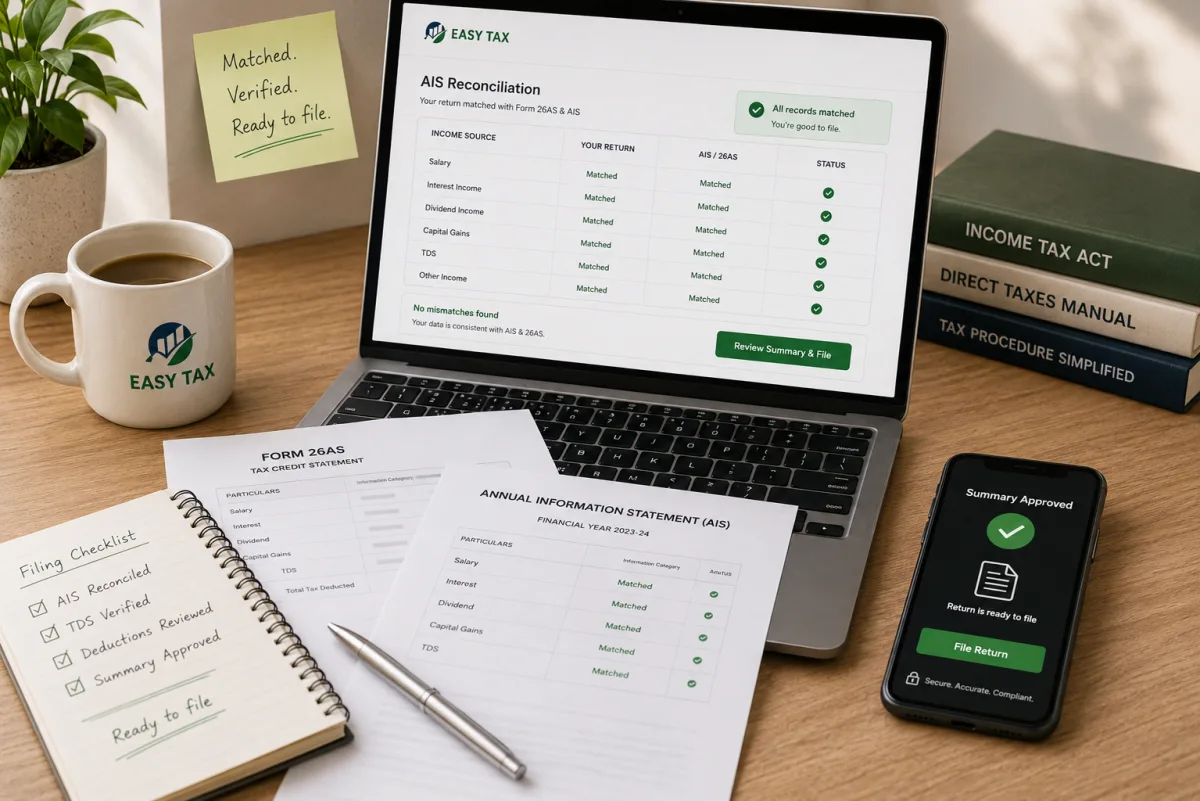
Matched to AIS, before the department checks
Your return is reconciled line-by-line with Form 26AS and AIS so TDS mismatches never come back as a notice. Filing is only done after you approve the summary.
With standard services vs With our expert team
- Slow and delayed reporting of irregularities
- Superficial checking of daily transactions
- Lack of specialized RBI compliance knowledge
- Missed NPA provisions leading to penalties
- Poor communication with branch management
- Real-time concurrent auditing and error rectification
- In-depth scrutiny of loans, advances, and KYC norms
- Expert CAs up-to-date with latest RBI notifications
- Accurate NPA assessment and provisioning
- Actionable reports to improve branch operations
How it works
-
Share your documents
Upload Form 16 and answer a 5-minute questionnaire.
-
Talk to your expert
Your assigned CA confirms income, deductions and regime on a short call.
-
Approve the summary
Review the computation and refund estimate; nothing is filed without your OK.
-
We file & you relax
E-filing, e-verification help and the ITR-V acknowledgement in your inbox.
Comprehensive Guide to Bank Audit AY 2026-27, explained
Banks are the foundation of our economy. They handle a huge amount of deposits and savings of the public, so they have to be closely monitored and reviewed. A bank audit is one important process of this monitoring.
‘Audit’ or ‘Auditing’ refers to an activity that is carried out by any business entity on its own or to fulfil the compulsion laid under any law to evaluate the transactions, accounts and documents of the business and to confirm its accuracy and legitimacy. This examination is conducted by internal or external auditors.
Bank Audit can be divided into three categories: Concurrent Audit, Internal Audit or Information Systems Audit, and Statutory Audit. Concurrent audits take place throughout the year to check daily transactions. Internal audits are carried out by the bank's own staff to check system security and internal controls. Statutory Audits are conducted at the end of the financial year by auditors appointed by the RBI to check overall compliance, NPAs, and statutory ratios like CRR and SLR.
Documents you will need
- Appointment Letter from Bank/RBI
- Previous Audit Reports (Concurrent/Statutory)
- Branch Manager Representation Letter
- List of NPAs and Restructured Accounts
- Details of large advances and limits sanctioned
- System manuals and IT security policies

Why choose us for this service
Fraud Prevention
Switched jobs? We merge employers correctly and fix double-counted slabs.
Regulatory Compliance
Side income reported right, expenses claimed where eligible.
Accurate NPA Provisioning
Old vs new compared on your real numbers, not thumb rules.
System Security
We monitor your refund until it's credited.
Operational Efficiency
Missed the deadline or made an error? We fix it.
Notice shield
Filing reconciled with AIS/26AS to prevent the most common notices.
Year-round access
Your expert stays reachable after filing, not just in July.
Statutory / Concurrent Bank Audit honest pricing
Standard starting fee per branch for comprehensive banking audits.
- Daily & weekly cash transaction verification
- Income leakage identification & revenue audit checklist
- Loan document verification for sanctioned limits
- RBI master circular compliance check
- Revenue audit report submission
- Everything in Basic
- Independent statutory audit of commercial / RRB branch
- NPA classification & provisioning review (IRAC norms)
- Long Form Audit Report (LFAR) drafting
- Tax audit & Ghosh / Jilani committee recommendations
- Formal submission & signing by Chartered Accountant
- Everything in Standard
- Borrower forensic audit & fund diversion check
- Unit inspection & collateral asset verification
- Detailed credit monitoring report for Zonal / Head Office
Comprehensive Guide to Bank Audit why it pays to use an expert
Banks are the foundation of our economy. They handle a huge amount of deposits and savings of the public, so they have to be closely monitored and reviewed. A bank audit is one important process of this monitoring.
‘Audit’ or ‘Auditing’ refers to an activity that is carried out by any business entity on its own or to fulfil the compulsion laid under any law to evaluate the transactions, accounts and documents of the business and to confirm its accuracy and legitimacy. This examination is conducted by internal or external auditors.
Bank Audit can be divided into three categories: Concurrent Audit, Internal Audit or Information Systems Audit, and Statutory Audit. Concurrent audits take place throughout the year to check daily transactions. Internal audits are carried out by the bank's own staff to check system security and internal controls. Statutory Audits are conducted at the end of the financial year by auditors appointed by the RBI to check overall compliance, NPAs, and statutory ratios like CRR and SLR.
Frequently Asked Questions
Everything salaried filers ask before handing their return to an expert.

File with an expert, sleep easy.
Most returns are ready for your approval within 48 hours of document upload.
Verified & Supervised by CA Jitendra Shari
Every filing, tax consultation, and compliance checklist is rigorously audited by practicing Chartered Accountants in Jaipur to ensure 100% adherence to Income Tax, GST, and MCA regulations.