

• All major brokers supported
  • 4.8★ Google rating
  • CA-reviewed schedules

Capital Gains Tax Filing

Sold shares or property? File it right, save more.

We turn broker statements and sale deeds into an accurate capital gains return — correct rates, grandfathering, exemptions and all — for AY 2026-27.

  • Every Trade Imported and classified
  • Right Rate Pre/post-July 2024
  • Exemptions 54/54EC/54F planned

Trusted by 10,000+ happy taxpayers across India

No spam. Your information is 100% secure.

easytax-mobile-tax-calculator

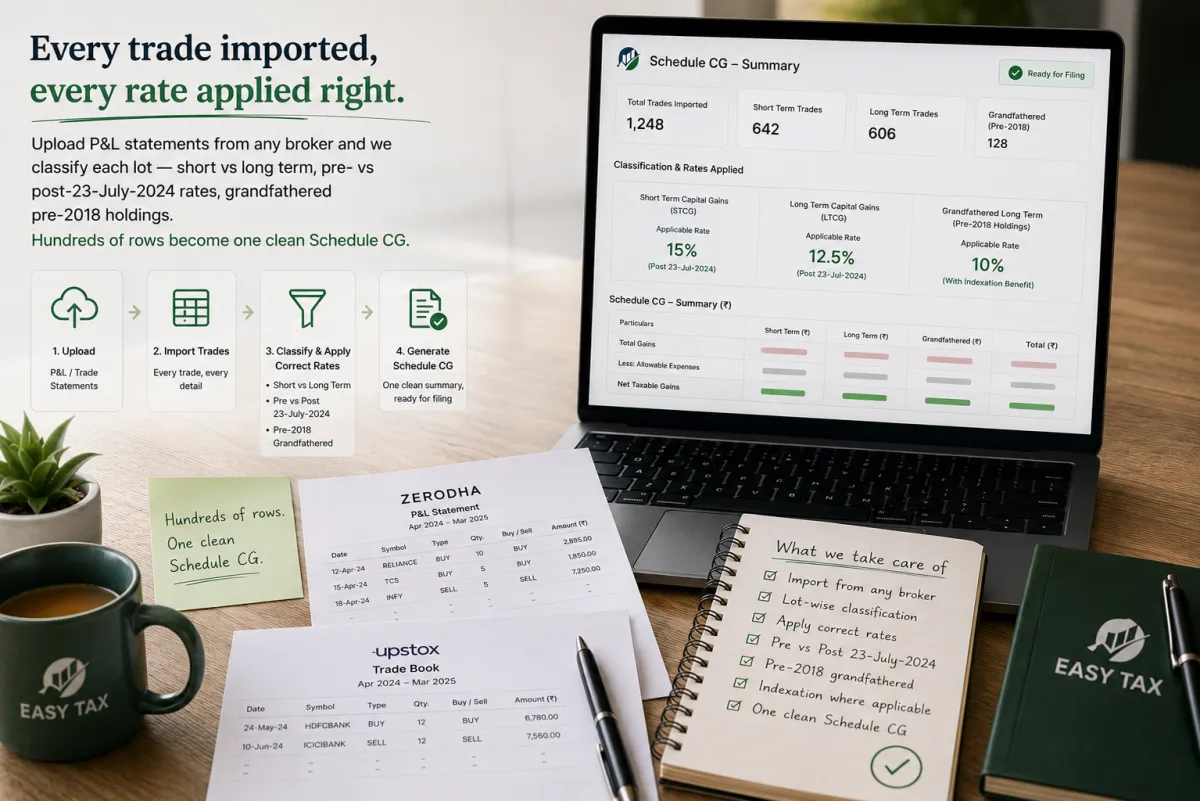
Every trade imported, every rate applied right

Upload P&L statements from any broker and we classify each lot — short vs long term, pre- vs post-23-July-2024 rates, grandfathered pre-2018 holdings. Hundreds of rows become one clean Schedule CG.
every-trade-imported-every-rate-applied-right

Property sales with exemptions planned

Sections 54, 54F and 54EC can legally shrink a property-sale tax bill to zero — but each has strict reinvestment deadlines. We compute both rate options where available and map your exemption route before the clock runs out.

stuck-an-expert-picks-up-where-you-left

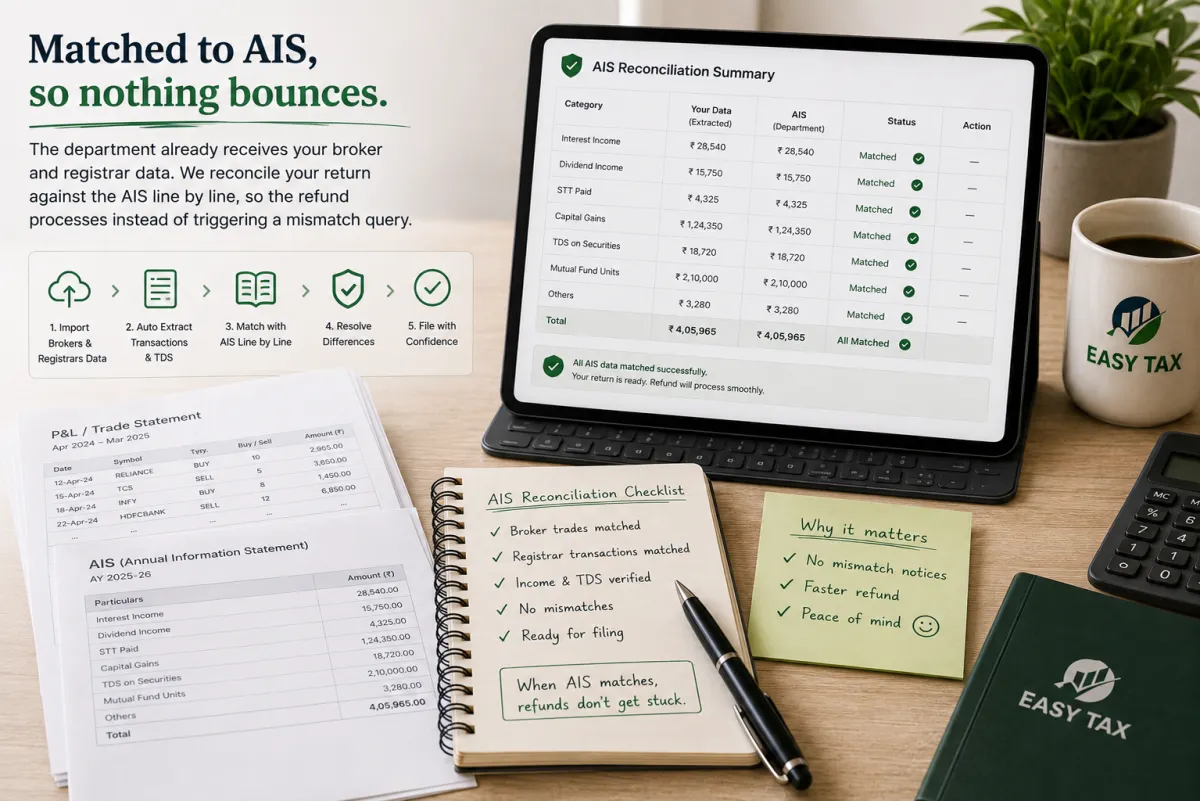
Matched to AIS, so nothing bounces

The department already receives your broker and registrar data. We reconcile your return against the AIS line by line, so the refund processes instead of triggering a mismatch query.
matched-to-ais-so-nothing-bounces

With EasyTax vs a portal at midnight

Say NO to

  • Copy-pasting 400 trades into a portal at midnight
  • Applying one tax rate to lots that straddle 23 July 2024
  • Losing the ₹1.25 lakh LTCG exemption to sloppy math
  • Forgetting grandfathered 2018 values on old holdings
  • Missing 54EC’s six-month bond deadline
  • AIS mismatch notices six months after filing

Say YES to

  • Broker statements imported and classified for you
  • The correct rate on every single lot
  • Exemptions (54/54F/54EC) planned inside their timelines
  • Losses set off and carried forward properly
  • A computation you approve before filing
  • Refunds that process without queries

How it works

  1. Upload statements

    Broker P&L, sale deeds, or both — any format your platform exports.

  2. We classify & compute

    Lot-wise rates, grandfathering, indexation options and exemptions applied.

  3. Approve the schedule

    A plain-English summary of gains, tax and refund before anything is filed.

  4. Filed & carried forward

    Return filed with losses recorded so future gains are offset.

Capital gains tax for AY 2026-27, explained

Getting your Capital Gain Tax Filing done correctly is crucial for your financial peace of mind. Many taxpayers struggle to understand the complex rules governing capital gains. This process involves reporting the profits earned from selling capital assets. Proper filing ensures compliance with Indian tax laws. It also helps you avoid hefty penalties and legal notices. Whether you sold property, shares, or mutual funds, you must declare the gains. Our detailed guide will simplify the entire process for you.

We will break down every essential requirement in this guide. You will learn how to maximize your legal deductions effectively. This knowledge empowers you to manage your wealth better. Let us dive deep into the world of taxation today. Every asset sale requires a careful evaluation of the gains made. You must classify these gains as either short-term or long-term. This classification directly impacts your overall tax liability significantly.

Essential Details on Capital Gain Tax

  • Capital gains arise directly from the transfer of a capital asset.
  • The tax generally applies in the year the transfer takes place.
  • Inherited property is never subject to tax until you actually sell it.
  • Proper financial documentation is absolutely essential for accurate calculation.
  • Massive exemptions are available if you reinvest the profits wisely.

Short-term gains usually attract a higher tax rate than long-term gains. Long-term gains often benefit from indexation and much lower rates. Understanding these nuances is critical for highly effective tax planning. Many individuals miss out on valuable exemptions simply out of ignorance. We are here to change that negative narrative completely today. You can save a significant amount of money with the right approach. Let us explore the core concepts in exhaustive detail.

What is Capital Gain Tax Filing?

Understanding the basics of this tax is your first step. It is essentially a tax levied on the profit from selling an asset. This asset could be real estate, gold, stocks, or mutual funds. The profit you make is considered your legal income. The government taxes this income under specific legal provisions. The filing process involves declaring this income in your tax return accurately.

You cannot hide these transactions from the income tax department ever. The department tracks high-value transactions very closely in today's digital world. You must know the difference between short-term and long-term gains clearly. Short-term assets are held for a brief period before final sale. This period varies depending entirely on the specific type of asset. For stocks, it is usually less than one full year.

Essential Details on Capital Gain Tax

  • Capital gains are classified based on the holding period of the asset.
  • The government uses this tax to generate revenue from asset appreciation.
  • Reporting these gains correctly is a mandatory legal requirement for citizens.
  • The calculation methods vary depending on the type of capital asset sold.
  • Indexation is a powerful tool to reduce taxes on long-term assets.

For real estate, it is less than twenty-four consecutive months. Long-term assets are held beyond these clearly specified periods. The tax rates differ significantly between the two distinct categories. Long-term gains often come with highly beneficial indexation benefits. Indexation adjusts the initial purchase price for historical inflation. This reduces your taxable profit and your ultimate tax burden. A lower taxable profit simply means you pay less tax.

Legal Framework for Capital Gain Tax Filing

The Income Tax Act of 1961 heavily governs all tax matters in India. Sections 45 to 55 specifically deal with all capital gains. Section 45 is the primary charging section for this specific tax. It states that any profit from the transfer of a capital asset is taxable. This profit is taxed directly under the head of Capital Gains. You must clearly understand the exact definition of a capital asset.

Section 2(14) clearly defines what constitutes a legal capital asset. It broadly includes property of any kind held by the assessee. It does not matter if it is connected to a business or not. There are some highly important exceptions to this legal definition. Stock-in-trade is strictly not considered a capital asset under the law. Personal effects like clothing and household furniture are also excluded.

Essential Details on Capital Gain Tax

  • The tax law requires you to index the cost of acquisition for long-term assets.
  • The Cost Inflation Index is notified by the government every single year.
  • Section 54 provides huge exemptions for reinvesting in a residential house.
  • Section 54EC allows massive tax savings by investing in specified bonds.
  • You must strictly meet specific timelines to claim these valuable exemptions.

However, precious jewelry, fine art. And expensive drawings are taxable capital assets. Rural agricultural land is entirely exempt from this specific tax. The legal definition of a transfer is also incredibly broad. Section 2(47) defines the term transfer comprehensively in the legal text. It includes the sale, exchange, or total relinquishment of an asset. It also thoroughly covers the extinguishment of any rights in an asset.

Step-by-Step Guide to Capital Gain Tax Filing

Filing your capital gains accurately always involves a highly systematic approach. First, carefully gather all documents related to the purchase and sale. You desperately need the purchase deed and the final sale deed for real estate. For stocks, you definitely need your detailed demat account statements. Determine the absolute exact date of initial acquisition and final transfer.

This crucially helps classify the asset as either short-term or long-term. Calculate the precise holding period carefully without any rounding errors. This is a highly critical step in the entire tax process. Absolute accuracy here is vital for your financial safety. Next, find the exact cost of acquisition and cost of improvement. If it is indeed a long-term asset, intelligently apply the indexation benefit.

Essential Details on Capital Gain Tax

  • Calculate short-term and long-term gains entirely separately to avoid errors.
  • Always set off any eligible capital losses from previous years carefully.
  • Long-term losses can only be strictly set off against long-term gains.
  • Short-term losses can cleverly be set off against both types of gains.
  • Always carry forward unadjusted losses to subsequent assessment years safely.

Multiply the original cost by the index of the final sale year. Divide it perfectly by the index of the initial purchase year. This mathematical formula gives you the indexed cost of acquisition. Subtract this indexed cost from the final overall sale value. Also, safely deduct any expenses incurred exclusively for the transfer. The resulting figure is your final gross capital gain amount. Now, evaluate if you are eligible for exemptions.

Documents Required for Capital Gain Tax Filing

Proper financial documentation is the absolute bedrock of accurate tax filing. You must keep all relevant papers perfectly organized and always ready. For real estate, you desperately need the original purchase agreement. You also absolutely need the final executed sale deed safely stored. Keep all receipts of any registration charges and stamp duty paid. These expenses can reduce your taxable gains incredibly significantly.

If you made major improvements to the property, keep those invoices. They form a massive part of your total cost of improvement. For financial assets, always securely download your detailed capital gains statement. Your reliable broker or mutual fund house provides this statement. It clearly physically shows your exact short-term and long-term gains. It also perfectly details the precise purchase and exact sale dates.

Essential Details on Capital Gain Tax

  • Aadhar card and PAN card are legally mandatory for any tax filing.
  • Form 26AS perfectly shows the exact TDS deducted on your property sale.
  • Annual Information Statement is a highly crucial ultimate reference document.
  • Keep strict proofs of all investments made to claim legal exemptions.
  • Always maintain the Capital Gains Account Scheme passbook if applicable.

Keep your personal bank statements handy to perfectly track the flow of funds. You must perfectly reconcile the transactions directly with your bank account. This ensures no financial transaction is totally missed during the calculation. Reconciling perfectly prevents mismatches and highly potential tax notices. Never ever throw away these important documents after filing your return. The aggressive income tax department can ask for them years later.

Benefits of Capital Gain Tax Filing

Filing your taxes totally correctly offers incredibly numerous amazing advantages. The most obvious massive benefit is absolute complete legal compliance. You completely avoid incredibly stressful scrutiny and nasty notices from the tax department. It slowly builds your solid profile as a highly honest taxpayer. A clean tax history makes borrowing money much easier. Banks heavily strictly rely on your ITR to process loan applications.

Consistent filing improves your financial creditworthiness incredibly significantly. It perfectly shows lenders that you have a highly stable and legitimate income. Another major incredible benefit is the amazing ability to claim exemptions. The generous government provides several great avenues to save your hard-earned money. You can easily reinvest in safe bonds or a brand new residential house. This can completely legally reduce your massive tax liability to absolutely zero.

Essential Details on Capital Gain Tax

  • Filing officially allows you to legally carry forward your capital losses.
  • These specific losses can legally offset future massive capital gains.
  • This is a highly powerful tool for incredibly effective tax planning.
  • Timely secure filing ensures you avoid nasty late fees and interest penalties.
  • It provides absolute complete peace of mind and massive financial security.

However, you must accurately file your return to legally claim these benefits. You simply cannot just skip filing if your taxable gain becomes zero after exemptions. You still definitely have to completely report the transaction. Total transparency is always heavily rewarded in the world of taxation. Furthermore, an accurately filed tax return strictly acts as proof of income. It perfectly facilitates incredibly seamless wealth transfer directly to the next generation.

Common Pitfalls and Penalties

Many busy taxpayers make totally avoidable stupid mistakes during their filing. One incredibly common bad error is totally ignoring the Annual Information Statement. The detailed AIS contains massive data from registries, banks, and brokers. If your filed return does not exactly match the AIS, expect a notice. Always perfectly reconcile your data with the AIS before submitting your ITR. This simple step saves you from massive headaches later on.

Another terrible mistake is carelessly choosing the absolute wrong ITR form. Using ITR-1 when you have huge capital gains makes your return completely defective. A legally defective return must be strictly revised within a very tight deadline. People also often badly miscalculate the exact holding period of an asset. This directly leads to totally incorrect legal classification of gains. Applying heavy short-term rates to long-term gains sadly costs you massive money.

Essential Details on Capital Gain Tax

  • Failing to legally report highly exempt long-term capital gains is a violation.
  • Not securely depositing money in the CGAS before the due date loses exemptions.
  • Section 50C aggressively applies if the sale price is less than stamp duty value.
  • If Section 50C is triggered, stamp value legally becomes the sale consideration.
  • Late filing totally attracts highly massive penalties precisely under Section 234F.

Conversely, illegally claiming long-term benefits for short-term assets heavily invites massive penalties. You must calculate the dates exactly from the precise date of acquisition. Do not ever heavily rely on lazy estimates or incredibly rough calculations. Absolute mathematical precision is absolutely totally necessary always. The aggressive tax department can levy a highly massive penalty on the evaded amount. This massive penalty is strictly levied legally under Section 270A of the Income Tax Act.

Edge Cases and Exceptions

The incredibly complex law surrounding capital gains has several highly unique scenarios. For instance, what exactly legally happens when you actually inherit property? There is absolutely strictly no tax liability perfectly at the time of inheritance. The massive tax only strictly applies when you eventually finally sell the inherited asset. The initial cost of acquisition strictly becomes the cost originally paid by the previous owner.

The highly crucial holding period also perfectly includes the time the previous owner held it. This is incredibly highly beneficial for the lucky taxpayer. It completely significantly massively increases the amazing indexation benefit. Another highly incredibly interesting specific case involves the conversion of a capital asset into stock-in-trade. This is highly incredibly common for massive real estate developers and busy builders. The specific conversion itself is strictly completely treated as a transfer perfectly under the law.

Essential Details on Capital Gain Tax

  • Reverse heavy mortgage specific schemes have highly special amazing tax exemptions.
  • Transfer of heavy massive assets completely between specific spouses is not taxed immediately.
  • Massive heavy gifts strictly entirely from perfectly specified legal relatives are exempt.
  • Sale of massive heavy agricultural land perfectly in deeply rural areas is tax-free.
  • Compulsory heavy state acquisition of specific property strictly has completely different rules.

Capital gains are strictly heavily calculated perfectly based on the current fair market value. However, the massive tax is incredibly only legally payable perfectly in the year the stock is sold. This perfectly legally incredibly defers the massive tax liability perfectly to a future date. You strictly incredibly must carefully handle such complex cases perfectly with extreme massive care. The complex heavy calculation strictly requires perfectly determining the exact fair market value accurately.

Why Choose EasyTax for Capital Gain Tax Filing

Navigating the complex world of tax laws is a daunting task for anyone. You need a trusted partner to safely guide you through this difficult process. EasyTax offers unparalleled expertise in handling capital gain tax filing for all citizens. Our expert team comprises seasoned chartered accountants and highly experienced tax professionals. We have decades of relevant experience handling very intricate and complex tax matters.

We constantly stay updated with every minor amendment in the country's tax laws. You can rest safely assured your filing is in highly experienced and capable hands. We prioritize your overall financial well-being above everything else in our business operations. We provide a completely personalized and entirely hassle-free service to all our loyal clients. We deeply understand that every single taxpayer's specific financial situation is totally unique.

Essential Details on Capital Gain Tax

  • We absolutely guarantee total accuracy in all our tax calculation methodologies.
  • Our highly secure digital platform ensures your personal data remains completely safe.
  • We provide comprehensive end-to-end support throughout the entire complex tax filing journey.
  • Our seasoned expert tax professionals are always available to answer your queries quickly.
  • We offer highly competitive service pricing with absolutely no hidden charges whatsoever.

We analyze your transactions meticulously to identify every possible legal tax exemption available. Our primary objective is to minimize your tax liability legally and entirely securely. We handle all the complex calculations and tedious paperwork completely on your behalf. You do not have to worry about a single thing during this entire process. Choose EasyTax today to experience absolute peace of mind and total financial security.

Special Considerations for NRIs

Non-Resident Indians face a slightly different set of rules for capital gains. The basic definitions of short-term and long-term remain generally the same for them. However, the tax rates and the TDS provisions are quite different and strict. When an NRI sells property in India, the buyer must deduct TDS aggressively. This TDS is deducted at the highest applicable rate for long-term capital gains.

The rate is typically twenty percent plus applicable surcharge and health and education cess. For short-term gains, the TDS rate can be as high as thirty percent. This heavy deduction often locks up a significant portion of the NRI's funds. NRIs can apply for a lower TDS certificate from the income tax department. This certificate directs the buyer to deduct tax at a much lower specified rate.

Essential Details on Capital Gain Tax

  • NRIs must obtain a lower deduction certificate well before executing the sale deed.
  • They can claim exemptions under sections 54 and 54F just like resident Indians.
  • Proper documentation is crucial for repatriating the sale proceeds outside the country.
  • Filing an income tax return in India is mandatory to claim any TDS refunds.
  • Double Taxation Avoidance Agreements can provide relief in their country of residence.

Applying for this certificate requires submitting detailed calculations and supporting documents to officers. The process can be time-consuming and often requires professional assistance on the ground. Once the sale is complete, the NRI must file their return in India. The final tax liability is calculated, and any excess TDS is fully refunded. EasyTax specializes in providing seamless tax filing and lower TDS services for NRIs.

Maximizing Exemptions Under Section 54

Section 54 is a lifeline for individuals selling their residential house property today. It allows you to claim total exemption from long-term capital gains tax legally. You must reinvest the gains in purchasing or constructing another residential house property. The new property must be purchased one year before or two years after sale. If you choose to construct, it must be completed within three years entirely.

This exemption is strictly available only to individuals and Hindu Undivided Families. You cannot claim this exemption if you buy a commercial property or land. The new residential house must be located strictly within the geographical boundaries of India. You can claim exemption for purchasing two houses if the gain is small. The total capital gain must not exceed two crore rupees for this specific dual benefit.

Essential Details on Capital Gain Tax

  • The dual house exemption is a once-in-a-lifetime opportunity for every single taxpayer.
  • If you cannot invest before filing, deposit the money in the CGAS account.
  • The Capital Gains Account Scheme safely parks your funds until you finally invest.
  • Withdrawing from the CGAS for non-specified purposes attracts immediate heavy tax penalties.
  • The new property cannot be sold within three years of its purchase date.

Selling the newly acquired property within three years reverses the entire tax exemption. The originally exempted capital gain becomes fully taxable in the year of new sale. Careful planning is essential to fully leverage the amazing benefits of Section 54. Many taxpayers make errors in calculating the strict timelines for investment and construction. Our expert consultants ensure you meet every single deadline and claim maximum legal benefits.

For more detailed assistance, explore our professional tax services or check official updates on the Income Tax Department website.

Documents you will need

  • PAN and Aadhaar
  • Capital gains / P&L statement from each broker or fund house
  • For property: sale deed, purchase deed, and improvement bills
  • Buyer’s TDS certificate (Form 16B) for property sales
  • Demat holding statement for grandfathered (pre-2018) equity
  • Reinvestment proofs — new property agreement or 54EC bond receipts
  • Form 16, if salaried (we file the full return, not just the schedule)

3d-checklist-scroll-with-office-character

Whatever you sold

Listed shares & ETFs

STCG/LTCG with the split-year 2024 rates handled lot-wise.

Mutual funds

Equity vs debt classification with their differing rules.

Property sales

Indexation-vs-flat-rate comparison where the law allows a choice.

ESOPs & RSUs

Perquisite value vs sale gain separated correctly, foreign plans included.

Unlisted shares

Startup and pre-IPO exits computed at the right rates.

Crypto / VDA

30% Schedule VDA reporting with 194S TDS credits claimed.

Loss harvesting review

Carried-forward and current losses set off in the optimal order.

Gift & inherited assets

Cost and holding period traced through the previous owner.

Simple, honest pricing

Investor

₹1,499 per return.

Choose plan
  • One broker, up to 200 trades
  • Equity & MF gains
  • Loss set-off & carry-forward
  • Full ITR filing included

Most popular

Investor Plus

For active investors

₹4,000 per return.

Choose plan
  • Everything in Investor
  • Multiple brokers, unlimited trades
  • ESOP/RSU and crypto schedules
  • AIS reconciliation report

Property

₹15,000 per transaction + return.

Choose plan
  • Everything in Investor Plus
  • Sale-deed based computation
  • 54/54F/54EC exemption planning
  • TDS (16B) credit & refund tracking

Documents, losses & why filing losses matters

What we need, and why

Accurate gains start with complete records. For securities we need the capital-gains or P&L statement from each broker or fund house, plus a demat holding statement for any equity bought before 31 January 2018 so grandfathering can be applied. For property we need the sale and purchase deeds, any improvement bills, and the buyer’s TDS certificate (Form 16B) so the deducted tax is credited. Claiming an exemption means we also need your reinvestment proof — a new-property agreement or 54EC bond receipt. If you are salaried, your Form 16 lets us file the complete return, not just the capital-gains schedule.

Losses are worth filing for

Even a loss-making year is worth filing carefully. Capital losses can be carried forward for up to eight years and set off against future gains — but only if the return is filed by the due date. Skip it, and that shield is gone permanently. Short-term and long-term losses have different set-off rules, and the order in which losses are applied affects your tax, so getting the sequence right matters. We record and carry forward your losses correctly so a bad year still reduces a good one later.

Why file with EasyTax

Every schedule is CA-reviewed, reconciled line by line against your AIS so refunds process without queries, and built with the correct rate on each lot — pre- and post-July-2024, grandfathered or indexed. We plan property exemptions inside their deadlines and select the right ITR form (ITR-2, or ITR-3 with business income). You approve a plain-English summary before we file, and your data is handled under India’s DPDP Act throughout.

Frequently asked questions

Everything investors ask before filing capital gains.

Your gains deserve an accurate return.

Upload your broker statement — computation preview within 48 hours.

Get my gains reviewed