

- 2,000+ GSTINs obtained
- 4.8★ Google rating
- Typically ~7 working days
GST Registration
Get your GSTIN without the runaround.
We prepare a rejection-proof application, handle Aadhaar authentication and clarifications, and track it until the certificate is in your inbox.
- Rejection-Proof Docs verified first
- Guided Aadhaar authentication handled
- Tracked ARN to certificate



Trusted by 10,000+ happy taxpayers across India
No spam. Your information is 100% secure.

First application, approved
Most GST rejections are documentation errors — a mismatched address proof, a missing NOC. We verify every document against the officer’s checklist before submission, so your first attempt is the last.

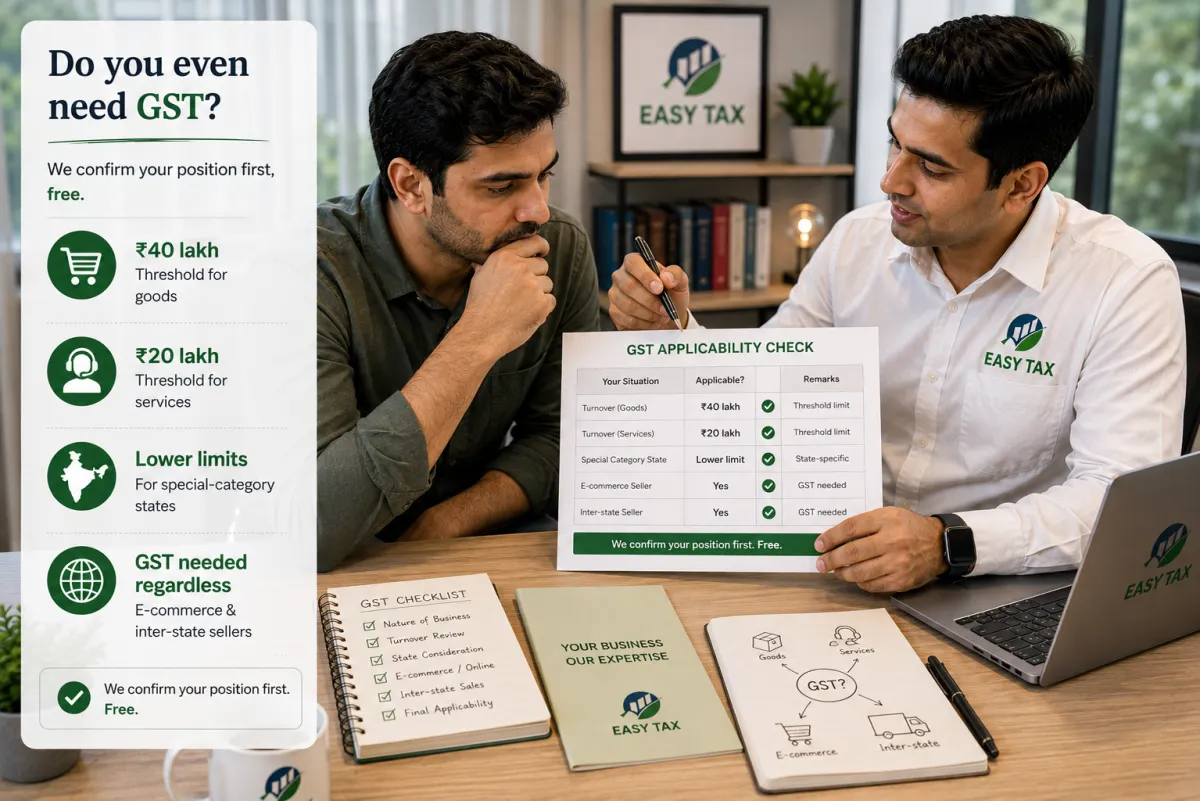
Do you even need GST?
Thresholds differ — ₹40 lakh for goods, ₹20 lakh for services, lower for special-category states; e-commerce and inter-state sellers need it regardless. We confirm your position first, free.
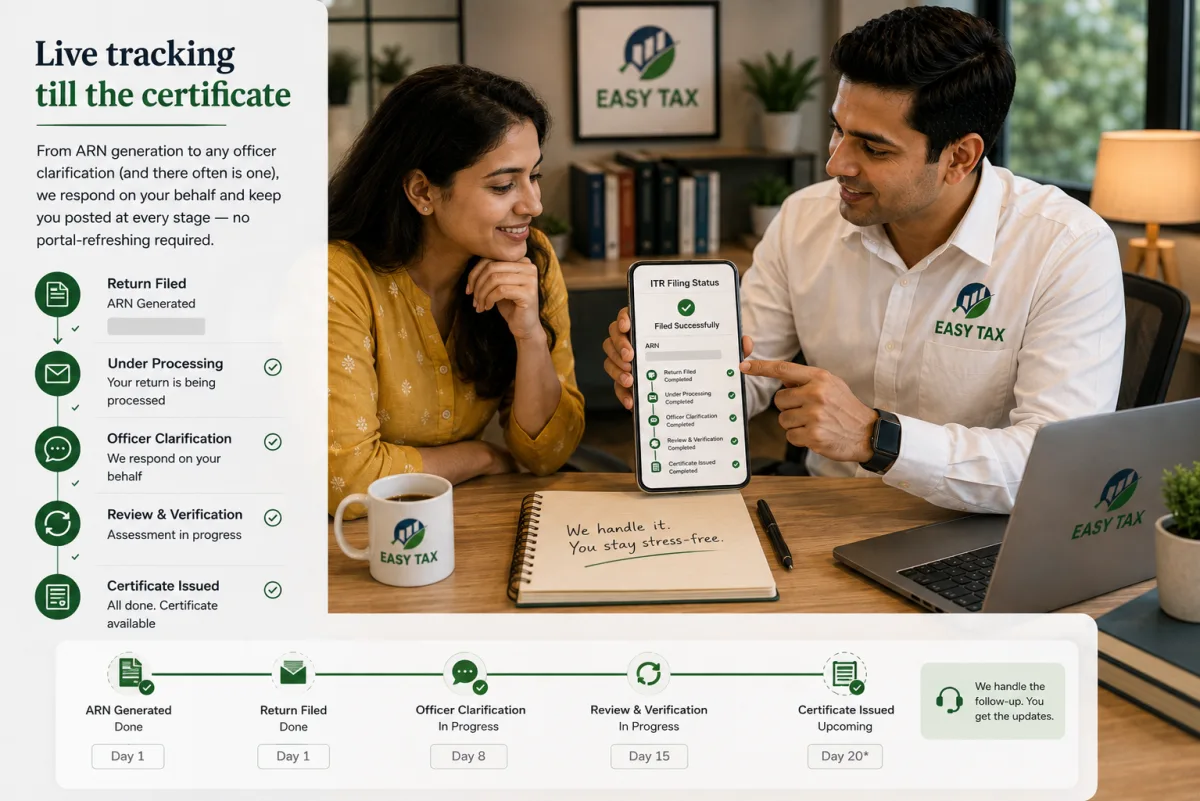
Live tracking till the certificate
From ARN generation to any officer clarification (and there often is one), we respond on your behalf and keep you posted at every stage — no portal-refreshing required.
With EasyTax vs the cyber-café route
Say NO to
- Rejections over a blurry electricity bill
- Guessing whether your turnover needs GST
- Aadhaar authentication loops with no help
- Weeks of silence after submitting
- Cyber-café applications with your OTPs
- Discovering compliance obligations after it is too late
Say YES to
- A document checklist verified before filing
- A clear yes/no on whether you need registration
- Officer clarifications answered by professionals
- ARN-to-certificate tracking with updates
- Your credentials staying yours — always
- A compliance-calendar briefing once the GSTIN arrives
How it works
-
Share your details
Business type, state and the short document list.
-
We verify & draft
Documents checked against rejection triggers; application prepared.
-
File & authenticate
Submission with Aadhaar authentication; ARN generated.
-
GSTIN delivered
Clarifications handled; certificate and first-steps briefing sent to you.
GST registration in India, explained
What GST registration means
GST registration is how a business obtains its GSTIN — the 15-digit identifier that lets it legally collect Goods and Services Tax, issue tax invoices and claim input tax credit. For many businesses it is mandatory; for others it is a strategic choice. The registration itself is free on the government portal, but the process trips people up: address-proof mismatches, Aadhaar authentication loops and officer clarifications cause a large share of first-attempt rejections. Getting a GSTIN cleanly means submitting a rejection-proof application, handling the authentication and any clarification correctly, and tracking it from ARN to certificate — which is exactly what turns a frustrating multi-week ordeal into roughly a week.
Who needs GST registration
Registration is mandatory once your turnover crosses the threshold — broadly ₹40 lakh for goods and ₹20 lakh for services, with lower limits for special-category states. But turnover is not the only trigger: if you sell inter-state, sell through e-commerce platforms like Amazon, Flipkart or Meesho, or fall under specific categories, you must register regardless of turnover. Service exporters register to file a LUT and keep exports zero-rated. Some businesses also register voluntarily, below the threshold, to claim input credit and gain B2B credibility. The first thing we do is confirm honestly which of these applies to you.
What our experts do for you
We start by confirming whether you actually need GST — free — so you neither miss a legal obligation nor register needlessly. We then verify every document against the officer’s rejection checklist: PAN, Aadhaar, business address proof, rent agreement and owner’s NOC where premises are rented, bank proof, and incorporation documents for companies and LLPs. We prepare and file the application, guide the Aadhaar authentication, and respond to any officer clarification on your behalf — the stage where unassisted applications most often stall. We track the ARN to certificate and, once your GSTIN arrives, brief you on the compliance calendar that now applies.
Thresholds, schemes and what comes after
Beyond the basic thresholds, the composition scheme offers lower compliance and a flat tax rate for smaller businesses that qualify — worth evaluating rather than defaulting to the regular scheme. Once registered, returns become mandatory, including NIL returns for dormant periods, so registration is the start of an ongoing obligation, not a one-time formality. For exporters, a Letter of Undertaking keeps exports zero-rated without paying and reclaiming tax. We flag the right scheme and the obligations that follow so there are no surprises after the certificate lands.
Documents you will need
- PAN of the business or proprietor
- Aadhaar of the proprietor / partners / directors
- Passport-size photo of the applicant(s)
- Business address proof — electricity bill or property-tax receipt
- Rent agreement plus owner’s NOC, if premises are rented
- Bank proof — cancelled cheque or statement
- Incorporation certificate & board resolution (companies/LLPs)
- Digital signature (DSC) for companies and LLPs

Whatever your business
Proprietors & freelancers
The fastest route for individuals crossing the threshold.
Companies & LLPs
Incorporation documents, DSC and authorised-signatory handled.
E-commerce sellers
Mandatory registration for Amazon, Flipkart, Meesho onboarding.
Service exporters
Registration plus LUT so exports stay zero-rated.
Multiple states
Additional place-of-business and multi-state registrations.
Composition scheme
Lower-compliance option evaluated and opted where it fits.
Voluntary registration
Input credit and B2B credibility even below threshold.
Amendments & cancellations
Address, trade-name changes and clean closures.
Simple, honest pricing
- Eligibility check
- Document verification
- Application filing & ARN
- Basic tracking
- Everything in Starter
- Officer clarification responses
- Aadhaar authentication support
- GSTIN + compliance briefing
- Everything in Standard
- Company/LLP with DSC support
- LUT filing for exporters
- First month’s GSTR filing free
Documents, fees & what happens after GSTIN
Why the documents matter
GST rejections are overwhelmingly documentation problems, so each item earns its place. Your PAN anchors the registration; Aadhaar drives the authentication that now speeds most approvals. The business address proof — an electricity bill or property-tax receipt — plus a rent agreement and owner’s NOC where you rent, is the single most common rejection trigger, which is why we verify it before filing. Bank proof and, for companies and LLPs, the incorporation certificate, board resolution and DSC complete the file. Verifying all of it against the officer’s checklist first is what makes a one-attempt approval realistic.
Fees, timelines and life after registration
GST registration itself is free on the government portal — you pay only a professional fee, quoted upfront. With clean documents and successful Aadhaar authentication, approval typically takes around seven working days, longer if an officer raises a clarification (which we answer on your behalf). Once your GSTIN is issued, filing returns becomes mandatory — even NIL returns for dormant periods — so registration begins an ongoing compliance cycle. We hand you a simple compliance calendar and can take over the filings entirely.
Why register with EasyTax
We tell you honestly whether you need GST, verify every document against the rejection checklist, guide the Aadhaar authentication, and answer officer clarifications — the stages where unassisted applications stall. We track the ARN to certificate and brief you on what comes next. If a properly documented application we filed is rejected, we re-file it at no extra professional fee. Your credentials stay yours, and everything is handled under India’s DPDP Act.
Frequently asked questions
Everything businesses ask before registering for GST.

Typically around seven working days when Aadhaar authentication succeeds and no clarification is raised; longer if the officer seeks additional documents. Our document-verification step exists precisely to avoid that clarification loop, so most applications we file are approved on the first attempt within roughly a week.
Not by threshold alone — but you do if you sell inter-state, sell through e-commerce platforms, or fall under specific notified categories, regardless of turnover. Voluntary registration can also make sense for input credit and B2B credibility. We assess your exact position honestly and tell you if you genuinely do not need to register.
No. GST registration itself is free on the government portal. You pay only our professional fee, which is quoted upfront with no hidden charges. Any suggestion of a large “government fee” for a basic registration is a red flag — the cost is the professional assistance, not a statutory levy.
Filing returns becomes mandatory, including NIL returns for periods with no activity. Skipping them stacks late fees and can lead to suspension of your registration. We hand you a simple compliance calendar so you know your due dates, and can take over your GSTR filings entirely so nothing is missed.
Yes, usually over address-proof issues or mismatched details — which is exactly why we verify every document against the officer’s checklist before filing. If a properly documented application we prepared is still rejected, we re-file it at no extra professional fee, addressing the officer’s specific objection so the second attempt succeeds.
The composition scheme lets smaller eligible businesses pay GST at a flat, lower rate with much simpler quarterly compliance, in exchange for not collecting GST from customers or claiming input credit. Whether it benefits you depends on your customers and margins, so we evaluate it against the regular scheme rather than defaulting to one.
Yes. Selling through platforms like Amazon, Flipkart or Meesho requires GST registration regardless of your turnover, because the platforms deduct TCS and require a GSTIN for onboarding. If you are planning to sell online, registering is a prerequisite, and we handle it so your marketplace onboarding is not held up.
Yes. A home address can be used, supported by an electricity bill or property-tax receipt and, if the property is rented, a rent agreement with the owner’s NOC. Home-based registration is common for freelancers and small businesses; the key is that the address proof is clear and consistent, which we verify before filing.
Yes. Your PAN, Aadhaar, bank and business documents are used only to prepare and file your registration, stored securely, and never shared. Unlike a cyber-café filing, your OTPs and credentials stay with you. All handling follows India’s Digital Personal Data Protection (DPDP) Act.
Ready to invoice properly? Get your GSTIN.
Most applications are filed within 24 hours of documents being complete.
Verified & Supervised by CA Jitendra Shari
Every filing, tax consultation, and compliance checklist is rigorously audited by practicing Chartered Accountants in Jaipur to ensure 100% adherence to Income Tax, GST, and MCA regulations.