
Annual Income Tax Estimator India: AY 2026–27 Guide
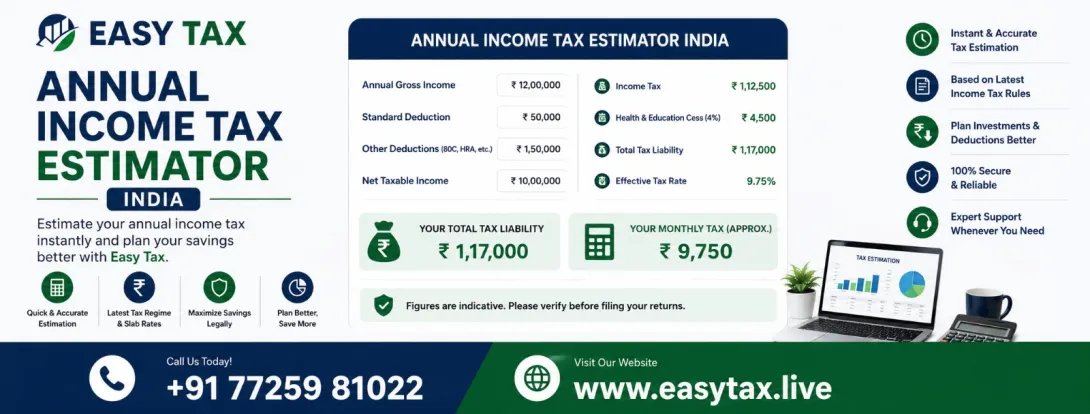
Income Tax Guide
Annual Income Tax Estimator India: Calculate Your Tax for AY 2026–27
An annual income tax estimator helps you calculate an approximate tax liability by considering your income, eligible deductions, tax regime and taxes already paid. This guide explains how to estimate income tax in India for Assessment Year (AY) 2026–27, compare the old and new tax regimes, and check your figures before filing your Income Tax Return (ITR).
Applicable period: AY 2026–27, relating to FY 2025–26 (income earned from 1 April 2025 to 31 March 2026).
Important: This article covers individual taxpayers. Tax treatment can differ for business income, capital gains, non-residents and special-rate income.
Related EasyTax resources: Try the EasyTax income tax calculator, compare old and new tax regimes, and get help through our expert-assisted ITR filing service.
What is an annual income tax estimator?
An annual income tax estimator is a planning tool that calculates an approximate tax liability using information such as salary, pension, rental income, interest, capital gains, business income, eligible deductions and tax payments already made.
It can help you understand your likely tax liability, compare eligible tax regimes and identify whether additional tax may be payable or a refund may arise. The estimate is only as reliable as the information entered and the tax rules used by the calculator.
An estimate is not an assessment or confirmation from the Income Tax Department. Reconcile the result with your records and the applicable provisions before filing your return.
Which tax year or assessment year should you select?
Selecting the correct period is essential. The tax law and rates applicable to a return depend on the period for which the income was earned.
| Term | Meaning | Relevant period |
|---|---|---|
| Financial Year (FY) 2025–26 | The year in which the income was earned | 1 April 2025 to 31 March 2026 |
| Assessment Year (AY) 2026–27 | The assessment year relating to income earned in FY 2025–26 | For reporting FY 2025–26 income |
| Tax Year (TY) 2026–27 | The tax year under the Income-tax Act, 2025 | 1 April 2026 to 31 March 2027 |
Important transition: The Income-tax Act, 2025 came into effect on 1 April 2026. For an estimate relating to AY 2026–27, the Income Tax Department's official estimator manual instructs users to select the Income-tax Act, 1961. The Income-tax Act, 2025 applies to Tax Year 2026–27.
Do not select a tax year merely because the calculator is labelled “2026–27”. Confirm whether it means AY 2026–27 or TY 2026–27.
Official reference: Income Tax Department — Income and Tax Estimator User Manual .
Information required to estimate income tax
Collect the relevant income and tax-payment details before using an income tax estimator. The information below is a preparation checklist; the exact inputs depend on your income sources and taxpayer category.
01 Personal and taxpayer details
- Taxpayer category, such as individual or HUF.
- Residential status for the relevant financial year.
- Age during the relevant previous year, where relevant to the regime.
- Applicable assessment year and Income-tax Act.
- Tax regime selected or available to you.
02 Income details
- Salary, allowances, perquisites and pension.
- Income or loss from house property.
- Interest from savings accounts, fixed deposits and other sources.
- Capital gains from shares, mutual funds, property or other assets.
- Business or professional income, where applicable.
- Other taxable income, including income that may be subject to special rates.
03 Deductions and exemptions
Enter only deductions and exemptions that are permitted under the selected regime and applicable to your circumstances. For example, eligible taxpayers under the old regime may need information about Section 80C investments, medical insurance, eligible NPS contributions, HRA and housing-loan interest.
Read the EasyTax guide to Section 80C deductions for a general overview. Confirm the current statutory conditions before claiming any deduction.
04 Taxes already paid
- Tax deducted at source (TDS).
- Tax collected at source (TCS), where applicable.
- Advance tax paid.
- Self-assessment tax paid.
New tax regime slabs for AY 2026–27
The new tax regime under Section 115BAC of the Income-tax Act, 1961 is the default regime for eligible taxpayers. Eligible taxpayers may opt for the old regime, subject to the applicable rules and procedure.
| Total taxable income | Tax rate |
|---|---|
| Up to ₹4,00,000 | Nil |
| ₹4,00,001 to ₹8,00,000 | 5% |
| ₹8,00,001 to ₹12,00,000 | 10% |
| ₹12,00,001 to ₹16,00,000 | 15% |
| ₹16,00,001 to ₹20,00,000 | 20% |
| ₹20,00,001 to ₹24,00,000 | 25% |
| Above ₹24,00,000 | 30% |
These are slab rates, not the complete tax calculation. The final calculation may also involve the standard deduction, eligible deductions, rebate under Section 87A, surcharge, marginal relief, health and education cess, and income taxable at special rates.
Section 87A rebate under the new regime
For AY 2026–27, a resident individual may be eligible for a rebate of up to ₹60,000 under Section 87A where the relevant total income does not exceed ₹12,00,000. The rebate is subject to statutory conditions and does not apply against tax on special-rate income. Marginal relief may be relevant where income is slightly above the threshold.
Standard deduction
Eligible salaried taxpayers and pensioners should check the applicable standard deduction for the selected regime and period. For FY 2025–26, the standard deduction for salary income under the new regime is ₹75,000. Do not automatically apply the same amount to family pension, business income or other income categories.
Official references: Income Tax Department — Salaried Individuals for AY 2026–27 and Income Tax Department — AY 2026–27 ITR FAQs .
Old tax regime: deductions and exemptions
The old tax regime has different slab rates and may permit deductions and exemptions that are restricted or unavailable under the new regime. Whether it produces a lower tax liability depends on the taxpayer's income, age, eligible deductions and exemptions.
For individuals below 60 years, the old-regime general slab structure for AY 2026–27 is:
| Total taxable income | Tax rate |
|---|---|
| Up to ₹2,50,000 | Nil |
| ₹2,50,001 to ₹5,00,000 | 5% |
| ₹5,00,001 to ₹10,00,000 | 20% |
| Above ₹10,00,000 | 30% |
The basic exemption limit under the old regime differs for resident senior citizens and super senior citizens. Confirm the applicable age category and rules before using this table for an estimate.
Common deductions and exemptions to review
- Section 80C: Eligible investments and payments, subject to the combined statutory limit and conditions.
- Section 80D: Eligible medical insurance premiums and specified medical expenditure, subject to conditions and limits.
- Section 80CCD: Eligible contributions to the National Pension System, subject to the applicable limits.
- HRA: House Rent Allowance exemption where the statutory conditions are satisfied.
- Section 24(b): Eligible housing-loan interest, subject to property type and other conditions.
- Other Chapter VI-A deductions: These may apply depending on the nature of the payment, taxpayer and statutory eligibility.
Do not assume that every deduction is available to every taxpayer. Some deductions have separate conditions, limits, documentation requirements or restrictions under the selected regime.
Explore the EasyTax HRA calculator for an initial HRA estimate, and review the EasyTax deductions guide. Verify the final claim against the applicable law and official guidance.
Section 87A rebate under the old regime
For AY 2026–27, a resident individual may be eligible for a rebate of up to ₹12,500 under Section 87A where the relevant total income does not exceed ₹5,00,000, subject to the statutory conditions.
How to compare the old and new tax regimes
Do not choose a regime only by looking at its headline tax rate. Compare the final estimated tax under both regimes after applying the deductions, exemptions and rebates that are actually available to you.
- Calculate your total income under the applicable income heads.
- Identify deductions and exemptions available under each regime.
- Apply the correct standard deduction, if eligible.
- Calculate tax using the correct slab rates and special-rate provisions.
- Apply any eligible rebate and marginal relief.
- Calculate surcharge and health and education cess, where applicable.
- Compare the final liability after accounting for tax credits.
The new regime may be suitable for taxpayers who do not have substantial eligible deductions. The old regime may be worth comparing where significant eligible deductions or exemptions are available. There is no single regime that is best for every taxpayer.
The Income Tax Department provides official guidance on the differences between the old and new tax regimes .
How to use an income tax estimator
Follow these steps to prepare an initial estimate for AY 2026–27:
- Select the correct period. Choose AY 2026–27 for income earned during FY 2025–26.
- Select the applicable Act. For AY 2026–27, select the Income-tax Act, 1961 in the official Income and Tax Estimator.
- Enter taxpayer details. Check taxpayer category, residential status and age.
- Enter all relevant income. Include salary, house property, capital gains, business or professional income and other sources, as applicable.
- Enter eligible deductions. Use only amounts supported by records and permitted under the selected regime.
- Enter tax payments. Include TDS, TCS, advance tax and self-assessment tax where supported by your records.
- Compare the regimes. Review the estimated result under each regime available to you.
- Reconcile the result. Compare the estimate with Form 16, AIS, Form 26AS, bank records and supporting documents before filing.
The official Income and Tax Estimator is available to registered users of the Income Tax e-Filing portal. The Department's manual explains the basic information, income, deduction and tax-detail sections.
Documents and records to check before filing
An estimator cannot identify missing income or incorrect deductions unless you enter accurate information. Review the relevant records before relying on the result.
| Record | What to verify |
|---|---|
| Form 16 | Salary, exemptions, deductions and employer TDS details. |
| Form 26AS | Tax credits and TDS/TCS entries reflected in the tax account. |
| AIS and TIS | Reported financial information and other tax-related entries. |
| Bank statements and interest certificates | Savings interest, fixed-deposit interest and other receipts. |
| Investment and insurance records | Amounts and eligibility for deductions claimed under the chosen regime. |
| Rent and housing-loan records | Rent paid, HRA details and eligible housing-loan interest. |
| Broker and mutual fund statements | Capital gains, dividends and transaction details. |
| Tax payment challans | Advance tax and self-assessment tax payments. |
The documents required depend on the return form and income sources. The Income Tax Department's AY 2026–27 ITR-2 FAQs describe examples of records relevant to taxpayers filing that form.
Tax payable, TDS and estimated refund
After estimating your total tax liability, compare it with eligible tax payments already made.
- If the estimated liability is higher than the tax paid or credited, additional tax may be payable.
- If eligible tax payments and credits exceed the final tax liability, a refund may arise.
- If tax payments and liability are equal, there may be no balance tax payable or refund.
A calculator's refund figure is not a refund approval. The final amount depends on the return filed, the tax credits accepted and processing by the Income Tax Department.
Reconcile TDS and other tax credits with Form 26AS and AIS before claiming them in your return.
Common income tax estimation mistakes
- Selecting the wrong assessment year: AY 2026–27 relates to FY 2025–26. Do not confuse it with Tax Year 2026–27 under the new Act.
- Entering salary but omitting other income: Bank interest, rent, capital gains and other taxable income may also affect the estimate.
- Claiming deductions without checking eligibility: A payment does not automatically qualify for a tax deduction.
- Applying old-regime deductions under the new regime: Many commonly claimed deductions and exemptions are restricted under the new regime.
- Ignoring age and residential status: These details can affect the applicable rules and tax treatment.
- Confusing TDS with final tax: TDS is a tax credit, not necessarily the final tax liability.
- Ignoring special-rate income: Certain capital gains and other income may be taxed under separate provisions.
- Relying on default calculator inputs: Check the income, deductions, tax period and assumptions used by any calculator.
Frequently asked questions
What is an annual income tax estimator?
It is a planning tool that estimates tax based on income, deductions, exemptions, tax regime and tax payments entered by the user. It is not a final assessment by the Income Tax Department.
Which financial year applies to AY 2026–27?
AY 2026–27 relates to FY 2025–26, which runs from 1 April 2025 to 31 March 2026.
Which Income-tax Act should I select for AY 2026–27?
The Income Tax Department's estimator manual says to select the Income-tax Act, 1961 for AY 2026–27. The Income-tax Act, 2025 applies to Tax Year 2026–27.
Is the new tax regime the default regime?
Yes. The new tax regime is the default for eligible taxpayers. Eligible taxpayers may opt for the old regime subject to the applicable conditions and procedure.
Can I claim Section 80C deductions under the new regime?
Section 80C deductions are generally not available under the new regime. Check the specific deductions permitted under the applicable law and period before entering any deduction.
Can an income tax estimator calculate my refund?
It may estimate a refund if eligible tax payments and credits exceed the estimated liability. The actual refund depends on the return filed and its processing by the Income Tax Department.
Is the estimator result the same as my final tax?
Not necessarily. Missing income, incorrect deductions, special-rate income, tax credits and changes in applicable rules can change the final liability.
Can I compare the old and new tax regimes?
Yes. Compare the final tax under each regime after applying only the deductions, exemptions and rebates for which you qualify.
Use EasyTax tools and get assistance
Once you have collected your income and deduction details, you can use the following EasyTax resources for further assistance:
- EasyTax Income Tax Calculator — for an additional old-versus-new regime estimate.
- EasyTax HRA Calculator — for an initial HRA exemption estimate.
- EasyTax deductions guide — for an overview of common deductions.
- Expert-assisted ITR filing — for assistance with return preparation.
Need help reviewing your tax estimate?
If you have multiple income sources, capital gains, business or professional income, foreign income, or uncertainty about deductions, consider getting your tax position reviewed before filing.
Official sources and further reading
- Income Tax Department — Income and Tax Estimator User Manual (applicable Act, assessment year and estimator inputs).
- Income Tax Department — Salaried Individuals for AY 2026–27 (tax slabs, regimes and return guidance).
- Income Tax Department — ITR-2 FAQs for AY 2026–27 (rebate, return eligibility and documents).
- Income Tax Department — New Tax vs Old Tax Regime FAQs (regime comparison and deductions).
- Income Tax Department — Deductions on which I can get tax benefit (deduction guidance; check the relevant period and conditions).
- Government of India — Finance Bill 2026 Memorandum (tax-rate provisions and explanatory material).
- Income Tax Department — Income-tax Act, 2025 (new Act, Rules, transition FAQs and official guidance).
Was this guide helpful?
Related reading

Crypto Tax Filing Mistakes in India (2026 Guide)
Crypto Tax Guide for India | Tax Year 2026–27 Crypto tax filing can become complicated when you trade frequently, use…

Apply for PAN Card Online in 2026: Step-by-Step Guide
How to Apply for PAN Card Online in 2026: Step-by-Step Guide If you need a new Permanent Account Number (PAN), you can…
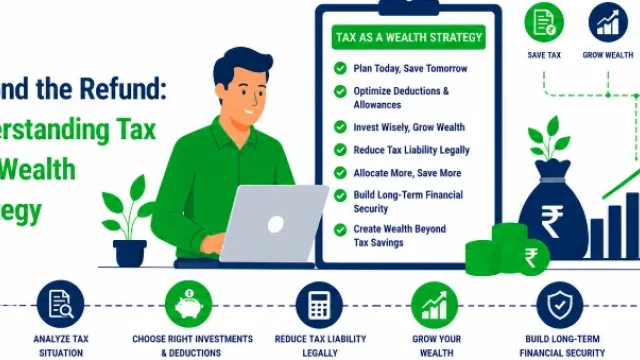
Tax Planning for Wealth Creation in India: Beyond Refunds
Beyond the Refund: How Tax Planning Builds Wealth in India A tax refund can feel like a financial win, but long-term…
Latest from the blog
SEO Agent connection test (temporary)
This is a temporary test post. It checks the connection between the EasyTax website and the SEO Agent publishing tool,…
Tax-Smart Tips for Salaried Employees: New Tax Regime
Tax-smart tips for salaried employees under the new tax regime: understand deductions, employer NPS, tax rebates,…
Tax-Smart Tips for Salaried Employees | EasyTax
Tax-smart tips for salaried employees under India’s new tax regime: compare deductions, employer NPS, rebates and…
EasyTax • Trusted by 10,000+ Clients
ITR Filing for Investors & Traders
Multi-broker P&L computation, tax-loss harvesting, F&O balance sheets & capital gains optimization by expert CAs.