
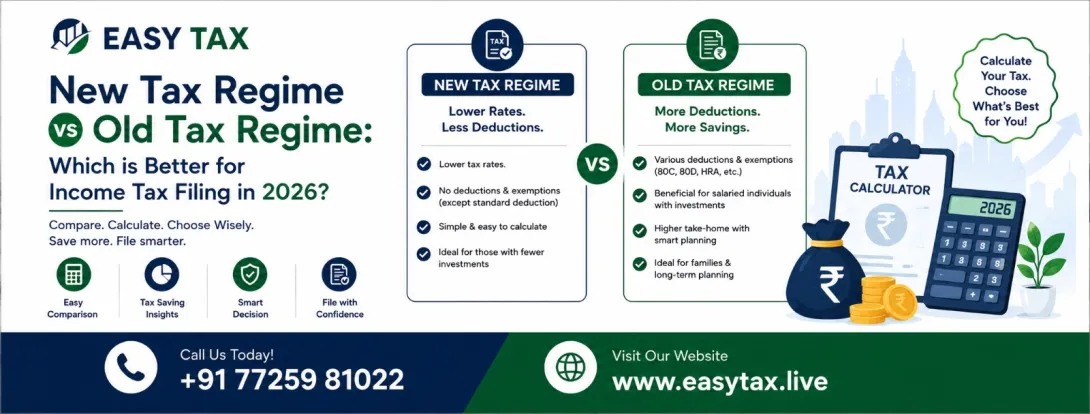
New Tax Regime vs Old Tax Regime: Which is Better for Income Tax Filing in 2026?
Updated: 23 November 2026
Jurisdiction: India
Applicable period: FY 2025–26 / AY 2026–27
New Tax Regime vs Old Tax Regime in 2026: Which Is Better?
Choosing between the new tax regime and old tax regime can change your final income-tax liability. The new regime generally offers revised slab rates with fewer deductions, while the old regime allows eligible taxpayers to claim several deductions and exemptions.
The better option depends on your income, age, residential status, HRA, investments, home-loan interest, insurance premiums, and other eligible deductions. Compare both regimes before filing your Income Tax Return.
Important tax-period clarification
AY 2026–27 relates to income earned during FY 2025–26, from 1 April 2025 to 31 March 2026. This return is generally governed by the Income-tax Act, 1961.
Income earned from 1 April 2026 onwards belongs to Tax Year 2026–27 and must be considered under the applicable provisions of the Income-tax Act, 2025. Do not mix AY 2026–27 with Tax Year 2026–27.
Old regime versus new regime
| Feature | Old regime | New regime |
|---|---|---|
| Default regime | No | Yes for eligible taxpayers |
| Common deductions | Available when eligible | Generally restricted |
| Section 80C | Available when eligible | Generally unavailable |
| HRA exemption | Available when eligible | Generally unavailable |
| Salary standard deduction | ₹50,000, subject to applicable rules | Up to ₹75,000, subject to applicable rules |
| Tax calculation | More deductions and exemptions | Lower slab structure with fewer deductions |
This table is a general comparison. Your actual result depends on your taxpayer category, income sources, deductions, exemptions, special-rate income, rebate, surcharge, cess, and other statutory conditions.
New tax regime slabs for AY 2026–27
| Taxable income | Tax rate |
|---|---|
| Up to ₹4,00,000 | Nil |
| ₹4,00,001 to ₹8,00,000 | 5% |
| ₹8,00,001 to ₹12,00,000 | 10% |
| ₹12,00,001 to ₹16,00,000 | 15% |
| ₹16,00,001 to ₹20,00,000 | 20% |
| ₹20,00,001 to ₹24,00,000 | 25% |
| Above ₹24,00,000 | 30% |
Section 87A rebate
For AY 2026–27, an eligible resident individual with total income up to ₹12 lakh may receive a rebate of up to ₹60,000 under Section 87A, subject to the statutory conditions.
The rebate is not a universal exemption for every type of income. Special-rate income and other statutory conditions must be considered separately.
A salaried taxpayer may also receive the applicable standard deduction. Therefore, a gross salary figure should not automatically be described as a universal tax-free limit.
Old tax regime slabs for AY 2026–27
Individuals below 60 years
| Taxable income | Tax rate |
|---|---|
| Up to ₹2,50,000 | Nil |
| ₹2,50,001 to ₹5,00,000 | 5% |
| ₹5,00,001 to ₹10,00,000 | 20% |
| Above ₹10,00,000 | 30% |
Resident senior citizens aged 60 to 79
| Taxable income | Tax rate |
|---|---|
| Up to ₹3,00,000 | Nil |
| ₹3,00,001 to ₹5,00,000 | 5% |
| ₹5,00,001 to ₹10,00,000 | 20% |
| Above ₹10,00,000 | 30% |
Resident super-senior citizens aged 80 or above
| Taxable income | Tax rate |
|---|---|
| Up to ₹5,00,000 | Nil |
| ₹5,00,001 to ₹10,00,000 | 20% |
| Above ₹10,00,000 | 30% |
Non-resident taxpayers should not assume that resident senior-citizen exemption limits apply to them.
Deductions commonly considered under the old regime
- Section 80C investments, subject to the combined statutory limit
- Eligible health-insurance deductions under Section 80D
- Additional NPS deduction under Section 80CCD(1B), where eligible
- HRA exemption under Section 10(13A), subject to conditions
- Eligible home-loan interest under Section 24(b)
- Other deductions allowed under the applicable provisions
Do not claim a deduction only because it appears in a checklist. Keep supporting documents and confirm eligibility for the selected tax regime.
Which regime may suit salaried employees?
The new regime may suit employees who have limited deductions, do not claim HRA, do not have substantial eligible home-loan interest, and prefer a simpler calculation.
The old regime may be worth comparing when an employee has eligible Section 80C investments, qualifying rent with HRA, health-insurance deductions, home-loan interest, or several other permitted deductions.
There is no single regime that is best for every taxpayer. Calculate both results using the same income, tax credits, and verified deductions.
Illustrative comparison
Consider a resident salaried individual below 60 years with gross salary of ₹15 lakh, ordinary salary income only, and no surcharge liability.
Example A: Limited deductions
| Particular | New regime | Old regime |
|---|---|---|
| Gross salary | ₹15,00,000 | ₹15,00,000 |
| Standard deduction | ₹75,000 | ₹50,000 |
| Taxable income before other adjustments | ₹14,25,000 | ₹14,50,000 |
| Illustrative estimated tax including 4% cess | ₹97,500 | ₹2,57,400 |
In this simplified example, the new regime produces the lower estimated tax. The result can change when eligible deductions and exemptions are added.
Example B: Substantial eligible deductions
If the same taxpayer has substantial verified deductions and exemptions under the old regime, the old regime may produce a lower result. The deductions must be legally eligible and supported by documents.
These examples exclude surcharge, marginal relief, special-rate income, tax credits, and individual-specific adjustments.
How to choose between the two regimes
- Collect salary, interest, rental, business, and capital-gains information.
- Reconcile income with Form 16, AIS, TIS, and Form 26AS.
- List only deductions for which you have valid supporting documents.
- Calculate taxable income under both regimes.
- Apply the correct slab rates and standard deduction.
- Apply rebate, surcharge, marginal relief, and cess where applicable.
- Compare the final estimated liability.
- Check the regime-selection procedure before filing the ITR.
How to select the old regime while filing ITR
The new regime is the default for eligible taxpayers. Eligible taxpayers may opt out and select the old regime by following the applicable procedure.
Taxpayers without business or professional income can generally select their regime while filing the return, subject to the prescribed due-date rules.
Taxpayers with business or professional income may need to submit Form 10-IEA when exercising the applicable option. The exact procedure depends on the taxpayer’s facts and current instructions.
Frequently asked questions
Which tax regime is better in 2026?
There is no universal answer. Compare both regimes using your actual income, deductions, exemptions, rebates, and tax credits.
Is the new tax regime compulsory?
The new regime is the default for eligible taxpayers, but eligible taxpayers may opt out subject to the applicable procedure.
Can I claim Section 80C in the new regime?
Section 80C is generally unavailable under the new regime. Check the current law for specifically permitted deductions.
Is HRA available under the new regime?
The usual HRA exemption under Section 10(13A) is generally not available under the new regime for AY 2026–27. Eligible taxpayers may consider it under the old regime.
Can salaried employees change their regime?
Eligible salaried taxpayers without business or professional income can generally choose their regime while filing the return, subject to the prescribed rules and due dates.
Final answer: old regime or new regime?
The new regime may be attractive for taxpayers with fewer deductions and ordinary income. The old regime may be beneficial for taxpayers with substantial eligible deductions and exemptions.
The correct choice is the regime that produces the lower legally calculated tax liability after considering your complete income and eligible claims.
Before filing, verify Form 16, AIS, TIS, Form 26AS, deductions, tax credits, and the applicable ITR form.
For complex income, business income, capital gains, or international income, consult an EasyTax tax professional .
Official references
Disclaimer
This article is for general educational information only. It is not an individual tax assessment, legal advice, or financial advice. Tax rates, deductions, rebates, forms, and filing procedures may change. Verify the current official provisions for the applicable period before filing.
Was this guide helpful?
Related reading

Why Your Business Needs a CA: 7 Signs You Shouldn't Ignore
Skip to article Business Accounting & Taxation Why Your Business Needs a CA: 7 Signs You Shouldn't Ignore Business…

Why is My Gst Credit Blocked? Common Reasons and Solutions
Understand why GST credit is blocked, how to check GSTR-2B and Section 16 conditions, and when Rule 37A, Section 17(5)…

Best Gst Consultant in Jaipur
EasyTax Home Blog Our services Contact Home / Blog / GST / Best GST Consultant in Jaipur GST compliance · Jaipur,…
Latest from the blog
Tax-Smart Tips for Salaried Employees: New Tax Regime
Tax-smart tips for salaried employees under the new tax regime: understand deductions, employer NPS, tax rebates,…
Tax-Smart Tips for Salaried Employees | EasyTax
Tax-smart tips for salaried employees under India’s new tax regime: compare deductions, employer NPS, rebates and…
Revised Form 161: CBDT Notification 134/2026 Explained
Income Tax · India · Tax update Revised Form 161: CBDT Notification 134/2026 Explained Updated: 19 November 2026 ·…
EasyTax • Trusted by 10,000+ Clients
GST Return Filing & Compliance
Timely GSTR-1 & GSTR-3B filing, 100% ITC matching and department notice defense by certified GST experts.