
GST Calculator Online in Jaipur: Rajasthan GST Rates 2026
Jaipur GST Calculator 2026: Rajasthan GST Rates, CGST, SGST and IGST Explained
If you run a shop, manufacturing unit, consultancy, trading business or online business in Jaipur, calculating GST correctly is an important part of preparing invoices and understanding the amount payable by your customer.
The EasyTax GST calculator can help you work out the tax amount on a value when you already know the applicable GST rate. This guide explains how GST calculations work, how to distinguish CGST and Rajasthan GST (RGST) from IGST, how to calculate tax-inclusive prices and how to check the correct rate for goods and services.
It is written for businesses in Jaipur and other parts of Rajasthan that need a practical introduction to GST calculations.
01 Use the EasyTax GST Calculator Online
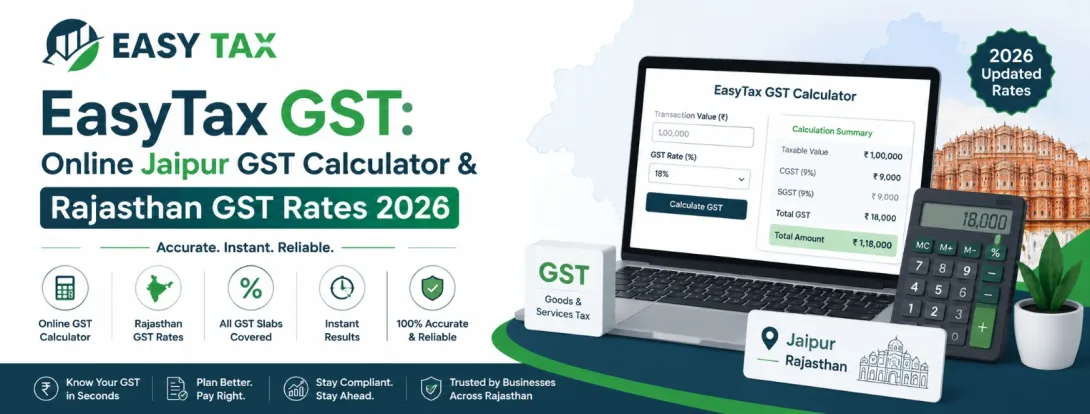
Use the EasyTax GST calculator when you know the taxable value and the applicable GST percentage. It can help you understand the tax amount, total invoice value and reverse calculation for a tax-inclusive price.
Open the EasyTax GST Calculator
What information should you have before calculating?
- The taxable value or total price, depending on the calculation.
- The applicable GST rate confirmed for the goods or services.
- Whether the transaction is intra-State or inter-State.
- Whether the entered amount is before GST or already includes GST.
If you are unsure about the applicable rate, first check the relevant GST rate schedule and classification. Do not select a rate only because it is commonly used by businesses in your industry.
02 What Is GST?
Goods and Services Tax (GST) is an indirect tax levied on supplies of goods and services under India's GST framework. The applicable tax depends on the nature of the supply, classification, place of supply, valuation and relevant notifications.
For businesses in Rajasthan, the main components to understand are:
- CGST: Central Goods and Services Tax.
- SGST/RGST: State Goods and Services Tax. In Rajasthan, this is Rajasthan GST (RGST).
- IGST: Integrated Goods and Services Tax, generally applicable to inter-State supplies and specified transactions.
When are CGST and RGST charged?
When a supply is treated as an intra-State supply in Rajasthan, CGST and RGST are generally charged together. For a rate represented as 18%, the usual split is 9% CGST and 9% RGST. The applicable classification and any special provisions must still be checked.
When is IGST charged?
When a supply is treated as an inter-State supply, IGST is generally charged instead of separately charging CGST and RGST. The place-of-supply provisions determine whether a transaction is intra-State or inter-State; the location of the customer alone does not resolve every case.
Official reference: CGST Act – Section 9 .
03 Rajasthan GST Rates in 2026: What Businesses Should Know
GST rates are notified for particular goods and services. They are not determined simply by whether a business is a textile trader, handicraft seller, manufacturer, restaurant or consultant.
The official rate schedules contain multiple rate categories. Depending on the item and the conditions attached to its classification, schedules can include nil or exempt entries, lower rates, standard rates and higher or special rates. Certain goods may also have separate compensation cess implications.
Therefore, a list of commonly seen percentages should not be treated as a complete rate chart for every product or service.
Why the HSN or SAC classification matters
Goods are generally classified using the Harmonised System of Nomenclature (HSN). Services are classified using the Services Accounting Code (SAC).
The rate notification must be read with the relevant classification, description, exclusions, conditions and amendments. Two products that appear similar in ordinary language may have different classifications or tax treatment.
Official sources for checking rates
- CBIC – GST rates for goods and services provides the central rate schedules and classification descriptions.
- Rajasthan Finance Department – Notification dated 17 September 2025 provides Rajasthan's State tax schedules for specified goods.
- GST Council – Press releases provides the Council's published recommendations and meeting updates.
- GST Council – FAQs provides published clarifications and FAQs, including material relating to its 57th meeting.
04 How to Find the Correct GST Rate for Your Product or Service
Before using a Jaipur GST calculator, identify the correct classification and rate for the transaction.
- Identify the exact product or service. Record its description, composition, use, packaging and other characteristics that may affect classification.
- Check the HSN or SAC classification. Use the applicable tariff and service classification references rather than relying only on a business category.
- Read the corresponding rate entry. Review the description, exclusions, conditions and relevant notification.
- Check amendments. Confirm whether the original entry has been amended, substituted or withdrawn.
- Confirm the transaction type. Determine whether CGST and RGST or IGST applies.
- Use the confirmed rate in the calculator. Enter the correct taxable value or tax-inclusive amount.
Example: Jaipur handicraft business
A handicraft seller in Jaipur should not assume that all handicrafts have one common GST rate. For example, a ceramic decorative item, a metal decorative article and a textile product may fall under different tariff headings.
The seller should identify the exact product classification and check the relevant rate entry. Any special treatment must be supported by the applicable notification.
This is particularly important for businesses dealing in Jaipur's textiles, jewellery, blue pottery, handicrafts, furniture and other manufactured or traded goods.
05 How to Calculate GST on an Amount
GST calculations commonly involve two situations: adding GST to a price before tax, or extracting GST from a price that already includes tax.
GST calculation on a price before tax
GST Amount = Taxable Value × GST Rate ÷ 100 Total Amount = Taxable Value + GST Amount
Example: Adding 18% GST
Assume the following illustrative figures:
- Taxable value: ₹10,000
- Applicable GST rate: 18%
- GST amount: ₹10,000 × 18 ÷ 100 = ₹1,800
- Total invoice amount: ₹11,800
If the transaction is intra-State and the applicable components are split equally:
- CGST at 9%: ₹900
- RGST at 9%: ₹900
- Total GST: ₹1,800
For an inter-State supply at the same illustrative total rate, IGST would be ₹1,800.
Reverse GST calculation on a tax-inclusive amount
Taxable Value = Inclusive Amount × 100 ÷ (100 + GST Rate) GST Amount = Inclusive Amount − Taxable Value
Example: Extracting 18% GST from ₹11,800
- Tax-inclusive amount: ₹11,800
- GST rate: 18%
- Taxable value: ₹11,800 × 100 ÷ 118 = ₹10,000
- GST amount: ₹11,800 − ₹10,000 = ₹1,800
These examples demonstrate the arithmetic only. The 18% rate is an assumed rate for the examples and is not a statement that every product or service is taxable at 18%.
06 CGST, Rajasthan GST and IGST: Practical Examples
The applicable tax components depend on the nature of the supply and the place-of-supply rules.
| Transaction example | Usual tax treatment | What to verify |
|---|---|---|
| Jaipur seller supplies goods to a customer in Jaipur | Generally CGST and RGST for an intra-State supply. | Supplier location, place of supply and applicable exceptions. |
| Jaipur seller supplies goods to a customer in another State | Generally IGST for an inter-State supply. | Place-of-supply provisions and transaction-specific rules. |
| Jaipur service provider supplies services to a customer in another State | May be IGST, depending on the applicable place-of-supply rule. | Service category, recipient status and statutory place-of-supply provisions. |
Do not determine the tax component only from the billing address or the customer's location. Certain transactions, including specific services and special cases, have their own place-of-supply rules.
07 GST Calculations for Jaipur Businesses
A correct calculation process can help businesses prepare invoices, review prices and understand their tax amounts. The underlying GST classification and legal treatment should always be verified.
Retail shops and traders
Retailers should verify the rate for each product category and maintain consistent product descriptions and HSN details in their billing records.
Textile and garment businesses
Textile and garment businesses should check the relevant tariff classification and any conditions linked to the product. Do not apply one rate to every fabric, garment or textile article without checking the rate schedule.
Handicraft and manufacturing businesses
Manufacturers and handicraft sellers should identify the precise product description and tariff entry. The word "handicraft" by itself does not establish an exemption or a particular rate.
Consultants and service providers
Service providers should check the relevant SAC and service rate entry. The applicable treatment may depend on the description of the service, recipient, place of supply and any specific conditions or exemptions.
Online sellers
Businesses selling through online marketplaces should separately review the GST treatment of their supplies, registration obligations, invoicing and any applicable e-commerce provisions.
08 GST Calculation Is Different from Input Tax Credit
A GST calculator can calculate an output tax amount from a value and a rate. It does not decide how much input tax credit a registered business is legally entitled to claim.
Input Tax Credit (ITC) is subject to the conditions and restrictions under the CGST Act and the applicable rules. These include possession of prescribed documents, receipt of goods or services, supplier-related conditions and restrictions on certain credits.
Section 17 also contains rules for apportionment and blocked credits. Therefore, not every GST amount paid on a business expense can automatically be claimed as ITC.
Official references: CGST Act – Section 16: Eligibility and conditions for ITC and CGST Act – Section 17: Apportionment and blocked credits .
09 GST Calculation and GST Return Filing Are Different Tasks
Calculating tax on an invoice is only one part of GST compliance. Registered taxpayers may also have to maintain records, report outward supplies, reconcile relevant information and file the returns applicable to their registration category.
GSTR-1 is generally used to report outward supply details. GSTR-3B is a summary return used to declare tax liabilities and discharge tax, subject to the taxpayer's applicable filing requirements.
The applicable return frequency and obligations depend on the taxpayer category and the law. Using a calculator does not submit a GST return or settle a tax liability.
Taxpayers should use the official GST Portal for return filing and other GST services.
10 GST Office and Official Help for Jaipur Businesses
Many GST activities, including registration applications, return filing and several taxpayer services, are available online through the GST Portal.
Where an in-person visit or jurisdiction-specific correspondence is required, first confirm the relevant authority and jurisdiction. Central GST and Rajasthan State GST authorities have different administrative responsibilities.
Do not assume that every Jaipur business belongs to the same GST office or range. Check the jurisdiction applicable to the registered address and the nature of the matter.
11 Common GST Calculation Mistakes to Avoid
- Using an outdated rate chart: Check current notifications and effective dates before selecting a rate.
- Choosing a rate by industry name: Confirm the exact HSN or SAC classification and notification entry.
- Confusing inclusive and exclusive prices: Select the correct calculation method before entering an amount.
- Charging CGST and RGST on every transaction: First determine whether the supply is intra-State or inter-State.
- Using a calculator result as an ITC confirmation: ITC has separate statutory eligibility conditions.
- Ignoring product-specific conditions: Packaging, composition, intended use and other classification details may matter.
- Assuming GST Council recommendations are already law: Check the corresponding government notification and its effective date.
- Relying on an incorrect place-of-supply assumption: Apply the relevant statutory place-of-supply rules.
12 Frequently Asked Questions About Jaipur GST Calculations
01 How can I calculate GST online in Jaipur?
Enter the taxable amount or tax-inclusive amount in a GST calculator, select the applicable rate and choose the appropriate calculation method. Confirm the legal rate and tax components before using the result on an invoice.
02 Is Rajasthan GST different from GST in other States?
The GST framework is based on central and State or Union Territory laws. Rajasthan applies its State GST law and relevant State notifications. For an intra-State supply in Rajasthan, CGST and RGST are generally charged together.
03 What is the difference between CGST, RGST and IGST?
CGST is the Central component and RGST is the Rajasthan State component generally charged on intra-State supplies. IGST is generally charged on inter-State supplies and specified transactions.
04 How do I calculate 18% GST on ₹10,000?
Assuming ₹10,000 is the taxable value, GST at 18% is ₹1,800 and the total is ₹11,800. For an eligible intra-State transaction with an equal split, this would generally comprise ₹900 CGST and ₹900 RGST.
05 How do I remove GST from an inclusive price?
Divide the inclusive amount by 1 plus the GST rate expressed as a decimal. For example, at an assumed 18% rate, divide the inclusive amount by 1.18 to calculate the taxable value.
06 Are all Jaipur handicrafts taxed at the same rate?
No. The applicable rate depends on the exact product classification and the relevant notification entry. Different handicraft materials and products can have different tax treatment.
07 Where can I check official GST rates?
Use the CBIC GST rate schedules and relevant government notifications. For Rajasthan State tax on intra-State goods supplies, also check the applicable Rajasthan Finance Department notifications.
08 Does a GST calculator determine my HSN or SAC code?
A basic GST calculator performs arithmetic using the rate entered by the user. Unless a separately verified classification feature is provided, it should not be treated as an HSN or SAC classification tool.
09 Can I claim ITC on every business purchase?
No. Input tax credit is subject to the conditions, restrictions and blocked-credit provisions of the GST law. A calculator cannot establish ITC eligibility.
10 Does using a GST calculator file my GST return?
No. A calculator only helps calculate an amount. Return filing and tax payment must be completed through the applicable GST compliance process.
11 Does a GST Council recommendation immediately change a rate?
Not necessarily. Check the relevant Central or State Government notification, its provisions and effective date before applying a recommended change.
12 Where can a Jaipur business get official GST help?
Start with the GST Portal for online taxpayer services. For jurisdiction-specific matters, use the official Central GST Jaipur Commissionerate or Rajasthan Finance Department resources as applicable.
13 Official GST Resources and References
The following government resources can help businesses verify GST rates, legal provisions and updates.
- GST Portal – Government of India
- CBIC – GST Goods and Services Rate Schedules
- Rajasthan Finance Department – Goods Rate Notification dated 17 September 2025
- CGST Act – Section 9: Levy and collection
- CGST Act – Section 15: Value of taxable supply
- CGST Act – Section 16: Input tax credit eligibility
- CGST Act – Section 17: Apportionment and blocked credits
- GST Council – Meeting recommendations and press releases
- GST Council – Official FAQs
- Central GST Jaipur Commissionerate
Need Help With GST Calculations or Compliance?
Calculating GST is one part of managing tax compliance. Businesses may also need support with rate verification, invoicing, return preparation and reconciliation.
Explore EasyTax services to understand the available assistance for your GST-related requirements.
Disclaimer
This article is for general educational information and does not constitute legal, tax or accounting advice. GST rates and tax treatment depend on the exact nature and classification of goods or services, the place of supply, applicable notifications and the effective date.
Calculator outputs are mathematical estimates based on the information entered. They do not independently establish the applicable GST rate, HSN/SAC classification, tax liability, return accuracy or input tax credit eligibility.
Verify the applicable law and notifications before issuing an invoice or filing a return. Consult a qualified GST professional for transaction-specific advice.
Was this guide helpful?
Related reading

Why Your Business Needs a CA: 7 Signs You Shouldn't Ignore
Skip to article Business Accounting & Taxation Why Your Business Needs a CA: 7 Signs You Shouldn't Ignore Business…

Why is My Gst Credit Blocked? Common Reasons and Solutions
Understand why GST credit is blocked, how to check GSTR-2B and Section 16 conditions, and when Rule 37A, Section 17(5)…

Best Gst Consultant in Jaipur
EasyTax Home Blog Our services Contact Home / Blog / GST / Best GST Consultant in Jaipur GST compliance · Jaipur,…
Latest from the blog

SEO Agent connection test (temporary)
This is a temporary test post. It checks the connection between the EasyTax website and the SEO Agent publishing tool,…
Tax-Smart Tips for Salaried Employees: New Tax Regime
Tax-smart tips for salaried employees under the new tax regime: understand deductions, employer NPS, tax rebates,…
Tax-Smart Tips for Salaried Employees | EasyTax
Tax-smart tips for salaried employees under India’s new tax regime: compare deductions, employer NPS, rebates and…
EasyTax • Trusted by 10,000+ Clients
GST Return Filing & Compliance
Timely GSTR-1 & GSTR-3B filing, 100% ITC matching and department notice defense by certified GST experts.