

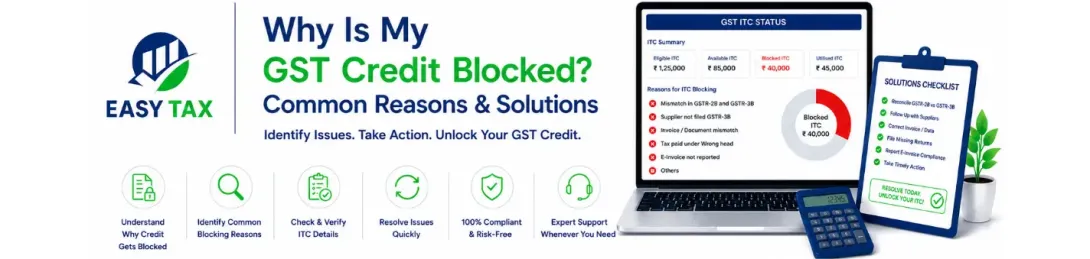
Why is My Gst Credit Blocked? Common Reasons and Solutions
Why Is My GST Credit Blocked? Common Reasons and How to Respond
If input tax credit (ITC) is missing from GSTR-2B, cannot be claimed in GSTR-3B, needs to be reversed, or cannot be used from your electronic credit ledger, first identify which GST rule is involved. These situations have different causes and remedies.
1. What does blocked GST credit actually mean?
The expression “blocked GST credit” is often used for different situations. Before filing a complaint or changing a return, identify exactly what appears on the GST Portal.
| What you observe | Possible issue | Where to investigate |
|---|---|---|
| Invoice is missing from GSTR-2B | Supplier reporting, timing or invoice mismatch | Supplier's GSTR-1/1A/IFF and your GSTR-2B |
| Invoice appears but ITC is ineligible | Section 16 condition, time limit or other restriction | Invoice, receipt evidence and applicable law |
| ITC needs to be reversed | Supplier tax non-payment or another reversal rule | Section 41, Rule 37A and applicable ITC rules |
| Ledger credit cannot be debited | Possible Rule 86A restriction | Portal communication and electronic credit ledger |
| Purchase belongs to a restricted category | Possible Section 17(5) blocked credit | Nature and business use of the purchase |
GSTR-2B is an auto-drafted, read-only ITC statement. It is an important reconciliation document, but an invoice appearing in GSTR-2B does not automatically establish every legal condition for claiming ITC.
Read the GST Portal GSTR-2B FAQ for its purpose and limitations.
2. Section 16: Check the basic conditions for claiming ITC
Section 16 of the CGST Act establishes the general eligibility framework. In broad terms, the recipient must be a registered person and the goods or services must be used or intended to be used in the course or furtherance of business.
For a typical purchase, review these points:
- Valid tax document: Keep the tax invoice, debit note or other document permitted by the Act and Rules.
- Supplier reporting: Check whether the supplier furnished the invoice details and whether they were communicated to you as required by Section 16(2)(aa).
- Receipt of goods or services: Retain delivery challans, e-way bills, goods-receipt notes, stock records, service deliverables or acceptance records, as applicable.
- Tax payment and return conditions: Check the applicable statutory conditions, including the supplier-tax-payment framework and your return obligations.
- Business use: Identify whether the purchase is for business, non-business, taxable, exempt or mixed use. Apportionment or reversal rules may apply.
- Payment to supplier: Review the 180-day payment condition under the applicable rules and its prescribed treatment.
- Time limit: Section 16(4) generally refers to 30 November following the end of the relevant financial year or furnishing of the relevant annual return, whichever is earlier. Check the applicable period and any special transitional provision.
Primary references: CBIC Tax Information Portal — Section 16 and CBIC Circular No. 237/31/2024-GST .
3. Supplier has not paid tax: Section 41 and Rule 37A
A supplier's failure to pay tax can create a separate ITC issue. Section 41(2), as substituted with effect from 1 October 2022, requires the recipient to reverse credit, with applicable interest, in the prescribed manner where tax payable on the relevant supply has not been paid by the supplier.
The provision allows re-availment in the prescribed manner when the supplier subsequently pays that tax.
Rule 37A addresses a specific situation where the supplier has furnished invoice details in the statement of outward supplies but has not furnished the corresponding return by the prescribed cut-off. It provides for recipient-side reversal and subsequent re-availment when the supplier files the relevant return.
Do not assume that every invoice missing from a reconciliation automatically falls under Rule 37A. Identify the financial year, supplier reporting, return filing and applicable rule conditions.
References: CBIC Tax Information Portal — Section 41 and Rule 37A text and amendment history . Verify the latest notified rule before acting.
4. Section 17(5): Check whether the purchase is a blocked-credit category
Section 17(5) blocks ITC on specified goods and services, subject to the wording and exceptions in the provision. It is not correct to assume that every expense in a broad category is automatically ineligible.
| Purchase area | What to examine |
|---|---|
| Motor vehicles | Vehicle type, seating capacity, business use and statutory exceptions such as specified further supply, passenger transportation or driving training. |
| Food and outdoor catering | Whether the supply falls within the restriction and whether an exception applies, including an obligation under law. |
| Club and fitness membership | Whether the inward supply falls within the express restriction and whether a statutory exception applies. |
| Employee travel benefits | Whether the benefit is covered by the specified category and whether an exception applies. |
| Works contract and construction | Distinguish construction of immovable property from plant and machinery and from supplies used for further supply of works contract service. |
| Gifts and free samples | Check the relevant statutory clauses and whether the transaction is genuinely a gift or sample. |
| Insurance, repair and maintenance | Do not decide by expense label alone. Check the underlying supply and any statutory exception. |
Read Section 17(5) together with its explanations, definitions and amendments. Also consider apportionment under Section 17(1) and 17(2) where purchases relate partly to non-business or exempt supplies.
Reference: CBIC — Central Goods and Services Tax Act, 2017 . This foundational Act page may not display every later amendment in consolidated form. Verify the current statutory wording before relying on a specific exception.
5. Rule 86A: An officer restricts debit from the electronic credit ledger
Rule 86A is different from an ordinary ITC eligibility check. It empowers the Commissioner or an authorised officer not below the rank of Assistant Commissioner, having reasons to believe that credit available in the electronic credit ledger has been fraudulently availed or is ineligible on specified grounds, to disallow debit of an equivalent amount from that ledger. Reasons must be recorded in writing.
The specified grounds include:
- Credit supported by documents issued by a supplier found non-existent or not operating from the declared place.
- Credit taken without actual receipt of goods or services.
- Credit relating to a supply for which tax has not been paid to the Government.
- The recipient being found non-existent or not operating from the declared place.
- The recipient not possessing the prescribed invoice, debit note or other document.
CBIC guidelines state that the power must not be exercised mechanically. The officer must apply their mind to the facts and base the belief on material evidence. The amount restricted should not exceed the credit believed to be fraudulently availed or ineligible.
Where evidence establishes that credit is eligible or the conditions for restriction no longer exist, Rule 86A(2) permits the authorised officer to allow debit, subject to the rule. Prepare an evidence-based representation. A representation does not itself release the restriction.
Primary reference: CBIC Guidelines for disallowing debit under Rule 86A, dated 2 November 2021 .
6. Step-by-step: How to diagnose an ITC problem
- Identify the affected period and amount. Record GSTIN, return period, supplier GSTIN, invoice number, invoice date, taxable value and tax amount.
- Download GSTR-2B. Open Services > Returns > Returns Dashboard, select the relevant period and open the GSTR-2B tile.
- Reconcile with books. Match GSTIN, invoice number, date, taxable value, tax amount, place of supply, credit notes and amendments.
- Check IMS where relevant. Review supplier-uploaded records and their status in the Invoice Management System. Do not assume an IMS action releases a Rule 86A restriction.
- Verify receipt and business use. Match the invoice to delivery records, stock records, service completion, contract and payment evidence.
- Contact the supplier where appropriate. Ask the supplier to confirm reporting and correct any inaccurate GSTIN, invoice or tax details.
- Classify the legal issue. Decide whether it concerns Section 16, Section 41, Rule 37A, Section 17(5) or Rule 86A.
- Prepare the correct return treatment or representation. Do not reverse, re-avail or amend credit solely to make a portal mismatch disappear.
- Escalate formal notices promptly. Record the issuing authority, date, provision, amount, grounds and response deadline. Obtain professional review.
The GST Portal GSTR-2B FAQ explains how to view and download the statement and advises reconciliation with books, avoiding duplicate credit and making required reversals.
The GST Portal IMS FAQ explains recipient actions and their effect on GSTR-2B.
7. Documents to collect
- Tax invoice, debit note and amended documents.
- Purchase order, contract and work order.
- Goods receipt note, delivery proof and e-way bill, where applicable.
- Service deliverables or acceptance records.
- Bank statement and supplier account ledger.
- GSTR-2B for the affected period.
- Relevant GSTR-3B return and working papers.
- IMS record and action history, where applicable.
- Supplier confirmation of filing or correction, where available.
- Any GST portal notice, order or ledger restriction details.
Maintain a clear audit trail. Do not alter, backdate or create documents to support a credit claim. If a document is missing, record that fact and obtain genuine supporting evidence where available.
8. Illustrative examples
Example A: Invoice missing from GSTR-2B
A buyer records a supplier invoice in its purchase register, but it is absent from GSTR-2B. The buyer should verify the supplier GSTIN, invoice details, reporting period and supplier filing. It should also preserve proof of receipt and payment. The invoice should not be treated as eligible merely because it is in the books.
Example B: Supplier has not filed the relevant return
The supplier has reported an invoice but has not furnished the corresponding return within the relevant Rule 37A framework. The recipient should identify the financial year and prescribed cut-off, then assess whether reversal and subsequent re-availment are required.
Example C: Ledger debit is restricted
A taxpayer receives a portal communication indicating a Rule 86A restriction. This is not merely an invoice mismatch. The taxpayer should obtain the communication details, identify the amount and date of restriction, assemble invoice-level evidence and submit a reasoned representation to the competent authority.
These examples are explanatory only. They do not determine the tax treatment of an actual invoice or taxpayer.
9. How to reduce future ITC mismatches
- Validate supplier GSTIN and invoice details before booking.
- Reconcile GSTR-2B with the purchase register every month.
- Review IMS records before filing the relevant return.
- Track supplier filing issues separately from blocked-credit issues.
- Retain proof of receipt, business use and supplier payment.
- Track Section 16(4) deadlines and historical-period provisions.
- Document the reason and return period for each reversal.
- Escalate suspected fake-invoice or Rule 86A matters promptly.
Frequently asked questions
Does an invoice in GSTR-2B automatically qualify for ITC?
No. GSTR-2B is an important reconciliation statement. The taxpayer must still self-assess eligibility under the CGST Act and Rules.
Can I edit GSTR-2B if an invoice is wrong or missing?
No. The GST Portal describes GSTR-2B as a read-only statement. Contact the supplier to correct the underlying outward-supply details where appropriate.
Is Rule 86A the same as Section 17(5)?
No. Section 17(5) identifies specified blocked-credit categories, subject to exceptions. Rule 86A concerns restriction of debit from the electronic credit ledger in specified circumstances.
Does Rule 86A blocking continue indefinitely?
No. The restriction ceases after one year from the date it was imposed. Other proceedings under the Act may continue separately.
What if the supplier later pays the tax?
Section 41(2) provides for re-availment in the prescribed manner where the supplier makes payment of the tax payable on the relevant supply. Check the applicable rule and return period.
Can I claim ITC after 30 November?
Section 16(4) generally refers to 30 November following the end of the relevant financial year or furnishing of the relevant annual return, whichever is earlier. Specific historical relief under Section 16(5) and 16(6) may apply to defined cases.
Should I reverse ITC just because the supplier has not replied?
Do not make a return adjustment based only on silence. Establish the applicable statutory condition and facts before deciding the treatment.
Need help reviewing an ITC mismatch or Rule 86A restriction?
Prepare your GSTIN, affected return periods, invoice-wise reconciliation, GSTR-2B and any portal notice before seeking professional advice.
Contact EasyTax to ask about GST compliance support.
Confirm that the contact page and service scope are live before publishing this call to action.
Official sources and further reading
- CBIC Tax Information Portal — CGST Act, Section 16.
- CBIC Tax Information Portal — CGST Act, Section 41.
- CBIC Circular No. 237/31/2024-GST, 15 October 2024.
- CBIC Guidelines for disallowing debit under Rule 86A.
- Rule 37A text and amendment history.
- GST Portal — Form GSTR-2B FAQ.
- GST Portal — Invoice Management System FAQs.
- CBIC — Central Goods and Services Tax Act, 2017.
Related reading
 GST
Why Your Business Needs a CA: 7 Signs You Shouldn't Ignore
 GST
Best Gst Consultant in Jaipur
GST
Tax Consultant in Jaipur
Latest from the blog



EasyTax • Jaipur
GST Return Filing & Compliance
Timely GSTR-1 & GSTR-3B filing, 100% ITC matching and department notice defense by certified GST experts.