

GST Refund Process: Eligibility and Step-by-Step Guide
How to Claim a GST Refund in India: Eligibility and Step-by-Step Process
Businesses may accumulate eligible input tax credit, make zero-rated supplies, pay tax in excess or encounter other situations in which GST law permits a refund. Recovering an eligible amount can improve working capital, but the correct refund category, supporting evidence and statutory conditions must be established first.
This guide explains the principal GST refund categories, who may apply, which documents may be needed and how to follow the application process through the GST Portal. It covers the Indian GST framework, including the Central Goods and Services Tax Act, 2017 (CGST Act), the applicable rules and relevant official guidance.
In this guide
01 What Is a GST Refund?
A GST refund is the repayment of tax, interest or another amount where the taxpayer is legally entitled to receive it under the applicable GST provisions.
Section 54 of the CGST Act contains the principal refund provisions. It covers claims for eligible tax paid, certain unutilised input tax credit and other specified situations. The rules prescribe the application procedure and supporting evidence.
A refund is not automatic merely because a business has paid tax or has an unused ITC balance. The taxpayer must establish the legal basis for the claim and comply with the applicable conditions.
02 Main Categories of GST Refunds in India
A. Refund of unutilised ITC on qualifying zero-rated supplies
Zero-rated supplies include qualifying exports and supplies to a Special Economic Zone (SEZ) developer or unit for authorised operations, subject to the IGST Act.
Where the applicable law permits the supply to be made without payment of integrated tax under a bond or Letter of Undertaking (LUT), the supplier may claim a refund of eligible unutilised ITC, subject to the statutory formula, documentation and restrictions.
The route for a zero-rated supply should be checked against the current IGST Act, notifications and GST Portal functionality. Do not assume that every exporter can choose any refund route without checking the applicable provisions.
B. Refund under the inverted duty structure
An inverted duty structure may arise when the GST rate on eligible inputs is higher than the rate on the corresponding output supplies. In qualifying cases, the taxpayer may claim a refund of accumulated unutilised ITC.
This refund is subject to Section 54(3), Rule 89, the prescribed formula and notified restrictions. Certain goods or supplies may be excluded. A difference between input and output rates alone does not establish that a refund is admissible.
C. Refund of excess tax paid
A taxpayer may have paid an amount in excess of the tax legally payable, for example because of a duplicate payment or an identified tax-payment error. A refund may be available where the statutory conditions are satisfied and the payment is properly evidenced.
The taxpayer should identify the original payment, explain why the amount is refundable and check whether the claim is subject to the unjust-enrichment provisions or another specific condition.
D. Refund of balance in the electronic cash ledger
A taxpayer may seek repayment of an eligible balance remaining in the electronic cash ledger. Section 54(1) contains a specific provision for claiming a qualifying balance through the relevant return in the prescribed manner.
This route should not be confused with a refund of accumulated ITC in the electronic credit ledger. The ledger from which the amount is claimed affects the applicable process.
E. Refund relating to supplies to SEZ units or developers
Supplies to an SEZ unit or developer for authorised operations can qualify as zero-rated supplies. The supplier generally needs the required evidence, including the relevant endorsement or confirmation from the specified SEZ officer, as applicable to the supply.
The supplier, type of supply and chosen tax-payment route determine the relevant refund procedure. The SEZ recipient should not be assumed to be the applicant for every such claim.
F. Refund relating to deemed exports
Certain notified supplies are treated as deemed exports under GST law. Rule 89 contains the refund application framework and specifies who may apply.
The recipient is generally the applicant. The supplier may apply in the specified circumstances where the recipient does not avail ITC and provides the prescribed undertaking. The applicable notification and documentary conditions must be checked.
G. Other specific refund situations
GST law also provides for refunds in certain other circumstances, including specified tax payments arising from transactions later treated as inter-State instead of intra-State supplies, subject to the relevant statutory provisions.
Each such claim should be classified under the applicable provision rather than placed under a generic “excess ITC” category.
03 Who May Be Eligible for a GST Refund?
Eligibility depends on the refund category and the facts of the transaction. Potential applicants include:
- Registered suppliers making qualifying zero-rated supplies.
- Registered taxpayers with eligible accumulation of ITC under the inverted duty structure provision.
- Taxpayers who have made an identifiable excess payment of tax.
- Suppliers or recipients involved in qualifying deemed-export transactions, depending on the prescribed application route.
- Suppliers making qualifying supplies to SEZ units or developers.
- Taxpayers claiming a qualifying balance in the electronic cash ledger through the prescribed process.
- Other persons specifically covered by a refund provision or notification.
Important conditions to check
- Whether the applicant is the person legally entitled to claim the refund.
- Whether the supply or payment falls within a recognised refund category.
- Whether the relevant returns and supporting statements have been furnished where required.
- Whether the ITC is eligible and supported by the underlying records.
- Whether any statutory exclusion, restriction or withholding provision applies.
- Whether the application is within the applicable limitation period.
- Whether the amount has already been claimed or refunded through another route.
04 Documents and Information Required for a GST Refund
The supporting documents depend on the category of refund. The following table is a preparation guide, not a universal mandatory-document list. The applicable Rule 89 requirements and the GST Portal's current document prompts should be checked for the individual claim.
| Refund category | Examples of relevant records | Important check |
|---|---|---|
| Export of goods | Export invoices, shipping bills or bills of export, relevant export manifest or report and return records. | Match invoice, shipping bill and export data. |
| Export of services | Export invoices, agreement or work records, payment realisation evidence such as BRC/FIRC or other prescribed evidence, and return records. | Check the statutory definition of export of services and evidence requirements. |
| Inverted duty structure | Purchase and sales invoices, ITC records, relevant returns and the prescribed category-specific statement. | Check eligible inputs, output tax and notified exclusions. |
| SEZ supplies | Invoices, supply records and relevant endorsement or evidence from the specified SEZ officer. | Confirm authorised operations and the correct applicant. |
| Deemed exports | Invoices, recipient and supplier records, prescribed declarations or undertakings and notification-related evidence. | Confirm who is entitled to file the claim. |
| Excess tax payment | Payment challans, ledger extracts, returns, reconciliation and an explanation of the excess payment. | Establish the amount and legal basis for repayment. |
| Cash ledger balance | Electronic cash ledger and relevant return information. | Check the prescribed return-based route. |
Prepare your records before filing
- GSTIN and authorised signatory details.
- Relevant tax-period and refund-category details.
- Copies or references of the relevant invoices and payment records.
- ITC ledger and reconciliation, where relevant.
- Export, SEZ or deemed-export evidence, where applicable.
- Bank account details and validation information required by the portal.
- Declarations, undertakings, certificates or statements prescribed for the claim.
05 Step-by-Step GST Refund Process
01 Identify the correct refund category
Start by identifying why the amount is refundable. Determine whether the claim concerns zero-rated supplies, inverted duty structure, excess tax payment, a cash ledger balance or another specific provision.
Do not select a category solely because it appears to offer a convenient route. The underlying transaction and statutory conditions must support the selection.
02 Check the refund calculation and eligibility
Reconcile the relevant invoices, returns, electronic ledgers and supporting documents. For unutilised ITC refunds, check the prescribed formula and the definition of eligible Net ITC and turnover.
For example, Rule 89 contains separate formula provisions for qualifying zero-rated supplies and inverted-duty refunds. These calculations should not be replaced with a simple comparison of input and output GST rates.
03 Reconcile returns and supporting records
Check the relevant GSTR-1 and GSTR-3B information, purchase records, export details and ledger balances as applicable. Resolve differences before filing where possible.
Retain a reconciliation that explains any differences between invoices, returns, shipping bills, payment evidence and the amount claimed.
04 Sign in to the GST Portal
Visit the official GST Portal and sign in using the authorised credentials for the registered taxpayer.
Navigate to the refund services and select the applicable refund application option. The exact portal labels and available options may change as the system is updated.
05 Complete Form GST RFD-01, where applicable
Rule 89 provides for electronic filing of Form GST RFD-01 for the refund categories covered by that rule. Select the correct category, enter the required period and amount, and provide the prescribed statements and documents.
Not every refund follows the same RFD-01 route. For example, a qualifying electronic cash ledger balance may be claimed through the prescribed return mechanism. Refund of integrated tax on exported goods also has a specific shipping-bill-based process under Rule 96.
06 Review and submit the application
Before submission, check the GSTIN, refund period, category, amount, bank details and supporting attachments. Ensure that declarations and undertakings are accurate and that the claim is not duplicated.
Submit the application using the prescribed electronic verification process. Retain the acknowledgement and Application Reference Number (ARN), where generated.
07 Monitor acknowledgement and deficiency communications
Track the application on the GST Portal. If the proper officer communicates a deficiency, read the deficiency memo carefully and follow the applicable procedure for rectification and filing a fresh application, where required.
Do not assume that an ARN means the refund has been approved. It is an application reference, not a final sanction order.
08 Respond to queries and track the final outcome
Review any notice or communication issued in relation to the refund claim. Provide a complete response within the applicable period and retain evidence of submission.
A refund may be sanctioned fully, sanctioned partly, withheld or rejected depending on the facts and legal provisions. Check the relevant order and payment status rather than relying only on an acknowledgement message.
06 What Is the Time Limit for Filing a GST Refund?
Section 54(1) of the CGST Act generally requires a refund application to be made before the expiry of two years from the relevant date. However, the meaning of “relevant date” differs according to the type of refund.
The relevant-date rules include specific provisions for exports, supplies to SEZs, deemed exports, refunds arising from orders, unutilised ITC and other circumstances.
Some refund categories have separate statutory time limits or procedural rules. A taxpayer should therefore obtain category-specific advice where the relevant date is unclear, an appeal or order is involved, or the claim relates to a historical tax period.
07 GST Refund Acknowledgement and Processing Timeline
Section 54(7) of the CGST Act states that the proper officer shall issue the order under Section 54(5) within 60 days from receipt of an application that is complete in all respects.
This is a statutory provision, not a promise that every applicant will receive money within 60 days of first logging in or submitting incomplete information. The relevant date, completeness of the application, deficiency procedure and other applicable provisions matter.
Refund processing developments announced in October 2026
The GST Council published FAQs following its 57th meeting held on 8 October 2026. The refund FAQ describes a phased move towards time-bound and automated processing for specified refund categories, based on system readiness and risk analysis.
The published FAQ describes, among other measures:
- A reduction in the acknowledgement or deficiency-memo period from 15 days to 10 days in the specified Phase I framework.
- System-based provisional sanction of up to 90% of the claimed amount for acknowledged low-risk claims relating to qualifying zero-rated supplies or inverted duty structure.
- Specific exclusions and conditions, including certain notified categories and Aadhaar-authentication-related requirements.
- Further automated processing measures to be introduced in phases according to system readiness.
08 Interest on Delayed GST Refunds
Section 56 of the CGST Act deals with interest on delayed refunds. It distinguishes between the ordinary delayed-refund situation and certain claims arising from an order that has attained finality.
- Ordinary delayed refund: Where an amount ordered to be refunded under Section 54(5) is not refunded within 60 days from receipt of the application under Section 54(1), Section 56 provides for interest at a rate not exceeding 6%, as notified.
- Refund following a final order: Where the refund arises from an order of an adjudicating authority, appellate authority, appellate tribunal or court that has attained finality, the proviso to Section 56 provides for interest at a rate not exceeding 9%, as notified, if the specified 60-day period is exceeded.
The applicable notified rate and the facts of the particular claim must be checked before calculating interest. The 9% ceiling is not a general interest rate for every delayed GST refund.
09 Common GST Refund Mistakes to Avoid
01 Choosing the wrong refund category
A claim under the wrong category can create avoidable scrutiny or procedural problems. Match the transaction to the applicable statutory route before filing.
02 Claiming ineligible ITC
An ITC balance does not automatically qualify for cash refund. Check the conditions and exclusions under Section 54(3), Rule 89 and the applicable notifications.
03 Incorrect invoice and return information
Differences between invoice details, returns and supporting records can lead to queries. Reconcile the relevant information before submitting the claim.
04 Missing category-specific documents
Export, SEZ, inverted-duty and deemed-export claims do not all require the same evidence. Use the document requirements applicable to the selected category.
05 Missing the relevant-date deadline
The general two-year period must be calculated using the relevant-date provision applicable to the particular claim. Do not rely on a generic invoice-date calculation.
06 Treating the ARN as refund approval
An acknowledgement confirms that an application reference has been generated. It does not itself establish that the refund has been sanctioned.
07 Ignoring portal notices and deficiency memos
Monitor communications and respond within the applicable period. Retain the acknowledgement of each response and the final order.
10 Illustrative Example: Inverted Duty Structure
Assume a manufacturer purchases eligible inputs that bear a higher GST rate than the rate applicable to its output supplies. As a result, eligible ITC may accumulate.
The business should not calculate its refund simply by subtracting the output GST rate from the input GST rate or by treating the entire ledger balance as refundable.
It must first establish that the output supplies qualify for the inverted-duty refund provision, check notified exclusions and apply the formula prescribed under Rule 89(5), using the relevant period's eligible Net ITC, turnover and tax payable figures.
The result is subject to the statutory maximum and the other applicable conditions. A professional should verify the calculation before filing.
11 Frequently Asked Questions About GST Refunds
01 Can every GST-registered business claim a GST refund?
No. Registration alone does not create refund eligibility. The business must satisfy a specific refund provision and its conditions.
02 Can a business claim a refund of all accumulated ITC?
No. Section 54(3) restricts refunds of unutilised ITC to specified situations, principally qualifying zero-rated supplies made without payment of tax and qualifying inverted-duty accumulation, subject to restrictions.
03 Which form is used for GST refund applications?
Form GST RFD-01 is used for the refund categories covered by Rule 89. Certain claims follow a different procedure, including the prescribed return-based process for eligible electronic cash ledger balances and the shipping-bill process for qualifying IGST refunds on exported goods.
04 How long does a GST refund take?
Section 54(7) specifies a 60-day period for the proper officer to issue the order after receipt of an application complete in all respects. Actual processing depends on the claim, its completeness, applicable procedures and any queries or withholding provisions.
05 Is the GST refund application deadline always two years?
Section 54(1) generally provides a two-year period from the relevant date, but the relevant date varies by refund category. Certain claims also have specific provisions. Check the applicable clause before filing.
06 Is interest payable on every delayed GST refund?
Section 56 provides for interest in specified delayed-refund situations. The applicable rate depends on the nature of the claim and the relevant notified rate. It should not be assumed that every delay automatically attracts the same rate.
07 Can an exporter claim a GST refund?
Qualifying exports are zero-rated supplies. The refund route depends on the applicable IGST provisions, whether tax is paid or the supply is made under LUT/bond, the nature of the export and the supporting evidence.
08 What should a taxpayer do if the refund application has a deficiency?
Read the deficiency communication and follow the procedure under the applicable refund rules. Where a fresh application is required, correct the identified issue and retain the relevant filing records.
09 Can a taxpayer track the refund application?
The applicant can use the GST Portal to check the status of the relevant application and communications. The ARN is useful for tracking, but it is not proof of final sanction.
10 Should a business use professional assistance?
Professional assistance may be useful where the claim involves export documentation, ITC reconciliation, inverted-duty calculations, SEZ supplies, deemed exports, historical claims or a notice from the tax department. The taxpayer should still review the facts and approve the claim before submission.
12 Official GST Refund Sources
Use the following government sources to verify the current legal position and portal procedure. The applicable notification and amendment should be checked for the tax period covered by the claim.
- CBIC – Central Goods and Services Tax Act, 2017 (especially Section 54 on refunds and Section 56 on interest).
- CBIC – CGST Rules, 2017 (Part A) (especially Rule 89, Rule 90 and related refund provisions).
- CBIC – GST Refund Rules (refund-rule reference; confirm the current consolidated version before relying on it).
- GST Council – Official FAQs (including FAQs relating to the 57th GST Council meeting held on 8 October 2026).
- Press Information Bureau – FAQs on Refunds, 9 October 2026 (phased refund-processing changes and automation framework).
- GST Portal – Official taxpayer portal (filing, application status and taxpayer services).
13 Need Help With a GST Refund?
GST refund claims can involve category-specific eligibility checks, ITC reconciliation, supporting documents and portal communications. A review before filing can help identify missing information and calculation issues.
EasyTax provides GST advisory support for businesses dealing with GST compliance, ITC matters and refund-related questions. The appropriate scope and fees should be confirmed before engaging a service.
Discuss Your GST Refund Query With EasyTax
Share the type of refund you are considering and the relevant tax period. The team can help identify the information and records needed for an initial review.
Conclusion
The GST refund process in India depends on the legal category of the claim, the applicant's eligibility, the supporting documents and the applicable filing procedure. A business should identify the correct provision, reconcile its records, calculate the claim under the relevant rules and monitor the application after submission.
Section 54, Rule 89 and the related refund provisions provide the framework, but not every excess payment or unutilised ITC balance is refundable. Checking the current notifications and portal instructions is particularly important where refund-processing procedures are changing.
Was this guide helpful?
Related reading

Why Your Business Needs a CA: 7 Signs You Shouldn't Ignore
Skip to article Business Accounting & Taxation Why Your Business Needs a CA: 7 Signs You Shouldn't Ignore Business…
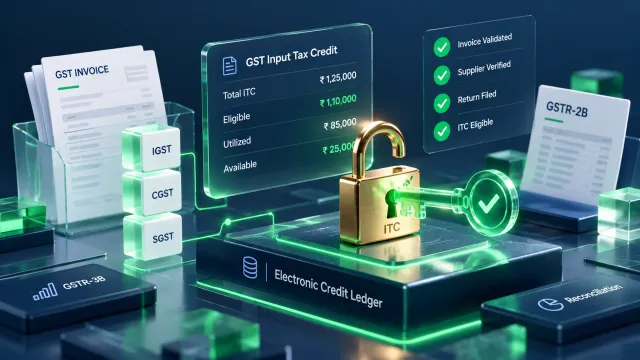
Why is My Gst Credit Blocked? Common Reasons and Solutions
Understand why GST credit is blocked, how to check GSTR-2B and Section 16 conditions, and when Rule 37A, Section 17(5)…

Best Gst Consultant in Jaipur
EasyTax Home Blog Our services Contact Home / Blog / GST / Best GST Consultant in Jaipur GST compliance · Jaipur,…
Latest from the blog

SEO Agent connection test (temporary)
This is a temporary test post. It checks the connection between the EasyTax website and the SEO Agent publishing tool,…
Tax-Smart Tips for Salaried Employees: New Tax Regime
Tax-smart tips for salaried employees under the new tax regime: understand deductions, employer NPS, tax rebates,…
Tax-Smart Tips for Salaried Employees | EasyTax
Tax-smart tips for salaried employees under India’s new tax regime: compare deductions, employer NPS, rebates and…
EasyTax • Trusted by 10,000+ Clients
GST Return Filing & Compliance
Timely GSTR-1 & GSTR-3B filing, 100% ITC matching and department notice defense by certified GST experts.