

10 Common GST Return Filing Mistakes to Avoid in India
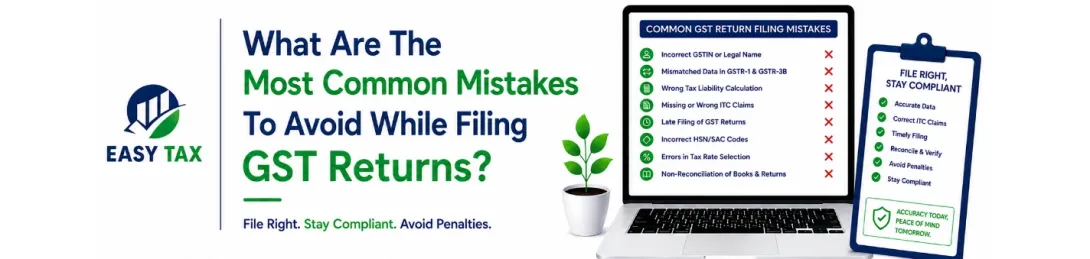
GST return filing mistakes can lead to ITC mismatches, late fees, interest, notices and correction work.
10 Common GST Return Filing Mistakes Businesses Should Avoid
Filing GST returns involves more than entering sales and purchase figures. Businesses must report transactions correctly, reconcile records, check Input Tax Credit (ITC) eligibility and meet the filing requirements applicable to their taxpayer category.
Even a small data-entry or classification error can create differences between accounting records and GST returns. Depending on the facts, an error may require correction, additional tax payment, ITC reversal or a response to a GST communication.
This guide explains ten common GST return filing mistakes, why they matter and the practical checks businesses can perform before filing GSTR-1, GSTR-3B or other applicable returns.
Understanding the GST Returns Your Business May Need to File
The return or statement applicable to a business depends on its registration type, activities, filing scheme and other relevant conditions. The following forms serve different purposes:
| Form | General purpose | Important check |
|---|---|---|
| GSTR-1 | Reports details of outward supplies, subject to the form's scope. | Check invoice details, amendments, credit notes and applicable reporting tables. |
| GSTR-3B | Summary return used to declare applicable tax liabilities and ITC. | Reconcile liability, eligible ITC, reversals and tax payment. |
| GSTR-2B | Auto-drafted statement used as an important source for reviewing inward-supply ITC information. | Investigate missing, incorrect or ineligible entries before claiming credit. |
| GSTR-9 | Annual return for taxpayers required to furnish it under applicable provisions and notifications. | Confirm whether the business is required to file it for the relevant financial year. |
Eligible taxpayers who have opted for the QRMP scheme may follow quarterly return filing with monthly tax-payment requirements. Do not assume that every registered taxpayer follows the same return frequency.
Refer to the official GST Portal GSTR-3B filing manual for the portal's filing process and applicable form guidance.
01 Entering an Incorrect GSTIN or Recipient Detail
A GSTIN identifies a registered taxpayer. Entering an incorrect recipient GSTIN, legal name, state or place-of-supply detail can result in incorrect invoice reporting and reconciliation difficulties.
Common errors include:
- Typing an incorrect GSTIN digit.
- Selecting the wrong customer registration.
- Using an outdated recipient detail.
- Incorrectly classifying an intra-State or inter-State supply.
How to avoid this mistake
- Obtain recipient details from a reliable customer record.
- Validate the GSTIN using the official GST Portal search facility.
- Check the legal name and registration status.
- Verify the place of supply and applicable tax treatment.
- Compare invoice details with the data prepared for GSTR-1.
A GSTIN check is a useful verification step, but it does not by itself establish the correct tax treatment of a transaction.
02 Missing the Applicable GST Return Filing Deadline
Different GST returns and taxpayer categories can have different filing frequencies and due dates. Missing an applicable deadline may result in late fees, interest on delayed tax payment or other consequences under the GST law.
A common mistake is using a general due-date chart without checking the taxpayer's actual filing category, tax period, extensions or applicable notifications.
How to avoid this mistake
- Identify every return and statement applicable to the GSTIN.
- Check the due date displayed on the GST Portal.
- Monitor official CBIC notifications and GST Portal advisories.
- Prepare invoices and reconciliation data before the filing date.
- Keep the filed return acknowledgement and payment records.
Section 47 of the CGST Act provides for late fees for specified filing defaults. Section 50 deals with interest on delayed payment of tax. The amount and applicability must be checked against the relevant provision and notifications; do not assume one universal amount applies to every return.
03 Claiming Input Tax Credit Without Checking Eligibility
Input Tax Credit can reduce eligible GST liability, but a purchase invoice does not automatically make the entire tax amount claimable. Businesses must check the conditions and restrictions under the CGST Act.
Common ITC mistakes include:
- Claiming credit without the prescribed supporting document.
- Claiming credit before receiving the goods or services.
- Claiming credit on an ineligible or blocked expense.
- Claiming the same invoice more than once.
- Ignoring applicable reversal requirements.
- Failing to investigate differences in GSTR-2B and purchase records.
How to avoid this mistake
- Check the invoice or other prescribed tax document.
- Confirm receipt of the goods or services.
- Review the applicable GSTR-2B information.
- Check supplier-related statutory conditions, including tax-payment requirements.
- Review Section 17 restrictions and blocked credits.
- Check whether any reversal or subsequent re-availment is required.
- Maintain a record explaining the eligibility of material ITC claims.
Section 16 of the CGST Act sets out the eligibility conditions for ITC. Section 17 covers apportionment and blocked credits. Businesses should review both provisions rather than treating invoice matching as an automatic entitlement to credit.
Official references: CGST Act, Section 16 and Section 17 .
04 Filing Returns Without Reconciling Books and GST Data
A business may maintain correct accounting records but still report incorrect figures in a GST return if the books, invoices and portal data are not compared before filing.
Important reconciliation checks include:
- Sales register against GSTR-1.
- Tax liability reported in GSTR-1 against GSTR-3B.
- Purchase register against GSTR-2B.
- Eligible ITC claimed against supporting documents and statutory conditions.
- Credit notes, debit notes and amendments against accounting records.
- Tax payment records against the electronic ledgers and return.
How to avoid this mistake
- Prepare a reconciliation for each applicable tax period.
- Classify differences as timing, data-entry, classification or eligibility issues.
- Investigate missing invoices and duplicate entries.
- Document the reason for every material adjustment.
- Resolve differences before submitting the relevant return wherever possible.
Reconciliation is a review control. It does not mean that every difference is automatically a tax shortfall or that every portal entry is automatically eligible for ITC.
05 Applying the Wrong GST Rate or Tax Classification
Goods and services may be subject to different GST treatments. Incorrect classification or rate selection can lead to an incorrect tax amount, invoice disputes and the need to correct reported information.
Examples of possible errors include:
- Selecting an incorrect HSN or SAC classification.
- Applying a rate that does not cover the actual supply.
- Using an incorrect exemption or concessional-rate assumption.
- Charging the wrong tax components for the place of supply.
How to avoid this mistake
- Identify the actual goods or services being supplied.
- Review the applicable classification and GST rate notification.
- Check exemption conditions and any relevant restrictions.
- Verify place-of-supply rules before deciding the tax components.
- Keep a record of the basis used for material classification decisions.
Do not rely only on an old invoice, a competitor's tax rate or a generic online rate chart. Check the applicable official rate notification for the transaction.
06 Reporting Incorrect or Incomplete Invoice Details
Invoice information is used for reporting outward supplies and reconciling transactions. Missing or incorrect details can create differences between the books, GSTR-1 and the recipient's records.
Review the following details where applicable:
- Invoice number and date.
- Supplier and recipient GSTIN.
- Taxable value and applicable tax amount.
- HSN or SAC classification.
- Place of supply and tax type.
- Credit notes, debit notes and amendments.
- Required e-invoice information, where applicable.
How to avoid this mistake
- Use a consistent invoice-numbering process.
- Compare the accounting record with the original invoice.
- Check taxable value and tax calculations.
- Verify that amendments and credit notes are reported correctly.
- Review the draft return before filing.
The invoice requirements should be checked against the applicable CGST Rules, including the relevant tax-invoice provisions.
07 Ignoring Supplier-Related Checks Before Claiming ITC
A buyer should not review an ITC claim only from its own purchase register. Supplier reporting and the statutory conditions for credit also matter.
Differences may arise when an invoice is missing from the relevant portal statement, has incorrect details or has been reported for the wrong recipient. Such differences should be investigated before the credit is claimed or retained.
How to avoid this mistake
- Compare purchase invoices with the relevant GSTR-2B period.
- Identify invoices that are missing or reported incorrectly.
- Contact the supplier with the invoice reference and discrepancy.
- Track the supplier's correction and the next relevant portal statement.
- Assess ITC using all applicable Section 16 conditions and Section 17 restrictions.
GSTR-2B is an important reconciliation source, but a matching entry alone does not remove the need to satisfy all applicable ITC conditions.
08 Reporting Duplicate Invoices or Missing Transactions
Duplicate data entry can cause the same invoice to appear more than once in a return. The opposite problem can also occur: an invoice may be left out of the reporting data.
Both situations can create differences between:
- The sales or purchase register.
- Accounting software.
- Invoice-level reporting data.
- GST returns already filed.
How to avoid this mistake
- Use invoice number, date, GSTIN and value to identify duplicate records.
- Compare the return data with the complete invoice register.
- Review cancelled invoices and credit notes separately.
- Maintain an exception list for missing or duplicate entries.
- Check the final draft before filing.
09 Maintaining Incomplete GST Books and Supporting Records
A business needs reliable records to support its outward supplies, inward supplies, ITC, tax payments and other GST-related entries. Missing records can make return preparation and later verification more difficult.
Depending on the business and transaction, relevant records may include:
- Sales and purchase registers.
- Tax invoices, debit notes and credit notes.
- Stock and inventory records, where applicable.
- ITC workings and reconciliation statements.
- GST return acknowledgements and filed return copies.
- Tax payment challans and relevant ledger records.
- E-way bills and e-invoice records, where applicable.
- Supplier and customer correspondence relevant to discrepancies.
How to avoid this mistake
- Maintain records in an organised accounting system.
- Reconcile accounting records with GST returns periodically.
- Keep supporting documents linked to material transactions.
- Restrict access to sensitive financial records.
- Follow the applicable statutory retention requirements.
Section 35 of the CGST Act covers accounts and other records. Section 36 deals with the period of retention. Businesses should check the current statutory provisions for their circumstances.
Official reference: CGST Act, Sections 35 and 36 .
10 Overlooking E-Invoicing Requirements
E-invoicing is a reporting process for notified taxpayers and specified transactions. It involves reporting prescribed invoice details to an Invoice Registration Portal and obtaining an Invoice Reference Number (IRN), where required.
It is not a requirement that applies identically to every GST registered business. Applicability depends on the notified turnover criteria, transaction scope and specified exclusions.
The notified threshold was reduced to an aggregate annual turnover of ₹5 crore with effect from 1 August 2023, subject to the applicable notification and exemptions. Businesses should verify their position using the current rules and official guidance.
How to avoid this mistake
- Check aggregate annual turnover across relevant GST registrations under the PAN.
- Review the turnover test for the relevant preceding financial years.
- Check whether the business falls within a notified exclusion.
- Confirm which transaction documents require e-invoice reporting.
- Verify the IRN and signed QR code where e-invoicing applies.
- Check the applicable time limit for reporting invoices to the IRP.
Official references: GST e-invoice mandate guidance and Notification No. 10/2023-Central Tax .
What Should You Do If You Find a GST Return Mistake?
The correction process depends on the return, the nature of the error, the tax period and the applicable statutory time limits. Do not assume that every GST return can be revised after filing.
- Identify the affected transaction. Record the invoice number, date, supplier or customer GSTIN, taxable value and tax amount.
- Identify the affected return. Determine whether the issue relates to GSTR-1, GSTR-3B, ITC reporting, tax payment or another filing.
- Calculate the difference. Compare the filed return with the books and supporting documents.
- Check the legal correction mechanism. Review the applicable form instructions, statutory provisions and time limits before making an adjustment.
- Assess additional tax, interest or reversal. Determine whether any payment, reversal or other action is required.
- Keep evidence. Save the reconciliation, supporting documents, challans, acknowledgements and correction workings.
Important distinction: The GST Portal's GSTR-3B manual states that amendment of a filed GSTR-3B is not allowed. Other GST forms may have different correction or amendment mechanisms, subject to applicable statutory limits. Take advice on the specific return and period before attempting a correction.
GST Return Filing Checklist: Checks to Complete Before Submission
Use this practical checklist before submitting the applicable GST return for a tax period.
- Confirm the correct GSTIN and registration details.
- Check the applicable return type and filing frequency.
- Verify outward supplies against the sales register.
- Check invoice numbers, dates, taxable values and tax amounts.
- Review credit notes, debit notes and amendments.
- Reconcile inward supplies with GSTR-2B.
- Check every ITC claim against Section 16 conditions.
- Review blocked credits and reversals under Section 17.
- Check the applicable GST rate and classification.
- Review tax liability and reverse-charge entries, where relevant.
- Confirm applicable e-invoice requirements.
- Review the draft return before filing.
- Verify tax payment and ledger balances.
- Download and retain the filed return acknowledgement.
- Record unresolved differences for follow-up.
Frequently Asked Questions About GST Return Filing Mistakes
01 What are the most common GST return filing mistakes?
Common mistakes include incorrect GSTIN details, missed applicable deadlines, ineligible ITC claims, unreconciled books, incorrect tax classification, invoice reporting errors, duplicate entries and incomplete supporting records.
02 Can a filed GSTR-3B return be revised?
The GST Portal manual states that amendment of a filed GSTR-3B is not allowed. Depending on the nature of the error, a correction or adjustment may need to be made through a subsequent return or another prescribed process. Check the relevant law and time limits before making an adjustment.
03 How can a business reduce ITC reconciliation errors?
Compare purchase records with GSTR-2B, verify prescribed documents and receipt of supplies, investigate missing or incorrect entries, and check all applicable ITC eligibility conditions and restrictions.
04 Is a GST return required when there are no business transactions?
A taxpayer may still be required to file the applicable return even when there is no business activity. The GST Portal explains that a nil GSTR-3B is subject to specific conditions, including the absence of relevant auto-populated data, manual entries and outstanding interest or late-fee liability. Check the applicable return instructions for the tax period.
05 What happens if a GST return is filed late?
Depending on the return and circumstances, late filing may attract late fees and delayed tax payment may attract interest. The applicable amount and any relief or waiver must be checked against the relevant statutory provisions and notifications.
06 Is e-invoicing mandatory for every GST-registered business?
No. E-invoicing applies to notified taxpayers and transactions, subject to the applicable turnover criteria and exclusions. Businesses should check the current notification and official e-invoice guidance to determine whether it applies to them.
07 Why is GST reconciliation important?
Reconciliation helps identify missing invoices, duplicate entries, incorrect tax values and differences between accounting records and GST portal information. It also helps businesses investigate ITC eligibility before filing.
08 Should a small business use professional GST filing support?
A business may consider professional assistance when its transactions, ITC reconciliation, return requirements or correction issues are complex. The scope of assistance should be agreed in advance and should not be treated as a guarantee against every error, notice or liability.
Official GST References
The following government resources can help businesses verify the legal requirements and portal filing procedures discussed in this article.
- Central Board of Indirect Taxes and Customs — CGST Act
Relevant provisions include Sections 16 and 17 (ITC), Sections 35 and 36 (accounts and records), Section 39 (returns), Section 47 (late fee) and Section 50 (interest). - GST Portal — Create, Submit and File GSTR-3B
Official guidance on return preparation, tax payment, nil returns and filing. - GST Portal — Filing a Nil GSTR-3B Return
Portal guidance on the conditions for nil filing. - GST Invoice Registration Portal — E-Invoice Mandate
Guidance on e-invoice applicability and its implementation. - Notification No. 10/2023-Central Tax
Official notification amending the e-invoice turnover threshold with effect from 1 August 2023.
Need Assistance With GST Return Filing?
Preparing GST returns can involve invoice verification, ITC reconciliation, tax calculations and review of applicable filing requirements. If your business needs assistance, EasyTax can discuss the relevant return, tax period, documents and scope of professional support.
Review the GST return filing service or contact the EasyTax team to discuss your requirements.
Disclaimer
This article is intended for general educational information about GST return filing in India. GST requirements can vary according to taxpayer category, transaction type, tax period, statutory amendments, notifications and applicable exemptions. The article is not a substitute for professional advice on a specific transaction or tax position.
Readers should verify the latest law, notifications and GST Portal instructions before filing a return or making a tax adjustment. The inclusion of an official reference does not imply endorsement of EasyTax by the Government of India.
Was this guide helpful?
Related reading

Why Your Business Needs a CA: 7 Signs You Shouldn't Ignore
Skip to article Business Accounting & Taxation Why Your Business Needs a CA: 7 Signs You Shouldn't Ignore Business…
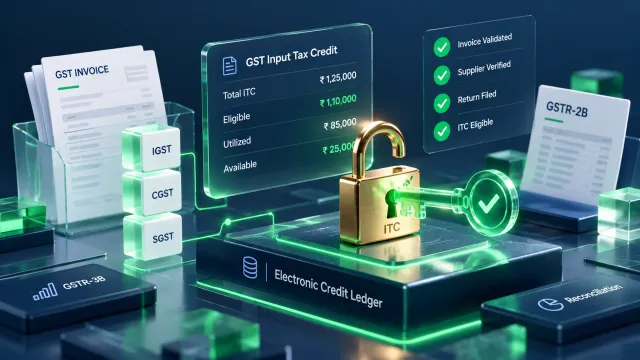
Why is My Gst Credit Blocked? Common Reasons and Solutions
Understand why GST credit is blocked, how to check GSTR-2B and Section 16 conditions, and when Rule 37A, Section 17(5)…

Best Gst Consultant in Jaipur
EasyTax Home Blog Our services Contact Home / Blog / GST / Best GST Consultant in Jaipur GST compliance · Jaipur,…
Latest from the blog

SEO Agent connection test (temporary)
This is a temporary test post. It checks the connection between the EasyTax website and the SEO Agent publishing tool,…
Tax-Smart Tips for Salaried Employees: New Tax Regime
Tax-smart tips for salaried employees under the new tax regime: understand deductions, employer NPS, tax rebates,…
Tax-Smart Tips for Salaried Employees | EasyTax
Tax-smart tips for salaried employees under India’s new tax regime: compare deductions, employer NPS, rebates and…
EasyTax • Trusted by 10,000+ Clients
GST Return Filing & Compliance
Timely GSTR-1 & GSTR-3B filing, 100% ITC matching and department notice defense by certified GST experts.