

Quick and Accurate GST Registration: Trust Easy Tax Filing India for Hassle-Free Compliance
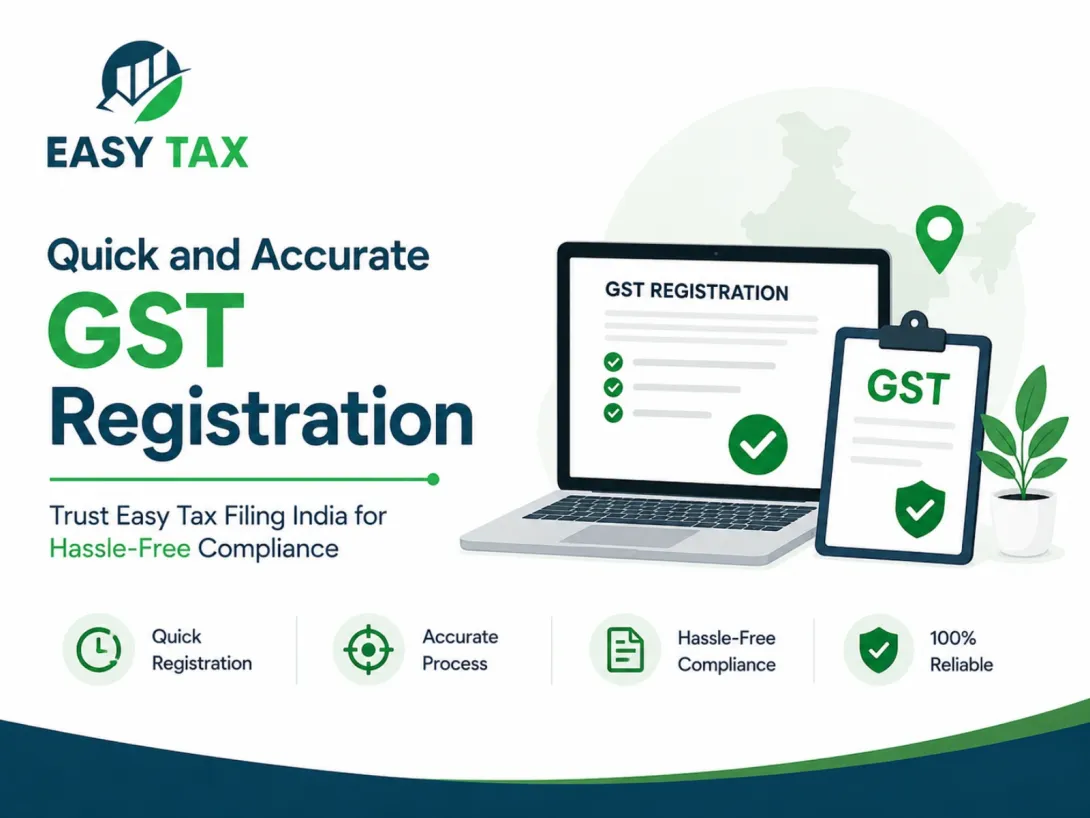
GST registration is the process through which an eligible business or supplier obtains a Goods and Services Tax Identification Number (GSTIN). Whether registration is compulsory depends on factors such as aggregate turnover, the type of supply, the State or Union Territory, and specific provisions or notifications under GST law. This guide explains the eligibility rules, documents and online application process in practical terms.
What Is GST Registration?
GST registration is the formal enrolment of a Visit EasyTax income-tax filing services.https://easytax.live/services/expert-assisted-itr-filing For related compliance support, explore EasyTax GST return filing services and EasyTax income-tax filing services. person or business under the Goods and Services Tax system. After registration is granted, the taxpayer receives a 15-character GSTIN linked to the relevant PAN and State or Union Territory.
A registered taxpayer must follow the compliance requirements applicable to their registration category. These may include issuing appropriate invoices or bills of supply, maintaining records, paying tax where due, and filing applicable GST returns.
GST registration is not automatically required for every small business. Businesses should first assess their aggregate turnover and the nature and location of their supplies under the Central Goods and Services Tax Act, 2017, the relevant State or Union Territory GST law, and applicable notifications.
Who Needs GST Registration in India?
Under Section 22 of the CGST Act, a supplier may become liable for registration when aggregate turnover exceeds the applicable threshold. Section 24 separately identifies certain categories that may require compulsory registration, subject to applicable exemptions and notifications.
01 Businesses crossing the applicable turnover limit
The threshold is not identical for every taxpayer. The general statutory threshold and the exemption available to eligible suppliers exclusively dealing in goods must be considered separately.
| Type of supply | General threshold guidance | Important qualification |
|---|---|---|
| Services or mixed supplies | Generally ₹20 lakh | A lower ₹10 lakh threshold applies in the specified States of Manipur, Mizoram, Nagaland and Tripura. Confirm the applicable State rules and notifications. |
| Exclusive supply of goods | Up to ₹40 lakh exemption may be available | The exemption is subject to Notification No. 10/2019-Central Tax, specified State exclusions, excluded goods and compulsory registration provisions. It is not a universal ₹40 lakh limit. |
02 What is aggregate turnover?
Aggregate turnover is calculated on an all-India basis for persons having the same PAN. It generally includes:
- Taxable supplies of goods and services.
- Exempt supplies.
- Exports of goods or services.
- Inter-State supplies.
The statutory definition excludes specified taxes such as CGST, SGST, UTGST, IGST and cess. It also excludes the value of inward supplies on which the recipient pays tax under reverse charge. Do not calculate eligibility using only the sales made from one shop, branch or State.
03 Persons who may require compulsory registration
Section 24 lists categories that can be required to register irrespective of the normal turnover threshold. Depending on the facts and applicable notifications, these can include:
- Persons making inter-State taxable supplies.
- Casual taxable persons making taxable supplies.
- Non-resident taxable persons making taxable supplies.
- Persons liable to pay tax under specified reverse-charge provisions.
- Persons liable to deduct tax at source under Section 51.
- Input Service Distributors.
- Specified agents supplying on behalf of taxable persons.
- Certain suppliers using e-commerce operators and e-commerce operators covered by the relevant provisions.
These categories should not be treated as a one-line rule for every business. Government notifications provide exemptions for certain transactions and classes of suppliers. For example, specific conditions apply to some small suppliers selling through e-commerce platforms. Check the current notification and the actual business model before deciding that registration is compulsory or unnecessary.
04 Who may not be required to register?
Section 23 provides that certain persons are not liable to registration. Examples include a person exclusively supplying goods or services that are not liable to GST or are wholly exempt, and an agriculturist to the extent of supply of produce out of cultivation of land.
These provisions must be read with the rest of the GST law. A business making both exempt and taxable supplies, or falling within a compulsory registration category, should obtain a case-specific assessment.
Documents Required for GST Registration
The documents depend on the constitution of the business, the identity of its authorised signatory and the evidence available for the principal place of business. Keep clear, legible copies ready before starting the application.
Common information and documents
- PAN of the business or proprietor, as applicable.
- Valid mobile number and email address for the primary authorised signatory.
- Proof of constitution of business, such as a partnership deed or certificate of incorporation, as applicable.
- Photograph of the relevant proprietor, partners or stakeholders, where required.
- Photograph and authorisation details of the authorised signatory, where applicable.
- Details of the principal place of business.
- Supporting proof for the business premises, based on whether the premises are owned, rented, leased or used with the owner's consent.
Proof of business address
| Premises arrangement | Examples of supporting documents |
|---|---|
| Owned premises | Property tax receipt, municipal khata or electricity bill, along with other supporting evidence as applicable. |
| Rented or leased premises | Valid rent or lease agreement and supporting ownership evidence of the lessor, as applicable. |
| Consent or shared premises | Consent letter and supporting ownership evidence of the person providing consent. |
Companies, LLPs, partnership firms, trusts and other entities may need additional constitution and authorisation documents. The GST Portal's document checklist should be checked for the applicant's exact business constitution and current upload requirements.
How to Apply for GST Registration Online
Applications for normal taxpayer registration are submitted through the official GST Portal. The broad process is as follows:
- Open the official GST Portal. Visit www.gst.gov.in.
- Start a new registration. Navigate to Services > Registration > New Registration.
- Complete Part A. Select the taxpayer category, State or Union Territory and district. Enter the legal name as per PAN, PAN, email address and mobile number.
- Verify the contact details. Complete the portal's OTP verification process to generate the Temporary Reference Number (TRN), where applicable.
- Complete Part B. Use the TRN to access the application and fill in the business, promoter or partner, authorised signatory, place of business, goods and services and other applicable details.
- Upload supporting documents. Attach the documents requested for the business constitution, authorised signatory and business premises.
- Complete the applicable authentication. Follow the Aadhaar authentication or other verification steps displayed by the portal. Some applications may be selected for additional verification or physical verification.
- Submit the application. Complete verification and submit using the electronic method available for the applicant, such as DSC, EVC or e-sign, as applicable.
- Track the application. Save the Application Reference Number (ARN) and use the GST Portal to check status or respond to a clarification notice, if one is issued.
- Download the registration certificate. If registration is approved, download the certificate and verify the GSTIN, legal name and principal place of business.
Common Reasons for GST Registration Delays or Clarification
An application may require clarification or additional verification when information is incomplete, inconsistent or difficult to verify. Review these points before submission:
- PAN and legal-name mismatch: Check that the name and PAN details match the relevant records.
- Incorrect business address: Ensure the address in the application matches the supporting premises documents.
- Insufficient premises proof: Upload the correct ownership, rent, lease or consent evidence for the arrangement.
- Incomplete authorisation: Check that the authorised signatory has the required appointment or authorisation evidence.
- Unclear uploads: Use readable documents in the file format and size accepted by the portal.
- Missed clarification: Monitor the application status and reply to any notice within the time allowed.
What Happens After GST Registration?
Receiving a GSTIN is the beginning of GST compliance, not the end of it. The taxpayer should understand the obligations attached to the registration type and business activity.
- Display the GST registration certificate as required by the rules.
- Display the GSTIN at the principal place of business and other places of business as required.
- Issue tax invoices, bills of supply or other prescribed documents, as applicable to the taxpayer's category.
- Maintain purchase, sales, stock and tax records as applicable.
- File the applicable GST returns or statements within the prescribed due dates.
- Review input tax credit eligibility and supporting records before claiming credit.
- Update registration details when a reportable change occurs.
Input tax credit is not automatic merely because a business has obtained GST registration. Eligibility, documentation, receipt of supplies, supplier reporting, payment and other statutory conditions must be considered before claiming credit.
Common GST Registration Mistakes to Avoid
- Applying without checking whether registration is legally required or whether a specific exemption applies.
- Using the wrong PAN or entering a legal name that does not match the PAN records.
- Selecting an incorrect business constitution or registration category.
- Uploading an incomplete rent agreement, consent letter or premises proof.
- Ignoring the all-India, PAN-based calculation of aggregate turnover.
- Assuming every online seller or inter-State supplier has exactly the same registration obligation.
- Failing to monitor the ARN or respond to a clarification notice.
- Assuming that GST registration automatically makes every purchase eligible for input tax credit.
Frequently Asked Questions About GST Registration
01 Is GST registration mandatory for every business?
No. Registration depends on the applicable turnover threshold, nature and location of supplies, compulsory-registration provisions and relevant exemptions. A business should assess its facts before applying.
02 What is the GST registration threshold in India?
The general threshold is commonly ₹20 lakh, with a lower threshold applicable in specified States for certain supplies. Eligible persons exclusively supplying goods may qualify for a ₹40 lakh exemption in States where the relevant notification applies. Exceptions and compulsory-registration provisions must also be checked.
03 Is the ₹40 lakh threshold applicable to service providers?
No. The ₹40 lakh exemption under Notification No. 10/2019-Central Tax is for eligible persons engaged in the exclusive supply of goods, subject to its conditions and exclusions. Service providers and businesses making mixed supplies should assess the applicable threshold separately.
04 Is PAN required for GST registration?
PAN is generally required for GST registration under Section 25 of the CGST Act. The law provides a specific alternative for certain persons required to deduct tax at source and separate treatment for non-resident taxable persons.
05 Can a business apply for GST registration voluntarily?
Yes. Section 25(3) permits a person who is not otherwise liable to register to obtain voluntary registration. Once registered, the applicable provisions and compliance responsibilities of a registered person apply.
06 How long does GST registration take?
There is no safe universal promise of approval within a fixed number of days. The application may undergo Aadhaar authentication, document checks, risk-based verification or physical verification. Applicants should monitor their ARN and portal notices.
07 Can I apply for GST registration without owning an office?
Ownership of the premises is not the only possible arrangement. Depending on the facts, a rented, leased, consent-based or shared premises arrangement may be supported with the documents accepted under the GST Portal's requirements.
08 What is a GSTIN?
GSTIN means Goods and Services Tax Identification Number. It is the unique identification number assigned to a registered taxpayer.
09 Can I claim input tax credit immediately after getting GSTIN?
Not automatically. Input tax credit is subject to the conditions and restrictions under GST law. The taxpayer should verify invoice, receipt, supplier reporting, payment and other applicable requirements.
10 What should I do if the GST Portal asks for clarification?
Read the notice carefully, identify the information or document requested, and submit a clear response with supporting evidence within the time stated in the notice. Keep the ARN and response acknowledgement for your records.
Get Assistance With GST Registration
GST registration decisions can depend on the business structure, turnover, supply locations, product or service category and applicable notifications. Before applying, review these details so that the registration application reflects the actual business position.
Need help with your GST registration?
Explore EasyTax's GST registration service for assistance with understanding the application requirements and preparing the registration documents.
Official Government References
The legal and procedural information in this article should be read with the applicable Act, notifications, rules and current GST Portal instructions. The following official resources are useful for verification:
- Central Goods and Services Tax Act, 2017 — CBIC (including Sections 2(6), 22, 23, 24 and 25).
- Notification No. 10/2019-Central Tax — GST Council (exemption for eligible exclusive suppliers of goods up to the specified turnover, subject to conditions).
- GST Portal User Guide — Apply for Registration (application workflow and supporting document guidance).
- GST Registration Document Checklist — GST Portal (examples of constitution, authorisation and premises documents).
- GST Common Portal (official application and registration-status services).
Disclaimer: This article is for general educational information and is not a substitute for advice on a specific GST registration case. Thresholds, exemptions and procedural requirements can depend on the facts and applicable notifications. Verify the latest law and portal instructions before acting.
Was this guide helpful?
Related reading

Why Your Business Needs a CA: 7 Signs You Shouldn't Ignore
Skip to article Business Accounting & Taxation Why Your Business Needs a CA: 7 Signs You Shouldn't Ignore Business…
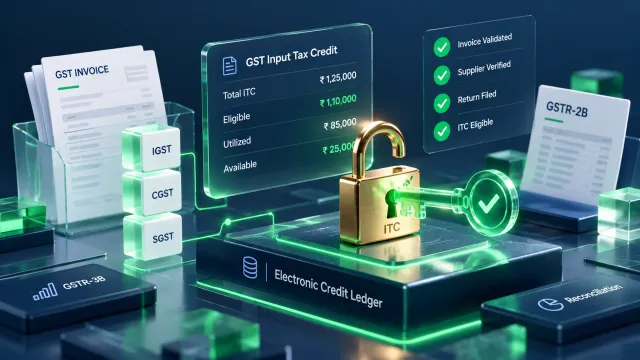
Why is My Gst Credit Blocked? Common Reasons and Solutions
Understand why GST credit is blocked, how to check GSTR-2B and Section 16 conditions, and when Rule 37A, Section 17(5)…

Best Gst Consultant in Jaipur
EasyTax Home Blog Our services Contact Home / Blog / GST / Best GST Consultant in Jaipur GST compliance · Jaipur,…
Latest from the blog

SEO Agent connection test (temporary)
This is a temporary test post. It checks the connection between the EasyTax website and the SEO Agent publishing tool,…
Tax-Smart Tips for Salaried Employees: New Tax Regime
Tax-smart tips for salaried employees under the new tax regime: understand deductions, employer NPS, tax rebates,…
Tax-Smart Tips for Salaried Employees | EasyTax
Tax-smart tips for salaried employees under India’s new tax regime: compare deductions, employer NPS, rebates and…
EasyTax • Trusted by 10,000+ Clients
GST Return Filing & Compliance
Timely GSTR-1 & GSTR-3B filing, 100% ITC matching and department notice defense by certified GST experts.