
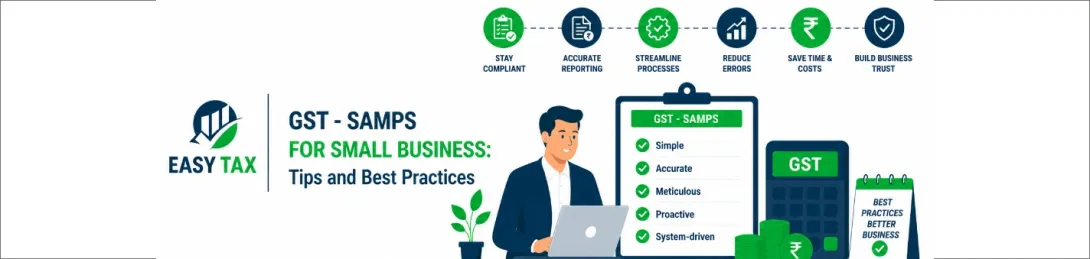
GST - SAMPS FOR SMALL BUSINESS: Tips and Best Practices
Essential Aspects of Tax
GST Compliance for Small Businesses: Complete Guide, Tips & Best Practices (2026) This process directly involves Tax Compliance. This process directly involves Tax Compliance. This process directly involves Tax Compliance.
Goods and Services Tax (GST) is one of the most important indirect tax systems in India. For small businesses, proper GST compliance is not just a legal requirement but also a key factor for smooth operations, financial stability. And business growth.
Failure to comply with GST rules can lead to penalties, blocked Input Tax Credit (ITC), and legal issues. That is why understanding GST basics, return filing, invoicing rules. And compliance strategies is essential.
In this guide, we will explain GST compliance for small businesses, step-by-step requirements, best practices, and expert tips to help you stay compliant and avoid penalties.
What is GST and Why is it Important?
GST (Goods and Services Tax) is a unified indirect tax system in India that replaced multiple taxes such as VAT, service tax, excise duty, and others.
Key benefits of GST:
- One Nation, One Tax system
- Transparent tax structure
- Easy input tax credit (ITC) system
- Reduced tax cascading
- Better compliance tracking
For small businesses, GST ensures credibility and allows expansion across states.
GST Registration for Small Businesses
When is GST Registration Mandatory?
A business must register for GST if:
Essential Aspects of Tax Compliance
- Annual turnover exceeds:
- ₹20 lakh (normal states)
- ₹10 lakh (special category states)
- Engaged in interstate supply of goods/services
- Selling on e-commerce platforms
- Providing taxable services
Voluntary GST Registration
Even if not mandatory, voluntary registration helps businesses:
✔ Claim Input Tax Credit (ITC)
✔ Improve business credibility
✔ Work with larger companies
✔ Expand to online marketplaces
GST Return Filing: Key Requirements
Small businesses must file GST returns regularly to stay compliant.
Main GST Returns:
1. GSTR-1
- Details of outward supplies (sales)
- Filed monthly or quarterly
2. GSTR-3B
- Summary return of sales and purchases
- Includes tax payment details
3. GSTR-9
- Annual return
- Consolidated GST summary
Why timely filing is important:
- Avoid penalties
- Maintain Input Tax Credit eligibility
- Prevent notices from GST department
GST Invoicing Rules for Small Businesses
Proper invoicing is essential for GST compliance.
A valid GST invoice must include:
- GSTIN of supplier and buyer
- Invoice number and date
- HSN/SAC code
- Taxable value
- CGST, SGST, IGST breakdown
- Place of supply
✔ Using digital billing software is highly recommended.
Input Tax Credit (ITC) Explained
ITC allows businesses to reduce tax liability by claiming credit on purchases.
Example:
If you pay ₹10,000 GST on purchases and collect ₹15,000 GST on sales, you pay only ₹5,000 to the government.
Conditions for claiming ITC:
✔ Supplier must file GST return
✔ Invoice must be valid
✔ Goods/services received
✔ Payment made within time
Common ITC mistake:
- Not reconciling GSTR-2B properly
E-Way Bill System
An E-way bill is required for transporting goods.
When is it required?
- Goods worth more than ₹50,000
- Inter-state transport
- Certain intra-state movements
Required details:
- Supplier and recipient details
- Invoice information
- Transport vehicle number
✔ Helps track movement of goods and prevent tax evasion
Essential Aspects of Tax Compliance
GST Compliance Best Practices for Small Businesses
1. Maintain Proper Records
Keep accurate records of:
- Sales
- Purchases
- Input tax credit
- Expenses
✔ Digital accounting tools reduce errors
2. File GST Returns on Time
Late filing leads to:
- Penalties
- Interest charges
- ITC blockage
✔ Always follow monthly or quarterly deadlines
3. Use Correct GST Rates
Different goods/services have different GST rates:
- 0%, 5%, 12%, 18%, 28%
✔ Applying wrong rates leads to compliance issues
4. Reconcile GSTR-1 and GSTR-3B
Ensure:
- Sales data matches
- Tax paid matches
- No mismatches in ITC
5. Monitor GST Notices
Respond quickly to:
- Demand notices
- Audit notices
- Clarification requests
GST Audit and Compliance Check
Businesses with turnover above a certain limit may face GST audit requirements.
GST Audit includes:
- Verification of financial records
- ITC validation
- Return accuracy check
✔ Proper bookkeeping avoids audit issues
Common GST Mistakes Small Businesses Should Avoid
- Delayed return filing
- Incorrect invoice format
- Wrong ITC claims
- Not maintaining digital records
- Ignoring GST notices
GST Composition Scheme (For Small Businesses)
Small businesses with turnover up to ₹1.5 crore can opt for composition scheme.
Benefits:
- Lower tax rate
- Less compliance
- Simple return filing
Limitation:
- No ITC benefit
- Restricted interstate sales
How Easy Tax Helps Small Businesses in GST Compliance
Easy Tax provides professional GST services for businesses of all sizes.
Services include:
✔ GST registration
✔ GST return filing (GSTR-1, GSTR-3B, GSTR-9)
✔ ITC reconciliation
✔ GST advisory and planning
✔ E-way bill support
✔ Audit assistance
Why choose Easy Tax?
✔ Expert GST consultants
✔ Error-free compliance
✔ Time-saving solutions
✔ Affordable pricing
✔ Business-focused tax planning
With professional guidance, businesses can focus on growth instead of tax stress.
Essential Aspects of Tax Compliance
Benefits of Proper GST Compliance
✔ Avoid penalties and legal issues
✔ Improve business credibility
✔ Smooth cash flow management
✔ Easy loan approvals
✔ Better financial planning
Frequently Asked Questions (FAQs)
1. Is GST mandatory for small businesses?
Yes, if turnover exceeds the prescribed limit or business is inter-state.
2. What happens if GST return is not filed?
You may face penalties, interest. And ITC blockage.
3. Can small businesses avoid GST registration?
Only if turnover is below threshold and no interstate supply.
4. What is the penalty for late GST filing?
₹50 per day (₹20 for NIL return) plus interest.
5. Can GST be managed without a consultant?
Yes. But expert help reduces errors and saves time.
Conclusion
GST compliance is essential for every small business in India. From registration to return filing, invoicing, ITC claims. And audits—each step requires accuracy and timely execution.
By following best practices and maintaining proper records, businesses can avoid penalties and ensure smooth operations.
However, professional support from Easy Tax makes GST management easier, faster, and completely stress-free.
With expert guidance, small businesses can focus on growth while staying fully compliant with GST laws.
For more detailed assistance, explore our professional tax services or check official updates on the Income Tax Department website.
EasyTax • Jaipur
GST Return Filing & Compliance
Timely GSTR-1 & GSTR-3B filing, 100% ITC matching and department notice defense by certified GST experts.