

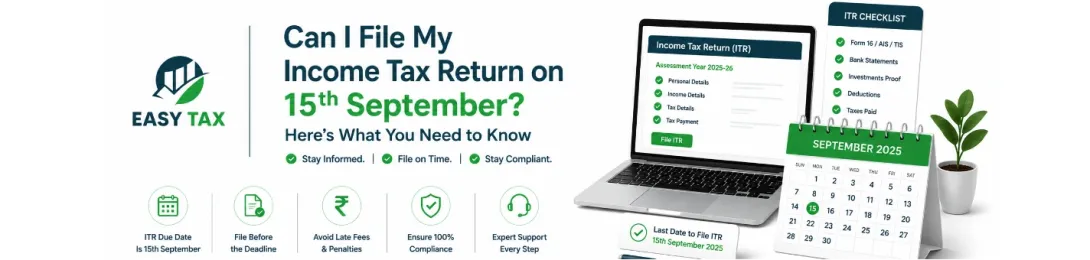
Can I File My Income Tax Return on 15th September? 2026
You can file the ITR on 15th September. Whether it is on time depends on your assessment year, taxpayer category, and applicable extension. For AY 2026–27, a salaried individual with a 31 July deadline would generally file a belated return on 15 September. A taxpayer covered by a later deadline may still be filing on time.
This guide covers Indian income earned from 1 April 2025 to 31 March 2026, filed for AY 2026–27. Sources were checked on 20 November 2026. Check your assessment year and any later official order before relying on a deadline.
Can you file the ITR on 15th September for AY 2026–27?
FY 2025–26 / AY 2026–27 returns remain governed by the Income-tax Act, 1961. Tax Year 2026–27 covers income from April 2026 to March 2027 under the Income-tax Act, 2025. Its return is a separate obligation after that year ends. Read the official return FAQs, Q3–5 and Q16.
| Taxpayer category | Return due date | 15 September filing |
|---|---|---|
| Ordinary salaried or other non-business individual with the row-4 deadline | 31 July 2026 | Generally belated, unless an applicable extension covers the case. |
| Covered non-audit business or professional filer under row 3 | 31 August 2026 | Belated, unless an applicable extension covers the case. |
| Persons covered by row 2 and Circular 07/2026 | 21 November 2026 | Within the extended return deadline. The corresponding audit-report date was extended to 21 October 2026. |
| Persons to whom section 92E applies, under row 1 | 30 November 2026 | Within the statutory return deadline. |
These categories follow the table below, Explanation 2 to section 139(1), amended by Finance Act 2026, section 5(a). Apply CBDT Circular 07/2026 only to the category it covers. Companies and partners require a category check. Your ITR form alone does not establish the deadline.
Why did the 2025 deadline mention 15 September?
For AY 2025–26, Circular 06/2025 moved the deadline from 31 July to 15 September 2025 for specified taxpayers. The Department's 15 September 2025 announcement confirmed a further extension to 16 September 2025. A covered taxpayer who filed ITR on 15th September 2025 was within that extended deadline.
For AY 2026–27, check the current-year category and order. Reusing a previous year's extension can lead to the wrong filing decision.
What happens if your September ITR is belated?
Under section 139(4), a belated AY 2026–27 return may be filed by 31 December 2026 or before completion of assessment, whichever comes first. The Department's return FAQs, Q7, explain this cutoff. See the EasyTax guide to belated-return filing for related information.
Late-filing fee and the ₹5 lakh boundary
If you are required to file and miss the applicable deadline, section 234F provides a fee of ₹5,000. The fee is capped at ₹1,000 when total income is ₹5 lakh or less. Professional assistance charges are separate. See the Finance Act 2021, section 60, and the official return FAQs, Q7.
Assume each person was legally required to file, had a 31 July 2026 deadline, filed on 15 September 2026, and verified within the permitted time. There is no applicable extension or waiver.
- A total income of ₹500,000 gives a section 234F fee of ₹1,000.
- A total income of ₹500,010 gives a section 234F fee of ₹5,000.
The examples cover the fee only. Income tax, interest, and service charges need separate checks. Read the EasyTax guide to late-filing fees and consequences.
Interest, regime choice, and loss carry-forward
Section 234A interest can apply if the tax remains payable. Check tax credits and previous payments when reviewing the amount due. See the ITR-1 FAQs, Q23.
Check the old-regime election before claiming deductions such as sections 80C and 80D. Non-business taxpayers make the election in a timely return. Applicable business or professional taxpayers use Form 10-IEA by their filing due date. The official tax-regime FAQs explain the process.
Timely loss-return filing matters for specified business, capital-gains, and racehorse-activity losses. Review your loss category before relying on carry-forward. The transition FAQs, Q21, explain the condition with reference to sections 139(3) and 80.
How to prepare and file your return
Keep applicable records ready.
- AIS and Form 26AS, reconciled with your records.
- Form 16 where applicable, bank statements, and interest records.
- Capital-gains statements or business accounts, where applicable.
- Evidence for deductions you are eligible to claim.
The ITR-1 FAQs, Q6, explain annexure-less filing. Retain supporting records so you can provide them if requested.
Follow the applicable filing steps.
- Log in to the official Income Tax e-Filing portal.
- Open e-file, income tax returns, and then file the income tax return. Select the assessment year.
- Choose the ITR form for your income, residency, and reporting requirements.
- Confirm the filing provision, including section 139(4) when applicable.
- Reconcile pre-filled income and tax credits. Enter complete information and eligible deductions.
- Review tax, fee, and interest. Pay any amount due and check payment details.
- Validate, submit, and complete verification. Save the acknowledgement.
The AY 2026–27 ITR-1 manual, section 5, illustrates that form's process. Follow the current instructions for your chosen form.
Complete verification within the applicable period
When verification is required after upload, e-verify within 30 days. If using a signed paper ITR-V, CPC must receive it within that period. Late verification can change the effective filing date and trigger late-filing consequences. An unverified return may be treated as invalid. Read the Department's ITR-V FAQs, Q1–4, and check the method required for your category.
Check whether PAN–Aadhaar linking applies to you. The Link Aadhaar FAQs, Q2, identify exemptions covering specified age, citizenship, residency, and state-based cases.
Questions about filing ITR on 15th September
Is 15 September the deadline every year?
No. The assessment year, taxpayer category, and applicable official extension determine your deadline. Use the year-specific table above for its stated scope.
Can I file on the due date itself?
Yes. The applicable filing date is inclusive. Allow time for submission and complete the required verification.
Can I correct an ITR already filed?
Section 139(5) allows eligible filers to correct an omission or wrong statement in an original or belated return. For AY 2026–27, the revised return must be filed by the end of the assessment year or before completion of assessment, whichever comes first, subject to applicable fee provisions. See the Finance Act 2026, section 5(b) and section 16.
Does a refund claim remove the late-filing fee?
No. Apply section 234F conditions, including your obligation to file. TDS or an expected refund alone does not settle that question.
What if the belated-return deadline has passed?
The available route depends on the year, eligibility, and whether you seek a refund or need to report additional income. Obtain advice before choosing the filing provision.
Get help with your filing category.
Before filing the ITR on 15th September, confirm your assessment year, deadline, and verification requirements. Ask EasyTax to review your income sources and filing position if you need assistance.
Explore CA-assisted ITR filing and confirm service scope and professional charges.
General information for the stated period. Qualified tax review and publication approval are pending.






EasyTax • Jaipur
Expert Assisted ITR Filing
Dedicated CA prepares, verifies, and files your ITR. Maximum refund, accurate deductions, zero notices.