

GST Audit Services in Jaipur: Filing & Review
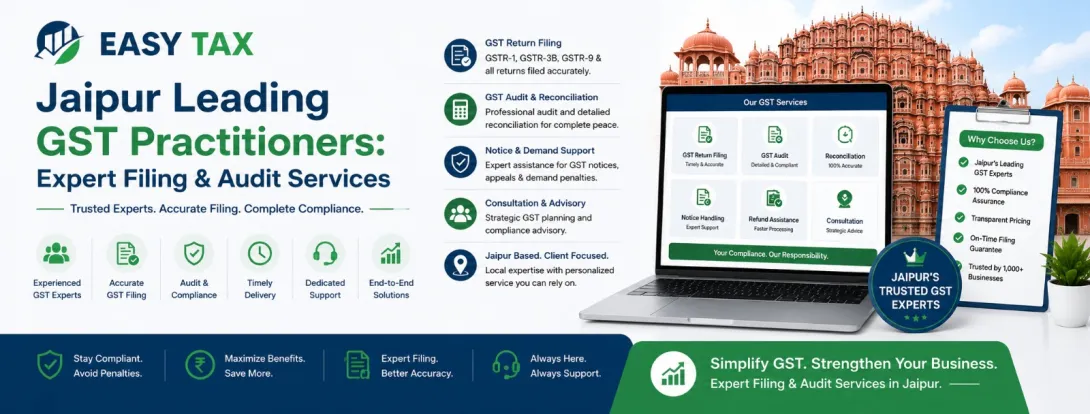
GST Consultant in Jaipur: Return Filing, Reconciliation and Audit Support
GST compliance involves more than filing returns before their due dates. Businesses also need to maintain accurate invoices, review input tax credit (ITC), reconcile accounting records with GST statements and understand their responsibilities under the applicable GST rules.
If you operate a business in Jaipur, a GST consultant may help you organise return filing, review discrepancies, prepare annual return information and understand departmental communications. The type of support required depends on your business activities, registration status, turnover and transactions.
This guide explains the GST services businesses commonly consider, the records they may need, important annual-return requirements and the difference between a voluntary GST review and a statutory audit.
Important: GST requirements can change through amendments, rules, notifications and circulars. Always verify the provisions applicable to the relevant financial year and taxpayer category before filing a return or making a tax decision.
GST services for businesses in Jaipur
Different businesses have different GST requirements. A retailer, manufacturer, consultant, restaurant, wholesaler and e-commerce seller may need different types of compliance support.
Before selecting a service, identify the actual requirement of your business. Common areas where professional assistance may be useful include the following.
01 GST registration assistance
GST registration requirements depend on the nature of the business, aggregate turnover, type of supply, location and specific provisions applicable to the taxpayer.
A GST practitioner may assist with understanding the registration requirement, organising documents and preparing an application through the GST Portal. The applicable registration provisions and exceptions should be checked before deciding whether registration is compulsory.
02 GST return filing
Registered businesses may have to file periodic GST returns according to their taxpayer category and applicable filing scheme. These may include GSTR-1 and GSTR-3B for eligible regular taxpayers.
Return preparation generally involves reviewing sales, purchases, taxable values, tax liability, eligible ITC, credit notes and other relevant records. The applicable return and filing frequency should be confirmed for the specific GST registration and tax period.
03 GST reconciliation
Reconciliation involves comparing information across accounting records, invoices, GST returns and relevant statements available on the GST Portal.
A reconciliation exercise may help identify differences in reported sales, purchase records, tax amounts or input tax credit. Each difference should be investigated using supporting documents and the applicable provisions.
04 GST notice assistance
A GST notice or departmental communication should be reviewed carefully. The taxpayer should identify the issuing authority, reference number, relevant provision, tax period, response deadline and information requested.
A professional may help organise the records and prepare a response based on the facts of the case. The outcome of a departmental proceeding cannot be guaranteed by a consultant.
05 Annual return and reconciliation support
Applicable registered persons may need assistance preparing annual return information and reconciling GST figures with their financial statements. The forms required depend on the applicable provisions, turnover and exemptions for the relevant financial year.
GST return filing: What should businesses review?
Accurate GST return filing begins with complete and correctly classified business records. Before preparing a return, businesses should review the information relevant to the reporting period.
Sales and outward-supply records
- Sales invoices and debit or credit notes.
- Taxable, exempt and other relevant outward supplies.
- Applicable tax rates and place-of-supply details.
- Sales returns, cancellations and amendments.
- Reconciliation of sales records with reported GST information.
Purchase and expense records
- Purchase invoices and debit or credit notes.
- Supplier GSTIN and invoice details.
- Relevant information available in GSTR-2B.
- Purchase entries in the accounting records.
- Documents supporting the business use of relevant purchases.
Tax liability and payment review
Businesses should review their output tax liability, applicable adjustments, electronic cash and credit ledger information and payments made for the relevant period.
A return should be prepared using the applicable GST forms and supporting information. Filing a return does not remove the need to maintain accurate books, invoices and other statutory records.
Official portal: GST Portal – Government of India .
Input tax credit reconciliation: Why does it matter?
Input tax credit allows an eligible registered person to claim credit of input tax subject to the conditions and restrictions prescribed under the GST law.
A purchase entry in accounting software or an invoice appearing in an auto-drafted statement does not, by itself, establish that the related ITC can be claimed. The taxpayer must consider the applicable legal conditions and supporting records.
What is GSTR-2B?
GSTR-2B is an auto-drafted, static ITC statement generated using information furnished by suppliers and other relevant sources. It helps taxpayers review the ITC information available for a particular tax period.
The GST Portal advises taxpayers to reconcile GSTR-2B with their own books and records. It also explains that other legal restrictions may affect ITC eligibility even where information appears in the statement.
What should be checked during ITC reconciliation?
- Whether relevant purchase invoices are available.
- Whether invoice details are consistent with the accounting records.
- Whether the goods or services have been received as required.
- Whether supplier-reported information is reflected in the relevant statement.
- Whether any credit notes or amendments require adjustment.
- Whether blocked-credit or other restrictions apply.
- Whether any credit has been claimed more than once.
- Whether reversals or other adjustments are required.
Reconciliation can help identify differences that require investigation. It does not guarantee that all ITC is eligible, that every invoice will match or that a taxpayer will not receive a departmental communication.
Relevant legal provisions: CGST Act, Section 16 – Eligibility and conditions for taking ITC and CGST Act, Section 17 – Apportionment and blocked credits .
For operational guidance, refer to the GST Portal's official GSTR-2B FAQ .
GSTR-9 and GSTR-9C: Annual GST return requirements
GSTR-9 is the annual return prescribed for applicable registered persons. However, the law and notifications provide for specified exclusions and exemptions. Businesses should check the requirement for their taxpayer category and the relevant financial year.
When is GSTR-9C generally required?
Under Rule 80(3) of the CGST Rules, a registered person whose aggregate turnover during a financial year exceeds ₹5 crore is generally required to furnish a self-certified reconciliation statement in FORM GSTR-9C along with the annual return, subject to the exclusions and provisions that apply.
The ₹5 crore threshold is relevant to GSTR-9C. It should not be treated as a universal test for every annual-return requirement. GSTR-9 and GSTR-9C applicability must be considered separately.
Is a CA-certified GST audit compulsory for every company?
No. A company's legal structure alone does not mean that it must obtain a separate statutory GST audit by a chartered accountant. The earlier requirement under Section 35(5) of the CGST Act was omitted with effect from 1 August 2021.
The current framework provides for an annual return and, where applicable, a self-certified reconciliation statement under Section 44 and Rule 80. This is different from the former mandatory GST audit requirement.
What records may be required for annual reconciliation?
- Annual sales and purchase registers.
- Financial statements and relevant accounting records.
- Filed GST returns for the financial year.
- Output tax liability and tax-payment information.
- ITC claimed, reversed and adjusted during the year.
- Reconciliation of turnover as per books and GST returns.
- Relevant credit notes, debit notes and amendments.
Rule 80 generally provides for filing the annual return by 31 December following the end of the financial year. However, extensions and exemptions may apply. Verify the due date and applicable requirements for the specific financial year before filing.
Official references: CGST Act – Section 44: Annual return and CGST Rules – Rule 80: Annual return .
For the treatment of late fee where GSTR-9C is required, refer to CBIC Circular No. 246/03/2025-GST dated 30 January 2025 .
GST e-invoicing requirements for businesses
E-invoicing is part of the GST compliance framework for specified registered persons and transactions. It involves reporting prescribed invoice details to the Invoice Registration Portal and obtaining the applicable Invoice Reference Number and signed QR code.
The notified turnover threshold was reduced from ₹10 crore to ₹5 crore with effect from 1 August 2023 through Notification No. 10/2023-Central Tax dated 10 May 2023, which amended the earlier e-invoicing notification.
This was a 2023 change, not a newly introduced 2026 threshold. Whether e-invoicing applies to a particular business must be checked against the principal notification, subsequent amendments, specified exclusions and the business's turnover history.
Businesses covered by e-invoicing requirements should review their invoicing process, accounting software, reporting workflow and applicable compliance records.
Official reference: Notification No. 10/2023-Central Tax dated 10 May 2023 .
Understanding GST audit services: Three different types of review
The expression "GST audit" is sometimes used broadly in business communication. However, a voluntary review by a private practitioner is not the same legal process as an audit conducted by tax authorities.
01 Voluntary GST health check or reconciliation
A business may voluntarily engage a suitably qualified professional to review its GST returns, invoices, accounting records, ITC documentation and reconciliations.
The scope of this service should be agreed in writing. It may cover a particular financial year, selected tax periods, specific transactions or identified compliance issues.
A voluntary review may help identify differences or documentation gaps. It does not become a statutory departmental audit merely because a professional reviews the business's records.
02 Departmental audit under Section 65
Section 65 of the CGST Act provides for an audit by the Commissioner or an officer authorised by the Commissioner. The provision sets out the statutory procedure, including advance notice and the audit process.
A private GST consultant cannot describe an ordinary voluntary review as a Section 65 departmental audit.
Official reference: CGST Act – Section 65: Audit by tax authorities .
03 Special audit under Section 66
Section 66 provides for a special audit in specified circumstances. Where the statutory conditions are met, an officer not below the rank of Assistant Commissioner may, with the prior approval of the Commissioner, direct the registered person to have records examined and audited by a chartered accountant or cost accountant nominated by the Commissioner.
This is a specific statutory process. It should not be confused with an ordinary voluntary GST health check or a service that every business must independently commission.
Official reference: CGST Act – Section 66: Special audit .
Documents to prepare before meeting a GST consultant
Keeping business records organised can make a GST review more efficient. The exact documents depend on the service and tax period involved.
Commonly useful records
- GST registration details and business information.
- Sales and purchase registers.
- Tax invoices, debit notes and credit notes.
- Filed GST returns and relevant acknowledgements.
- Relevant GSTR-2B statements.
- Electronic cash, credit and liability ledger information.
- Bank statements and payment evidence, where relevant.
- Trial balance and financial statements, where applicable.
- Previous GST notices, replies and orders.
- Import, export or e-commerce transaction records, where applicable.
Not every document in this list is mandatory for every engagement. The consultant should identify the records needed for the agreed scope and tax period.
Protect confidential business information. Do not share passwords, OTPs or login credentials through ordinary messages or email.
How to choose a GST consultant in Jaipur
When comparing GST service providers, look beyond advertising descriptions such as "best" or "leading". Check the actual qualifications, service scope, communication process and deliverables offered by the person handling your work.
Questions to ask before appointing a practitioner
- Who will handle the work? Ask for the name and relevant professional qualifications of the person responsible for the engagement.
- What is included in the service? Confirm whether the fee covers return preparation, filing, reconciliation, document review or notice assistance.
- Which tax periods will be covered? Identify the financial year, GST registration and specific tax periods included in the engagement.
- How will discrepancies be reported? Ask whether you will receive a written summary of identified differences, supporting documents required and suggested next steps.
- How will confidential records be handled? Understand how documents will be collected, stored and shared.
- What are the professional fees? Request a written estimate and clarify additional charges for extra periods, notices or complex transactions.
- What filing evidence will be provided? Confirm whether the engagement includes copies of submitted returns and relevant filing acknowledgements.
A clearly defined engagement should identify the work to be performed, the records required, the expected deliverables, the fee and any exclusions.
No practitioner should promise that a business will never receive a GST notice, that all ITC will automatically be accepted or that a particular departmental outcome is guaranteed.
Common GST compliance mistakes businesses should avoid
01 Incorrect sales reporting
Differences between sales invoices, accounting records and GST returns may require investigation. Businesses should maintain consistent records and review relevant amendments.
02 Claiming ITC without checking eligibility
ITC should be reviewed against the statutory conditions, restrictions and supporting documents. The appearance of an invoice in an auto-drafted statement does not remove the need for self-assessment.
03 Ignoring credit notes and amendments
Credit notes and amendments can affect reported values, tax liability and reconciliation. They should be considered in the relevant tax period.
04 Using outdated GST guidance
Old articles may contain historical thresholds, due dates or procedures. Verify the relevant financial year and current notifications before relying on them.
05 Confusing voluntary review with statutory audit
A private professional review is different from a departmental audit under Section 65 or a special audit under Section 66.
06 Missing a notice response deadline
Businesses should identify the actual response date stated in a notice and obtain appropriate professional advice where necessary.
GST compliance support for businesses across Jaipur
Jaipur has businesses operating in retail, trading, manufacturing, hospitality, professional services, construction and e-commerce. Their GST requirements can differ according to the nature of their supplies, transaction structure and registration status.
Businesses in areas such as Mansarovar, Vaishali Nagar, Malviya Nagar, Sitapura and other Jaipur commercial locations should assess their own compliance requirements rather than assume that the same filing process applies to every business.
Before selecting a service provider, identify whether you need registration assistance, periodic return filing, ITC reconciliation, annual return support or help responding to a notice.
A clearly defined requirement makes it easier to compare professional services and understand the work being offered.
Looking for GST filing or reconciliation assistance?
If your business needs help understanding its GST compliance requirements, first identify the relevant tax period, registration details and records available for review.
You can review the EasyTax GST service information to understand the service offering. Confirm the actual scope, professional responsible, fees and deliverables with EasyTax before proceeding.
Service clarification: A service description does not mean that every business requires a GST audit or reconciliation engagement. The appropriate service depends on the taxpayer's facts and applicable law.
Frequently asked questions about GST consultants in Jaipur
01 Why might a business need a GST consultant in Jaipur?
A business may seek professional help with registration, periodic return preparation, ITC review, reconciliations, annual returns or departmental communications. The required service depends on its business activities and compliance position.
02 Is GSTR-9 mandatory for every GST-registered business?
Not necessarily. Section 44 and the applicable rules and notifications provide for annual-return requirements and specified exemptions. Check the applicable financial year and taxpayer category before deciding whether GSTR-9 is required.
03 When is GSTR-9C generally required?
Under the general rule in Rule 80(3), a registered person whose aggregate turnover during a financial year exceeds ₹5 crore is required to furnish a self-certified reconciliation statement in GSTR-9C along with the annual return, subject to applicable exclusions and provisions.
04 Is a GST audit by a CA compulsory for every company?
No. A company's legal structure alone does not create a requirement for a separate statutory GST audit by a CA. The former Section 35(5) requirement was omitted with effect from 1 August 2021. Other annual-return or reconciliation requirements may still apply.
05 What is the difference between a GST review and a departmental audit?
A voluntary GST review is a professional service engaged by a business. A departmental audit under Section 65 is conducted by an authorised tax officer under the statutory procedure. A special audit under Section 66 is a separate statutory process involving a CA or cost accountant nominated by the Commissioner.
06 Does GSTR-2B matching guarantee ITC eligibility?
No. GSTR-2B provides auto-drafted information for review. ITC eligibility must still be assessed against the applicable legal conditions, restrictions and supporting records.
07 Can a GST consultant guarantee that a business will never receive a notice?
No. A professional may help review records and address identified compliance issues, but cannot guarantee that a tax authority will never issue a notice or that a proceeding will have a particular outcome.
08 What documents should I prepare for a GST review?
Depending on the engagement, useful records may include GST returns, sales and purchase registers, invoices, GSTR-2B statements, ledgers, financial statements and previous departmental communications.
09 Where can I check official GST rules and notifications?
Businesses can refer to the GST Portal and Central Board of Indirect Taxes and Customs (CBIC) for official GST information, legislation, notifications and instructions.
Official GST resources and legal references
The following primary and official resources can help readers verify GST requirements. The applicable version and financial year should always be checked before taking action.
- CGST Act – Section 44: Annual return
- CGST Rules – Rule 80: Annual return
- CGST Act – Section 16: ITC eligibility
- CGST Act – Section 17: Blocked credits
- CGST Act – Section 65: Departmental audit
- CGST Act – Section 66: Special audit
- GST Portal – GSTR-2B FAQ
- CBIC Circular No. 246/03/2025-GST
- Notification No. 10/2023-Central Tax – E-invoicing threshold
Disclaimer
This article is intended for general educational and informational purposes. It is not a substitute for professional advice based on a taxpayer's documents, transactions and individual circumstances.
GST legislation, rules, notifications, exemptions, filing procedures and due dates may change. Verify the applicable position for the relevant financial year using official government sources or consult a suitably qualified professional before taking action.
Was this guide helpful?
Related reading

Why Your Business Needs a CA: 7 Signs You Shouldn't Ignore
Skip to article Business Accounting & Taxation Why Your Business Needs a CA: 7 Signs You Shouldn't Ignore Business…

Why is My Gst Credit Blocked? Common Reasons and Solutions
Understand why GST credit is blocked, how to check GSTR-2B and Section 16 conditions, and when Rule 37A, Section 17(5)…

Best Gst Consultant in Jaipur
EasyTax Home Blog Our services Contact Home / Blog / GST / Best GST Consultant in Jaipur GST compliance · Jaipur,…
Latest from the blog

SEO Agent connection test (temporary)
This is a temporary test post. It checks the connection between the EasyTax website and the SEO Agent publishing tool,…
Tax-Smart Tips for Salaried Employees: New Tax Regime
Tax-smart tips for salaried employees under the new tax regime: understand deductions, employer NPS, tax rebates,…
Tax-Smart Tips for Salaried Employees | EasyTax
Tax-smart tips for salaried employees under India’s new tax regime: compare deductions, employer NPS, rebates and…
EasyTax • Trusted by 10,000+ Clients
GST Return Filing & Compliance
Timely GSTR-1 & GSTR-3B filing, 100% ITC matching and department notice defense by certified GST experts.