

GST Calculator Online 2026: CGST, SGST & IGST Guide
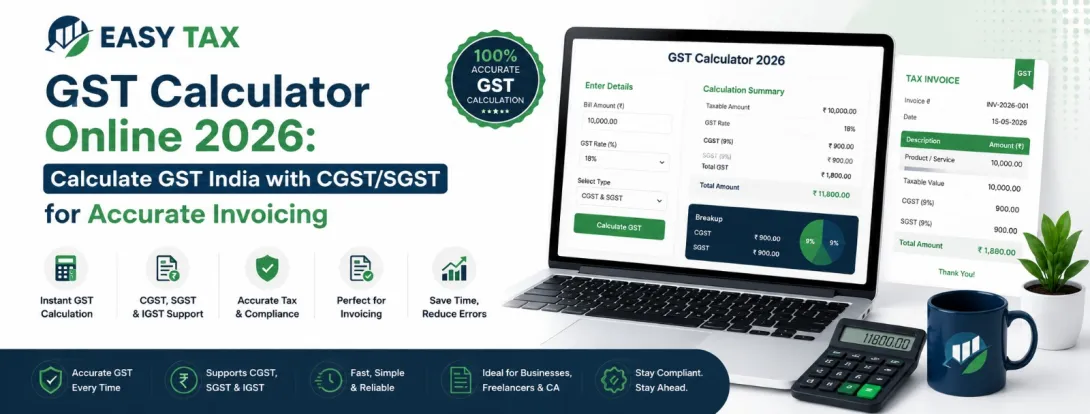
GST Calculator India 2026: Calculate GST, CGST, SGST and IGST Online
NNeed to calculate GST? Use this GST calculator online for a product, service or invoice.Use the calculator below to estimate the taxable value, GST amount and final price. You can calculate GST on an amount before tax or extract GST from a price that already includes tax.
The calculator also separates the tax into CGST and SGST for an intra-State supply, or displays IGST for an inter-State supply. You must select the correct GST rate and supply type based on the applicable GST classification and place-of-supply rules.
Online GST Calculator
Enter the amount, GST rate and calculation type. The result will show the taxable value, tax amount and total payable.
Enter the rate applicable to your specific goods or services. Do not select a rate only because it is commonly used.
GST Calculation Result
Taxable value
₹0.00
GST rate
0%
Total GST
₹0.00
CGST
₹0.00
SGST / UTGST
₹0.00
IGST
₹0.00
Final amount
₹0.00
This calculator provides an arithmetic estimate. It does not determine the legally applicable GST rate, classification, exemption, place of supply, reverse-charge liability or eligibility for input tax credit.
What is GST in India?
Goods and Services Tax (GST) is an indirect tax levied on specified supplies of goods and services in India. The GST framework includes Central GST (CGST), State GST (SGST), Union Territory GST (UTGST) and Integrated GST (IGST).
The applicable tax depends on the nature of the supply, the classification of the goods or service, the location of the supplier, the place of supply and any applicable exemption or special provision.
A GST calculator helps estimate the tax amount once the correct taxable value and rate have been identified. It does not replace the legal classification exercise.
How to calculate GST in India
For a straightforward calculation where the taxable value and applicable GST rate are already known, use this formula:
Invoice total = Taxable value + GST amount
For example, if the taxable value is ₹1,000 and the applicable GST rate is 18%:
- Taxable value: ₹1,000
- GST amount: ₹1,000 × 18 ÷ 100 = ₹180
- Invoice total: ₹1,000 + ₹180 = ₹1,180
This example assumes that 18% is the correct rate for the particular supply. It is an arithmetic example, not a classification decision.
GST-inclusive and GST-exclusive calculations
01 GST-exclusive amount
A GST-exclusive price is the value before GST is added. Multiply the taxable value by the applicable rate to calculate the tax.
Example: A service has a taxable value of ₹2,000 and an assumed GST rate of 18%.
- Taxable value: ₹2,000
- GST: ₹360
- Total including GST: ₹2,360
02 GST-inclusive amount
A GST-inclusive price already contains GST. To extract the tax component, use:
GST = Inclusive amount − Taxable value
Example: The final price is ₹1,180 and the assumed GST rate is 18%.
- Taxable value: ₹1,180 × 100 ÷ 118 = ₹1,000
- GST included: ₹180
- Final price: ₹1,180
Use the inclusive option in the calculator when you know the final price but need to identify its estimated pre-tax value and tax component.
Difference between CGST, SGST, UTGST and IGST
The nature of a supply determines whether CGST and SGST (or UTGST) or IGST is generally applicable. The legal determination uses the location of the supplier and the place-of-supply provisions. Physical movement across a State border alone is not a complete test for every transaction.
| Tax component | General application | Example at an assumed total rate of 18% |
|---|---|---|
| CGST | Central component of a taxable intra-State supply. | 9% |
| SGST | State component of a taxable intra-State supply. | 9% |
| UTGST | Union Territory component where applicable instead of SGST. | Generally paired with CGST for the relevant intra-UT supply. |
| IGST | Generally applies to inter-State supplies and specified other transactions. | 18% |
Intra-State example
Assume a taxable supply with a value of ₹1,000 is an intra-State supply and the applicable total GST rate is 18%.
- CGST at 9%: ₹90
- SGST at 9%: ₹90
- Total GST: ₹180
- Invoice total: ₹1,180
Inter-State example
Assume the same taxable value and rate, but the supply qualifies as an inter-State supply under the IGST Act.
- IGST at 18%: ₹180
- Invoice total: ₹1,180
The examples illustrate the arithmetic only. For an actual transaction, verify the applicable place-of-supply rules, including special provisions for particular goods and services.
How to identify the correct GST rate in 2026
There is no single GST rate that applies to every product or service. The rate must be identified using the relevant classification, description, conditions and applicable Central Tax (Rate) or Integrated Tax (Rate) notification.
Do not assume that a product or service attracts a particular rate only because another similar item has that rate. Packaging, description, use, classification and notification conditions can affect the result.
The CBIC GST rate schedule provides separate information for goods and services. It should be checked before entering a rate into the calculator.
Rate notifications can change. The rate should therefore be checked against the notification applicable on the date of the supply, rather than relying only on an old article, invoice template or general rate summary.
GST calculation examples
The following examples use assumed rates to explain the calculation. They do not establish the rate applicable to any particular product or service.
| Taxable value | Assumed rate | GST amount | Total price |
|---|---|---|---|
| ₹500 | 5% | ₹25 | ₹525 |
| ₹1,000 | 12% | ₹120 | ₹1,120 |
| ₹2,000 | 18% | ₹360 | ₹2,360 |
| ₹5,000 | 28% | ₹1,400 | ₹6,400 |
These are mathematical examples only. The actual rate may differ, and some supplies may be exempt, nil-rated or subject to special conditions. A rate must be verified before it is used for invoicing.
How GST is shown on an invoice
A GST tax invoice should contain the particulars required under the applicable GST law and rules. Depending on the transaction, these may include the supplier and recipient details, GSTIN, invoice number and date, description of goods or services, HSN or SAC details, taxable value, applicable rate and tax amount.
For an intra-State supply, the relevant CGST and SGST (or UTGST) amounts are generally shown separately. For an inter-State supply, IGST is generally shown. The correct treatment depends on the legal nature of the supply.
The calculator's output is not a tax invoice. It does not check GSTIN validity, invoice numbering, HSN/SAC accuracy, place of supply, exemption eligibility, input tax credit conditions or all mandatory invoice particulars.
GST e-invoicing threshold in India
E-invoicing is a separate compliance requirement. It is not the same as calculating GST on an invoice.
Notification No. 10/2023-Central Tax dated 10 May 2023 lowered the applicable aggregate turnover threshold to more than ₹5 crore with effect from 1 August 2023, subject to the conditions and exclusions in the applicable rules and notifications.
The relevant turnover test considers aggregate turnover across GST registrations under the same PAN, as provided by the applicable rules. Taxpayers should verify their actual applicability rather than relying only on portal enablement status.
Refer to the official GST Council entry for Notification No. 10/2023-Central Tax and the GST e-invoice portal for applicable guidance and status checks.
What is Reverse Charge Mechanism (RCM)?
Under the Reverse Charge Mechanism, the recipient is responsible for paying GST instead of the supplier in specified circumstances.
The CGST Act and IGST Act provide for reverse charge in notified categories of supplies and other specified circumstances. It should not be assumed that every purchase from an unregistered supplier automatically attracts reverse charge.
Before applying RCM, verify the nature of the supply, supplier status, recipient status, relevant notification and any applicable exemption or exception.
A standard GST calculator can calculate a tax amount after the applicable rate is known. It cannot independently decide whether a transaction is covered by RCM.
For further information, consult the GST Council's Reverse Charge Mechanism guide and the current applicable notifications.
Who can use an online GST calculator?
A GST calculator can help different users estimate the tax component of a transaction, provided they already know the correct rate and calculation basis.
- Small businesses: Estimate tax and final selling prices.
- Retailers: Calculate the tax component of a price.
- Service providers: Estimate GST on a taxable service after verifying its classification.
- Accountants: Cross-check basic invoice arithmetic.
- Customers: Understand the approximate tax included in a quoted price.
The calculator is not a substitute for professional advice where the transaction involves exemptions, special valuation, composite or mixed supplies, exports, imports, place-of-supply issues or reverse charge.
Frequently asked questions about GST calculation
01 How do I calculate 18% GST on ₹1,000?
Multiply ₹1,000 by 18 and divide by 100. The GST amount is ₹180 and the total amount is ₹1,180, assuming the applicable rate is 18%.
02 How do I calculate GST from an inclusive price?
Divide the inclusive amount by (100 + the GST rate), then multiply by 100 to find the taxable value. Subtract the taxable value from the inclusive amount to find the GST component.
03 What is the difference between CGST and SGST?
CGST is the Central component and SGST is the State component generally charged on an intra-State taxable supply. For a qualifying inter-State supply, IGST generally applies instead.
04 When is IGST charged?
IGST generally applies when a supply qualifies as an inter-State supply under the IGST Act. The determination depends on the supplier's location and the legally determined place of supply, subject to special rules.
05 Does this calculator automatically identify the GST rate?
No. You must enter the applicable rate after checking the relevant GST rate schedule and classification. The calculator performs the arithmetic only.
06 Is GST the same for all goods and services?
No. GST rates depend on the classification and conditions applicable to the particular goods or services. Some supplies may also be exempt or subject to special provisions.
07 Is the GST calculator result a valid tax invoice?
No. The result is a calculation estimate. A tax invoice must meet the applicable statutory particulars and other requirements.
08 Does every purchase from an unregistered supplier attract RCM?
No. Reverse charge applies in specified notified circumstances. Check the relevant provisions and notifications before treating a purchase as an RCM transaction.
Official GST resources
Use the following government and official resources to verify GST rates, legal provisions and compliance requirements.
- CBIC – GST rates for goods and services
- CBIC Tax Information Portal – GST Acts and provisions
- GST Council – Notification No. 10/2023-Central Tax
- GST e-invoice portal
- Gazette of India – GST rate notification dated 27 October 2026
- India Code – Integrated Goods and Services Tax Act, 2017
- GST Council – Reverse Charge Mechanism
The applicable law and notifications should be checked for the date and facts of the specific transaction. General guidance and calculator examples cannot determine every taxpayer's legal position.
Need help understanding your GST calculation?
If your transaction involves a classification question, GST registration, invoicing or return-filing issue, consider getting advice based on the actual transaction documents and applicable GST provisions.
Visit EasyTax to explore its tax services and verified contact options.
Was this guide helpful?
Related reading

Why Your Business Needs a CA: 7 Signs You Shouldn't Ignore
Skip to article Business Accounting & Taxation Why Your Business Needs a CA: 7 Signs You Shouldn't Ignore Business…
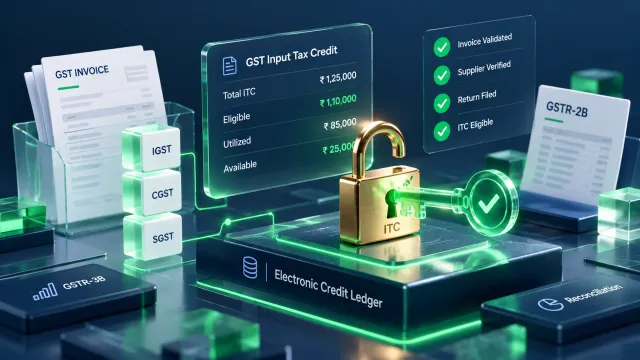
Why is My Gst Credit Blocked? Common Reasons and Solutions
Understand why GST credit is blocked, how to check GSTR-2B and Section 16 conditions, and when Rule 37A, Section 17(5)…

Best Gst Consultant in Jaipur
EasyTax Home Blog Our services Contact Home / Blog / GST / Best GST Consultant in Jaipur GST compliance · Jaipur,…
Latest from the blog

SEO Agent connection test (temporary)
This is a temporary test post. It checks the connection between the EasyTax website and the SEO Agent publishing tool,…
Tax-Smart Tips for Salaried Employees: New Tax Regime
Tax-smart tips for salaried employees under the new tax regime: understand deductions, employer NPS, tax rebates,…
Tax-Smart Tips for Salaried Employees | EasyTax
Tax-smart tips for salaried employees under India’s new tax regime: compare deductions, employer NPS, rebates and…
EasyTax • Trusted by 10,000+ Clients
GST Return Filing & Compliance
Timely GSTR-1 & GSTR-3B filing, 100% ITC matching and department notice defense by certified GST experts.