

HRA Calculator FY 2025-26: Calculate Your HRA Exemption
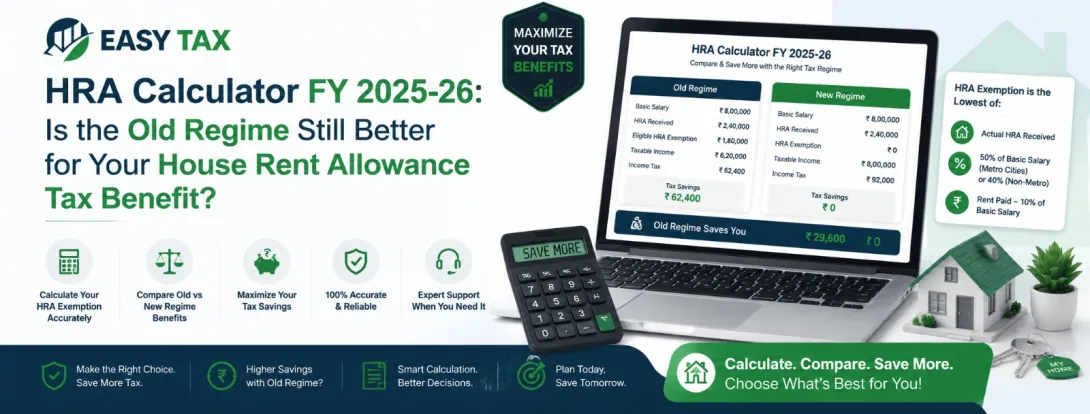
HRA Calculator FY 2025–26: Calculate Your House Rent Allowance Exemption
House Rent Allowance (HRA) is a salary component that can help eligible salaried employees reduce their taxable salary when they live in rented residential accommodation. The exemption is not equal to the full rent paid or the full HRA received. It is calculated using three statutory limits under Section 10(13A) of the Income-tax Act, 1961, read with Rule 2A of the Income-tax Rules, 1962.
This guide explains how to calculate HRA exemption for FY 2025–26 (AY 2026–27), which cities qualify for the 50% salary limit, what documents to retain and how HRA affects the choice between the old and new tax regimes.
Key Takeaways
- For FY 2025–26, HRA exemption is governed by Section 10(13A) and Rule 2A.
- The exemption is the least of actual HRA received, rent paid minus 10% of eligible salary, and 40% or 50% of eligible salary.
- The 50% limit applies only to Delhi, Mumbai, Kolkata and Chennai for FY 2025–26. Other locations use 40%.
- HRA exemption is not available under the default new tax regime for AY 2026–27.
- Eligible employees who choose the old regime may claim HRA exemption if the statutory conditions are met.
- There is no universal deduction threshold at which the old regime always becomes better. Compare the complete tax liability under both regimes.
01 What Is House Rent Allowance?
House Rent Allowance is an amount an employer may pay an employee as part of salary to help meet residential rent expenses. Under the old tax regime, a qualifying employee can claim an exemption for part of the HRA received, subject to the statutory conditions.
HRA exemption is generally relevant when:
- Your employer provides HRA as a distinct salary component.
- You occupy rented residential accommodation.
- You actually incur rent expenditure for the accommodation.
- You meet the applicable conditions and select the tax regime that permits the exemption.
If you live in your own house and do not pay rent, you cannot claim HRA exemption merely because HRA appears in your salary structure. The HRA received is generally taxable in that situation.
The Income Tax Department explains the salary treatment and HRA exemption under Section 10(13A) in its Income from Salary guidance.
02 HRA Exemption Rules for FY 2025–26 (AY 2026–27)
For FY 2025–26, Section 10(13A) of the Income-tax Act, 1961, read with Rule 2A of the Income-tax Rules, 1962, prescribes a least-of-three calculation.
Exempt HRA is the least of the following amounts:
- Actual HRA received from the employer during the relevant period.
- Actual rent paid minus 10% of eligible salary for that period.
- 50% of eligible salary if the rented accommodation is in Delhi, Mumbai, Kolkata or Chennai; 40% for any other location.
HRA exemption = Least of (Actual HRA, Rent paid − 10% of salary, 40% or 50% of salary).
Taxable HRA = Actual HRA received − HRA exemption.
The calculation should be made for the period during which the employee actually occupied rented accommodation and paid rent. If the employee changes residence, salary structure or rent during the year, the calculation may need to be split into relevant periods.
Official reference: Income Tax Department – Salaried Individuals for AY 2026–27.
03 Which Cities Qualify for the 50% HRA Limit in FY 2025–26?
For FY 2025–26, the 50% salary limit applies only where the rented residential accommodation is situated in one of these four cities:
| Location of rented accommodation | Salary percentage limit |
|---|---|
| Delhi | 50% |
| Mumbai | 50% |
| Kolkata | 50% |
| Chennai | 50% |
| All other locations, including Bengaluru, Hyderabad, Pune, Ahmedabad and Jaipur | 40% |
The relevant location is the place where the rented residential accommodation is situated, not simply the employer's registered office or the employee's work location.
The Income Tax Department's AY 2026–27 salary guidance confirms the four-city classification: official AY 2026–27 guidance.
04 What Is Included in Salary for HRA Calculation?
The word "salary" in the HRA formula does not mean your entire cost-to-company (CTC) or gross salary. For Section 10(13A) and Rule 2A, the relevant salary generally includes:
- Basic salary.
- Dearness allowance, if it forms part of retirement benefits under the terms of employment.
- Commission where it is paid as a fixed percentage of turnover achieved by the employee.
Other allowances and perquisites are not automatically included in the salary base for the HRA calculation. Use the salary components and employment terms relevant to the period of occupation.
Do not calculate the 40% or 50% limit using total CTC without checking which components qualify as salary under Rule 2A.
05 HRA Calculation Example for FY 2025–26
Consider an employee living in Jaipur who receives monthly basic salary of ₹60,000, monthly HRA of ₹35,000 and pays monthly rent of ₹40,000. Assume there is no qualifying dearness allowance or turnover-based commission.
Annual salary and rent details
| Annual basic salary | ₹7,20,000 |
| Annual HRA received | ₹4,20,000 |
| Annual rent paid | ₹4,80,000 |
| City | Jaipur (40% limit) |
01 Actual HRA received
₹4,20,000
02 Rent paid minus 10% of salary
₹4,80,000 − 10% of ₹7,20,000 = ₹4,08,000
03 40% of salary for Jaipur
40% of ₹7,20,000 = ₹2,88,000
04 Select the least amount
The least of ₹4,20,000, ₹4,08,000 and ₹2,88,000 is ₹2,88,000.
| Annual HRA received | ₹4,20,000 |
|---|---|
| HRA exemption | ₹2,88,000 |
| Taxable HRA | ₹1,32,000 |
This is an illustration of the HRA formula, not a complete income-tax calculation. The employee's final tax depends on other salary components, income, deductions, regime selection and applicable tax provisions.
06 Is HRA Exemption Available Under the New Tax Regime?
No. For AY 2026–27, HRA exemption under Section 10(13A) is not available when an eligible taxpayer is taxed under the default new regime governed by Section 115BAC of the Income-tax Act, 1961.
Under the old regime, an eligible salaried employee may claim HRA exemption if the employee receives HRA, pays rent for occupied residential accommodation and satisfies the applicable conditions.
| Feature | Old tax regime | New tax regime |
|---|---|---|
| HRA exemption | Available if eligible under Section 10(13A) | Not available |
| Section 80C deductions | Available subject to conditions and limits | Generally not available |
| Section 80D deduction | Available subject to conditions and limits | Generally not available |
| Tax rates | Old-regime slab structure | New-regime slab structure |
The new regime is the default, but eligible taxpayers may opt for the old regime under the applicable rules. The Income Tax Department confirms that HRA exemption is not available under the new regime: New Tax vs Old Tax Regime FAQs.
07 Does the Old Tax Regime Become Better if You Pay High Rent?
A high HRA exemption can reduce taxable salary under the old regime, but it does not automatically make the old regime better. The correct choice depends on the total tax liability under both regimes.
Your comparison should account for:
- HRA exemption available under the old regime.
- Eligible Section 80C and Section 80D deductions.
- Eligible home-loan interest and other permitted deductions.
- The standard deduction available under each regime.
- Your total taxable income and applicable slab rates.
- Any special-rate income, surcharge or other tax adjustments.
There is no universal HRA or total-deduction amount at which the old regime always wins. Two employees with identical rent may have different results because their salaries, deductions and income sources differ.
Start by estimating your HRA exemption with the EasyTax HRA Calculator. Then compare the overall tax liability using the EasyTax Income Tax Calculator. For additional planning support, visit EasyTax Tax Planning.
08 HRA Rules From 1 April 2026: What Changes for Tax Year 2026–27?
The Income-tax Act, 2025 and Income-tax Rules, 2026 apply from 1 April 2026. For Tax Year 2026–27, the HRA exemption framework is set out in Schedule III, Table Sl. No. 11 of the 2025 Act and Rule 279 of the 2026 Rules.
Rule 279 retains the least-of-three calculation, but expands the locations qualifying for the 50% salary limit.
| Residential location for Tax Year 2026–27 | Salary percentage limit under Rule 279 |
|---|---|
| Mumbai, Kolkata, Delhi, Chennai, Hyderabad, Pune, Ahmedabad and Bengaluru | 50% |
| Any other place | 40% |
Rule 279 also states that salary includes dearness allowance if it is provided for under the terms of employment, but excludes other allowances and perquisites.
Official sources: Income-tax Rules, 2026 – Gazette notification; Income-tax Act, 2025 – Section 202.
09 Documents and Records to Maintain for an HRA Claim
Keep clear records showing that you occupied rented residential accommodation and actually paid rent. Depending on your employer's process and the facts of your claim, useful records may include:
- Rent receipts identifying the rental period, amount and landlord.
- Rent agreement, where one has been executed.
- Bank statements, UPI records or other payment evidence.
- Salary slips showing the HRA component and salary details.
- Landlord's name, address and PAN where required.
- Records supporting the period of occupancy and any change of address.
Under the Income Tax Department's guidance, where annual rent paid exceeds ₹1,00,000, the employee is required to report the landlord's PAN to the employer for HRA-related verification. If the landlord does not have a PAN, follow the applicable declaration and employer documentation procedure rather than inventing or entering an incorrect PAN.
An employee should check the employer's current proof-submission instructions. Do not assume that a particular stamp, notarisation or registration requirement applies to every rent receipt or tenancy.
Official reference: Income Tax Department – Salaried Individuals guidance.
10 Can You Pay Rent to Your Parents and Claim HRA?
A genuine landlord-tenant arrangement with a parent may qualify for HRA exemption if the parent owns or is legally entitled to let out the property, the employee actually occupies the residence, rent is genuinely paid and the employee satisfies the other HRA conditions.
Keep appropriate evidence, such as the rental arrangement, rent receipts and payment records. The parent must consider the rent received under the applicable income-tax provisions and report it correctly.
A paper-only arrangement or a claim unsupported by actual rent payment and occupancy should not be treated as eligible merely because the landlord is a family member. The tax treatment depends on the facts and supporting evidence.
11 What If Your Employer Does Not Pay HRA?
If you pay rent but do not receive HRA from your employer, Section 10(13A) is not the relevant exemption because there is no HRA allowance to exempt.
An eligible individual may instead examine the deduction under Section 80GG of the Income-tax Act, 1961, subject to its conditions, limits and restrictions. Section 80GG is a separate deduction and should not be confused with HRA exemption.
Check the applicable return instructions and your eligibility before claiming Section 80GG. Do not claim both benefits in a way that is prohibited by the statutory conditions.
12 How to Use an HRA Calculator
An HRA calculator can estimate the exempt and taxable portions of HRA using the statutory formula. Before entering information, confirm that the calculator is set to the correct financial year and city classification.
- Enter your basic salary for the relevant period.
- Include eligible dearness allowance and qualifying turnover-based commission, if applicable.
- Enter the HRA actually received from your employer.
- Enter the rent actually paid for the residential accommodation.
- Select the location of the rented property.
- Enter the period during which you occupied the rented accommodation.
- Review the three limits and identify the lowest amount.
- Subtract the exempt HRA from actual HRA received to determine taxable HRA.
Use the EasyTax HRA Exemption Calculator for an estimate. Confirm the selected tax period and city rules before relying on the result.
HRA exemption is only one part of salary taxation. Use the Income Tax Calculator to compare your overall tax liability under the applicable regimes.
13 Common HRA Calculation Mistakes to Avoid
- Using CTC instead of eligible salary: The HRA salary base is defined by the applicable rule and is not the same as total CTC.
- Applying 50% to every major city: For FY 2025–26, only Delhi, Mumbai, Kolkata and Chennai qualify for the 50% limit.
- Using the 2026 city list for FY 2025–26: The expanded eight-city rule applies from 1 April 2026, not retrospectively.
- Claiming HRA without paying rent: Actual rent expenditure and occupation of rented residential accommodation are important conditions.
- Claiming HRA in the default new regime: HRA exemption is not available under the default new regime for AY 2026–27.
- Ignoring the period of occupation: Calculate only for the period during which the rented accommodation was occupied and rent was paid.
- Assuming HRA alone decides the regime: Compare total tax liability after all eligible deductions and adjustments.
- Using unsupported documents or figures: Keep genuine rent, salary and payment records and respond accurately to employer requirements.
14 Frequently Asked Questions About HRA
01 How is HRA exemption calculated for FY 2025–26?
It is the least of actual HRA received, rent paid minus 10% of eligible salary, and 50% of salary for Delhi, Mumbai, Kolkata or Chennai or 40% for any other location.
02 Is HRA fully exempt from income tax?
No. The exempt amount is calculated using the statutory least-of-three formula. Any HRA received in excess of the exemption is generally taxable as salary.
03 Can I claim HRA exemption under the new tax regime?
No. HRA exemption under Section 10(13A) is not available under the default new tax regime for AY 2026–27. An eligible taxpayer may consider the old regime, subject to the applicable option rules.
04 Does Bengaluru qualify for the 50% HRA limit in FY 2025–26?
No. For FY 2025–26, Bengaluru is subject to the 40% limit under Rule 2A. The expanded list that includes Bengaluru applies from 1 April 2026 under Rule 279 of the Income-tax Rules, 2026.
05 Does Jaipur qualify for the 50% HRA limit?
No. Jaipur falls under the 40% salary limit for FY 2025–26 because the 50% limit applies only to Delhi, Mumbai, Kolkata and Chennai.
06 Is landlord PAN required for HRA claims?
The Income Tax Department's employer guidance requires the employee to report the landlord's PAN where annual rent paid exceeds ₹1,00,000. Follow the applicable employer and tax-department documentation procedure.
07 Can I claim HRA if I pay rent to my parents?
A genuine arrangement may qualify if the parent owns or is legally entitled to let the property, rent is actually paid and the employee occupies the residence. Maintain supporting records and ensure the parent reports the rental income correctly.
08 Can I claim HRA if I own a house in another city?
Owning a house elsewhere does not automatically prevent an HRA claim. The rented accommodation, actual rent payment, occupancy and other statutory conditions must be examined. Any home-loan deduction must be assessed separately.
09 What is the difference between HRA exemption and Section 80GG?
HRA exemption under Section 10(13A) applies to qualifying HRA received from an employer. Section 80GG is a separate deduction that may be available to eligible individuals who pay rent but do not receive HRA, subject to statutory conditions.
10 Is the old tax regime always better for people paying high rent?
No. HRA can reduce taxable salary under the old regime, but the final choice depends on the total tax calculation, including eligible deductions, exemptions, income and tax rates. Compare both regimes rather than relying on a fixed break-even amount.
15 Get Help With HRA and Income-tax Planning
HRA calculations can become more complicated when salary components change, an employee moves between cities, rent is paid for only part of the year or multiple income sources are involved.
Start with the EasyTax HRA Calculator to estimate the eligible exemption. Then use the EasyTax Income Tax Calculator to compare the overall tax liability.
For personalised support, explore EasyTax Tax Planning or Expert-Assisted ITR Filing. If you have received an income-tax communication, see Income Tax Notice Assistance.
Professional assistance can help review the documents and applicable rules, but the final tax treatment depends on your facts and the law. No particular refund or absence of notices can be guaranteed.
Official References
- Income Tax Department – Salaried Individuals for AY 2026–27 (HRA exemption, salary and city limits).
- Income Tax Department – Income from Salary (Section 10(13A), Rule 2A and HRA computation).
- Income Tax Department – New Tax vs Old Tax Regime FAQs (HRA availability and regime selection).
- Gazette Notification – Income-tax Rules, 2026 (Rule 279 and expanded city list effective 1 April 2026).
- Income-tax Act, 2025 – Section 202 (default new-regime computation and restrictions on exemptions).
Disclaimer
This article is for general educational information about Indian HRA exemption and tax-regime comparison. The main HRA calculation is for FY 2025–26 / AY 2026–27 under the Income-tax Act, 1961. The separate discussion of Tax Year 2026–27 explains the law effective from 1 April 2026. This article is not individual tax or legal advice. Eligibility and tax treatment depend on the taxpayer's salary structure, rent payments, residential status, tax-regime choice and other facts. Refer to the applicable Act, Rules, notifications and current Income Tax Department guidance before filing a return.
Editorial review: The designated Chartered Accountant should review the final deployed article, the linked HRA calculator's year-specific city logic and all worked examples before publication.
Was this guide helpful?
Related reading
Tax-Smart Tips for Salaried Employees: New Tax Regime
Tax-smart tips for salaried employees under the new tax regime: understand deductions, employer NPS, tax rebates,…
Tax-Smart Tips for Salaried Employees | EasyTax
Tax-smart tips for salaried employees under India’s new tax regime: compare deductions, employer NPS, rebates and…
Revised Form 161: CBDT Notification 134/2026 Explained
Income Tax · India · Tax update Revised Form 161: CBDT Notification 134/2026 Explained Updated: 19 November 2026 ·…
Latest from the blog
SEO Agent connection test (temporary)
This is a temporary test post. It checks the connection between the EasyTax website and the SEO Agent publishing tool,…

The Complete Guide to the Bank Audit Process
Home / Blog / Tax compliance EasyTax · Tax compliance guide Tax Compliance in India: Income Tax, GST & TDS Tax…

Ca Services for Startups: What We Offer and Why It Matters
Home › Blog › Startup & CA Startup & CA CA Services for Startups in India: What Founders Need and Why It Matters From…
EasyTax • Trusted by 10,000+ Clients
Expert Assisted ITR Filing
Dedicated CA prepares, verifies, and files your ITR. Maximum refund, accurate deductions, zero notices.